
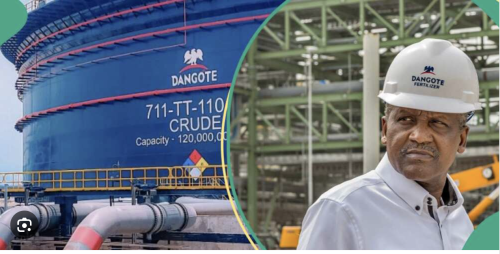
The seven major oil marketers in Nigeria have registered with the Dangote Petroleum Refinery for the lifting and distribution of refined petroleum products produced by the $20bn plant.
Dealers under the aegis of the Major Oil Marketers Association of Nigeria confirmed on Sunday that with the registration, they would commence the distribution of fuel produced from the facility once the commercial terms are sorted.
This came as the Independent Petroleum Marketers Association of Nigeria also revealed that they would meet with the management of the Dangote refinery this week to discuss terms of product loading.
Similarly, the Petroleum Products Retail Outlets Owners Association of Nigeria stated that PETROAN had been engaging the management of the multi-billion dollar refinery for the supply of products from the facility.
As IPMAN and PETROAN engage the refinery, major marketers who are members of MOMAN have already registered with the plant and are set to start buying products.
The seven major marketers include 11 Plc, Conoil Plc, Ardova Plc, MRS Oil Nigeria Plc, OVH Energy Marketing Limited, Total Nigeria Plc and NNPC Retail.
On Friday, the Dangote Petroleum Refinery announced the commencement of production of Automotive Gas Oil, also known as diesel, and JetA1 or aviation fuel.
The President of the Dangote Group, Aliko Dangote, had in a statement issued by the firm, thanked President Bola Tinubu for his support, encouragement, and thoughtful advice towards the actualisation of the project.
He also thanked the Nigerian National Petroleum Company Limited, Nigerian Upstream Petroleum Regulatory Commission, Nigerian Midstream and Downstream Petroleum Regulatory Authority, and Nigerians for their support and belief in the historic project.
“We have started the production of diesel and aviation fuel, and the products will be in the market within this month once we receive regulatory approvals. This is a big day for Nigeria. We are delighted to have reached this significant milestone.
“This is an important achievement for our country as it demonstrates our ability to develop and deliver large capital projects. This is a game changer for our country, and I am very fulfilled with the actualisation of this project,” Dangote stated.
The refinery, located in Lagos, has so far received six million barrels of crude oil at its two SPMs located 25km from the shore. The first crude delivery was done on December 12, 2023, and the 6th cargo was delivered on January 8, 2024.
The refinery can load 2,900 trucks a day at its truck-loading gantries. The products from the refinery will conform to Euro V specifications, according to the firm.
“The refinery design complies with the World Bank, US EPA, European emission norms, and Department of Petroleum Resources emission/effluent norms, employing state-of-the-art technology,” the company stated.
The Dangote Petroleum Refinery and Petrochemical Project, a subsidiary of Dangote Industries Limited, is a 650,000 barrels per day crude oil refinery, located in Dangote Industries Free Zone, Ibeju-Lekki, Lagos, Nigeria.
The Dangote Petroleum Refinery is an industrial plant that transforms crude oil into various usable petroleum products such as diesel, gasoline, jet fuel, and kerosene.
Dangote Petroleum Refinery with a capacity to refine 650,000 barrels of crude oil per day covers an area of approximately 2,635 hectares in the Lekki Free Trade Zone in Lagos.
MOMAN ready
When contacted and asked whether major oil marketers would be involved in the lifting of refined products from the Dangote refinery, or whether the facility would distribute the fuel itself, the Executive Secretary/Chief Executive Officer, MOMAN, Clement Isong, replied, “I confirm that we (major marketers) have met with him (Dangote).
According to Isong, all MOMAN members have registered with Dangote Petroleum Refinery to become marketers of its products. He told The PUNCH that MOMAN members would have the product in their stations the moment it was available for sale.
“We have all registered with Dangote so that we call buy and sell. All my members are registered with Dangote. Whenever the product is ready and starts coming out, you will see it in our filling stations,” he said.
I confirm that my members have registered with them. We were waiting for the production to start and now it has started and they will start discussing the commercial terms. So yes, major marketers and other players will buy for the market. The important thing was the registration.
“So now the commercial terms will be agreed with each marketer and then they will buy from them. There are several ways you can buy from them. They have loading ranks, over 90, so you can take your truck to go and pick. You can also use vessels to pick. Those are the two ways you pick products.”
Asked to state how soon marketers would start picking products from the plant, Isong said, “I don’t know, but I know we started registration last year. So as soon as they say they are ready we will pick the products. Also as soon as the commercial terms are set, my members will pick.”
Former President Muhammadu Buhari inaugurated the Dangote refinery in May 2022. The facility missed its crude oil refining target a number of times due to the non-supply of crude to the plant by oil producers.
It, however, started receiving crude oil batches of one million barrels each in December 2023 and got the 6th batch of one million barrels of crude this month. Officials at the plant had explained that the refinery required six million barrels of crude to commence production.
Meanwhile, the MOMAN CEO expressed excitement about the coming onstream of the refinery but stated that he could not tell what the pricing policy of the refinery would be.
“It should be the market price because you need to recover your cost, and capital, and repay your loans. I don’t know what the market price will be, but I know that with my international experience in the economics of petroleum, nobody does this business to make a loss,” he stated.
The prices of diesel and aviation fuel are fully deregulated commodities, unlike that of Premium Motor Spirit, popularly called petrol, which has been a subject of debate on whether it is being subsidised or not.
Meanwhile, the major marketers CEO further explained that the cost of crude oil would play a major role in determining the cost of fuel from Dangote refinery.
He said, “We expect the price of products to be what is called market price. Remember he has built the refinery at $19bn. He has to refund his loan. He has to pay his contractors. He has to pay the owners of capital.
“I believe he will sell the product at a price that will enable him to recover his costs, both capital and operational costs, and then make a profit. I don’t expect the price to be much different from the market price today.
“You know that crude oil is also priced in dollars, so what’s the difference? The price of crude oil is the same internationally, even if you buy locally. Why will you buy below the cost, unless you want to go back to subsidising. Crude oil is very expensive to produce. A lot of that oil is offshore.
“I’ve heard some people say there will be savings in freight, that might be true. But that is a very small part of the cost. The major part of the cost is the raw material, which is the crude oil; even the refining cost is quite small. I don’t expect a significant drop in price, definitely not N400, that’s very unlikely, in my opinion.”
The President of IPMAN, Abubakar Maigandi, told one of our correspondents that the association would meet the management of Dangote refinery this week to discuss modalities around the loading of products.
He also stated that independent marketers would not be able to state the project cost of refined petroleum products now, until the commencement of loading.
“It is when we start loading that he can give us the price and then we will know how much to sell,” Maigandi stated.
Asked to state when IPMAN members would start loading, he replied, “We are going to hold a meeting with him this week. No date has been fixed yet for the appointment, but the meeting is to be held this week.”
When questioned further to tell the amount of reprieve Nigerians should expect in firms of the cost of refined products, the IPMAN president said, “We can’t say that yet and wouldn’t want to estimate. So it is after our meeting that we can now tell the direction, especially when we start loading products. However, there will be changes.
“Immediately he starts releasing products, we are assured of the availability of products and there will be no more scarcity, provided that he is producing. Also, it will create employment opportunities.”
Price reduction imminent
On his part, the President of PETROAN, Billy Gillis-Harry, said the cost of refined products would drop marginally, but noted that it would be tough to give a specific amount now.
On how much reduction in the cost of diesel and aviation fuel should Nigerians expect once the products start hitting the market, he said, “It is difficult to give an exact figure because so many variables are at play.
“However, the fact that the crude oil that is being used is the one for domestic consumption, takes away the cost of freight and insurance from the total cost. So if that has been removed, there is a likelihood that prices will be impacted positively to the benefit of Nigerians.
“But what exactly will be the price is to be awaited and worked out because, for instance, we don’t know how much he received the crude oil, whether it is in naira or dollar, and those are business information that sometimes is difficult to release.
“However, regardless of whatever the situation is, we should still expect a reprieve, some advantages should come to us. So that is my thinking.”
The PETROAN president faulted the pricing templates that were being released some years back for petroleum products, stressing that the computations were not realistic.
“We kept writing and talking against it. So, of course, when it stopped we were not surprised, because you cannot just do arm-chair projections on these things. There must be empirical values and these values vary day to day, hour to hour, and minute to minute.
“So you can’t just wake up and say this is the price unless you are speculating. And if you are speculating, then you cannot give us a price band. Therefore that information is actually business secrets if a company wishes to post it,” he stated.
Gillis-Harry also stated that PETROAN had been meeting with the management of the Dangote refinery concerning the supply and distribution of products from the plant.
PETROAN meeting Dangote
“PETROAN has been interfacing with the Dangote refinery for a long time. So we hope that with the production coming in, PETROAN will also speed up and advance discussion on how our members can benefit and how Nigerians can be served better and efficiently.
“We’ve been having discussions with them, because, at the end of the day, Dangote cannot be the one producing and also selling at the retail outlets. We know that in previous times such tendencies were not too far-fetched, but we hope that in this dispensation everybody will do their part,” he stated.
Gillis-Harry noted that the coming onstream of the Dangote refinery means that “the sleeping giant is gradually waking up, and Dangote has fired the opening shot that refining can happen in-country. So it is a thing for us to be glad about. Next is the Port Harcourt refinery
“Nigeria stopped refining crude since the regime of former President Olusegun Obasanjo when we were refining at a minimal capacity. And before he finished his tenure as President, the refining of crude in Nigeria had ground to a halt. So it is a big plus for us that Dangote refinery has started production.”
Also speaking on the coming onstream of the facility, a former President, Association of National Accountants of Nigeria, Dr Sam Nzekwe, expressed excitement about the development and said the cost of refined products should drop.
“The commencement of production at Dangote refinery is a good development but we await to see what is going to be the prices of products from the facility. We believe that with Dangote refinery, fuel will be cheaper because the cost of logistics in importing fuel will be removed.
“The situation where someone will come to Nigeria to get crude oil, take it abroad, refine it, and bring it back to us as fuel will be gone. So the cost of logistics will be factored into the cost of these refined products. But with the Dangote refinery, I know that that cost will be removed and fuel prices will be reduced.
“This may not be significant, but at least we should see a marginal reduction from the price we pay for fuel now. This will also encourage the NNPC to deliver its refineries and the government should license more players to refine crude. How can you be exporting crude and importing fuel? It is not sensible,” Nzekwe stated.
A national ex-officio of IPMAN, Surajudeen Bada, also expressed joy over the commencement of production at the Dangote refinery and said he was hopeful that the expectations of Nigerians would be met.
“We hope it will be able to meet the expectations of Nigerians because a lot of Nigerians have expected so much from Dangote in the last year. Now that it is coming up, we hope that it will reduce the current hardship,” he stated.
When told that Nigerians were expecting a reduction in the price of fuel, Bada said, “I know people are concerned about the price, but if the product is available everywhere and accessible to marketers, competition will set in.
“When we compete among ourselves, we will have to reduce our (profit) margin. Already we have a fixed margin that we should benefit as marketers. But we will be ready to forgo N1, N2 from our margin, and anything we forgo is for the benefit of the masses.”
On his part, Prof. Ndubuisi Ekekwe, said, “Congratulations to team Dangote refinery. Everything is easy until one is asked to do it. From industry to industry, Dangote has continued to serve his nation and his continent.
“In five years, someone here will say ‘the refinery sector was given to Dangote’, forgetting how it was before Aliko decided to pay attention. And as they continue to talk, who knows, you could pick the power sector, and they will forget how Nigeria has been generating darkness for ages.
“Aliko Dangote we salute because nations rise when great entrepreneurs emerge, not when ‘siddon-look’ analysts bark. Congrats that the refinery is up and running. We want more wins!”
CREDIT: PUNCH