

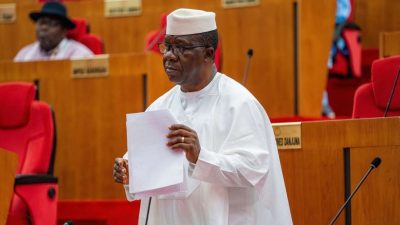
Nigerian Senate Leader, Opeyemi Bamidele, has announced plans to sponsor a constitutional amendment bill proposing a single six-year term for the President and state governors.
While speaking with journalists in Abuja, Bamidele stated that this proposal will be among the first pieces of legislation he introduces when the 11th Senate is inaugurated following the 2027 general elections.
The push aims to reform Nigeria’s current political structure, which permits a maximum of two four-year terms.
Nigeria currently operates a two-term system under which presidents and governors can serve a maximum of two four-year terms.
However, the Senate leader argued that the arrangement often compels elected officials to begin strategising for a second term barely midway into their first tenure, thereby diverting attention from governance.
“One of the first set of bills that I look forward to moving, by God’s grace, when we come back for the 11th Senate, God willing, is for a bill that will only make it possible for anyone who wants to be president of this country, or governor in any part of this country, to spend only one term of six years,” he said.
According to him, a single six-year tenure would remove the pressure and distractions associated with seeking re-election.
“So that you don’t even have to worry about wasting almost one and a half years of your first term thinking and struggling and looking forward to how you’ll be re-elected.
“If you know you are there for six years, only one tenure, you put in your best from day one. You know this is the only chance that you have,” Bamidele said.
The lawmaker acknowledged that the proposal may generate debate and may not attract unanimous support, but insisted that lawmakers must continue to pursue reforms aimed at improving governance.
“That’s my opinion. It doesn’t mean everybody will agree with me. But it also does not mean that I am prevented from doing that because that has not been the law,” he said.
Bamidele further noted that laws are not static and should evolve to meet changing national realities.
“The essence of law, the essence of parliament, is that laws are like human beings; they grow,” he added.
The proposal is expected to reignite a long-running constitutional debate over the tenure of elected executives in Nigeria.
Similar suggestions for a single tenure have surfaced at different times since the return to democratic rule in 1999, with supporters arguing that it would curb the distractions of re-election campaigns and encourage long-term policy implementation.
In recent constitutional review proposals sent to the National Assembly, former Vice President and presidential candidate of the African Democratic Congress, Atiku Abubakar, advocated for a six-year single term for president and governors, with the presidency constitutionally rotated among the country’s six geopolitical zones.
He stated that he would make the constitutional amendment his top priority if elected.
Critics, however, have contended that a second-term option gives voters the opportunity to reward performance or reject underperforming leaders at the polls.
If formally introduced and passed by the National Assembly, the bill would require far-reaching amendments to the 1999 Constitution and approval by at least two-thirds of the state Houses of Assembly before it can become law.