
The Committee of Banks in Nigeria on Thursday lifted the victims of the recent flooding in some parts of Jigawa State with a solidarity visit to Dutse, the state capital, during which they made donation of assorted items of relief materials to the State Government as part of their own contribution to alleviate the plight of those impacted by the September 2024 natural disaster.
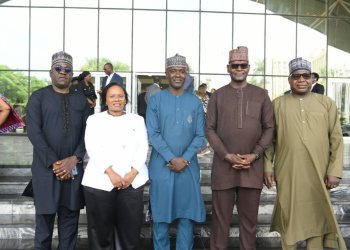
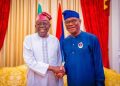
The donation of the relief materials comprising food items, including bags of rice, cartons of vegetable cooking oil, mattresses, and beverages were presented to the Governor of Jigawa State, Malam Umar A. Namadi, by a high-powered delegation of the Committee of Banks in Nigeria led by their Chairman and Group Managing Director/Chief Executive Officer (GMD/CEO), United Bank for Africa Plc (UBA), Dr. Oliver Alawuba.
Other banks’ CEOs that were on the delegation included the Managing Director/Chief Executive Officer (GMD/CEO), Access Bank Plc, Mr. Roosevelt Ogbonna; Group Managing Director/Chief Executive Officer (GMD/CEO), Zenith Bank Plc, Dame (Dr.) Adaora Umeoji; and Group Managing Director/Chief Executive Officer (GMD/CEO); Fidelity Bank Plc, Dr. (Mrs.) Nneka Onyeali-Ikpe.
In his remarks while presenting the relief materials, Dr. Alawuba stated that the gesture by the bankers was one of the ways to empathise with the government and people of Jigawa State, and importantly the residents who were severely impacted by the floods. He added that the relief materials were targeted at boosting the current multi-stakeholder efforts to support the flood victims in getting back on their feet, as well as supporting critical institutions that provide care for the victims, especially public hospitals.
“I stand before you today as the Chairman of the Committee of Banks in Nigerian, to demonstrate our solidarity with the Government and good people of Jigawa State. Principally, we are in Jigawa State to empathize with the State Government, families, and relations of those who were severely impacted by the recent flooding that occurred across some local government areas of the state, in specifically in September this year. We pray for the repose of souls that were lost in the devastating floods, as well as comfort for their families. We also pray for the recovery and restoration of those who lost properties and valuables during the floods,’’ he said.
Speaking further, Dr. Alawuba asserted: “We are here today to lend our hand of help to the State Government by donating relief materials worth several millions of Naira in support of the affected residents, and also critical institutions that provide care such as public hospitals. We believe the relief materials consisting of food items such as; bags of rice, cartons of vegetable cooking oil, mattresses, and beverages would go a long way in providing comfort and lessen the burden of the victims impacted by the floods.’’
The Chairman, Committee of Banks in Nigeria added that the humanitarian gesture was a testament to the Nigeria banking sector’s commitment to supporting the well-being of Nigerians in times of need. “As bankers, we are not just concerned about the economic implications of natural disasters; we are also deeply troubled by the human suffering that accompanies them. We believe that it is our collective responsibility to support those affected and help them rebuild their lives,’’ he noted.
Dr. Alawuba stated that the gesture further affirmed the commitment of the Nigerian financial institutions to leading from the front as agents of positive change in society, while assuring that they would continue to work together to support those in need, promote economic growth and development, and to contribute to the well-being of our great nation.
He expressed gratitude to his colleague CEOs of Nigeria banks for their generosity and contribution to the relief effort. “Your support underscores our unrelenting passion for national development and care for the environment where we do our business,’’ he applauded.
Dr. Alawuba affirmed the long history of commitment of the Nigerian banking and financial institutions to the well-being of the Nigerian people and the environment, stating that the banking sector provided similar interventions to the victims of the 2011 flooding which affected 28 states and that of 2013 flooding which affected 32 states of the federation. Other interventions by the financial institutions include corporate support for the management and containment of the spread of COVID-19 pandemic in 2020, including funding support for public healthcare infrastructure, and access to credit for micro and small businesses to stay afloat in the post-pandemic era.
He said, “Notably, we were proud to be part of the Central Bank of Nigeria-led Private Sector Coalition Against COVID-19 (CACOVID) Relief Fund, where we contributed significantly to the Fund’s efforts to provide palliatives to vulnerable Nigerians and strengthen the nation’s healthcare infrastructure. The intervention of the banking sector resulted in over Thirty-two Billion Naira (N32 billion) being pooled to fill a significant funding gap for the governments during the unexpected global pandemic.
“Furthermore, as we navigated the post-pandemic era, Nigerian banks played important roles in helping businesses recover. Banks in Nigeria supported firms of all sizes, to mitigate the impact of the extended lockdown and disruption to business activities in many ways. Through the stabilization funds, Nigerian banks provided loans and credits to small and medium businesses to stay afloat, thereby ensuring business sustainability, preventing job losses, and fostering national economic growth.’’
Additionally, Dr. Alawuba said Nigerian banks also support many other laudable initiatives across both economic and non-economic sectors, one of which is in the area of security. For example, he said banks have continued to support the Lagos State Security Trust Fund, which has become a model copied by other states for sustainable funding of the training, equipment, and welfare needs of personnel of the Nigeria Police deployed to the state. He said the support has led to improved security of lives and property in the state.
He disclosed further that the banking sector supported the government in rebuilding and remodeling of Police stations destroyed in the wake of the #EndSARS protesters, in 2020. With the support, he added that officers and men of the Nigeria Police now have more befitting workplaces to function.
The bankers commended Governor Namadi, the federal and state governments, donor agencies and other stakeholders for the efforts in responding to the need of the victims of the flooding, while noting that, through collective efforts and actions, we could all make a big difference in the society, as well as build a prosperous nation that works for all.
Responding, Governor Namadi thanked the Committee of Banks in Nigeria for their humanitarian gesture, describing it as a rare demonstration of love, care and empathy for humanity. He said he was particularly touched receiving such a high number of bank chiefs leaving their offices to come and show solidarity to the families and individuals affected by the flood.
“On behalf of the government and people of Jigawa State, I want to most sincerely thank you for this visit. Certainly, what you have done today has demonstrated a good sign of love, care and maturity because, I don’t think it has ever happened like this, for four managing directors of the big Nigerian banks leaving their offices and come and sympathise with us on the incident that happened to us; that has shown the serious sign of love, care and maturity,’’ he enthused.
Governor Namadi assured that the state government would continue to seek opportunities to work together with the financial institutions as critical enablers of socio-economic growth, adding that with the significant support of the banks, the task of supporting the flood victims to get back to normal life had received a boost.
He stated, “So whilst I really thank you very much, I assure you that as we go on we will continue to work together for the betterment of this country. Certainty, some time two of you at one time or the other has done something to help out Jigawa State and today again we are putting ourselves together as the body of banks’ CEOs also coming to our aide, to help our people and bring them back to life in order to move forward.’’
The governor gave the assurance that the donated relief materials would be judiciously used and get to the people they were meant for. “I also want to assure you that the Jigawa State government will continue to work together with you, to ensure that we improve the lives of those affected by the devastating floods.
“Like we said, these people have really suffered a lot; they lost their means of livelihood which is not easy at this time, but with the people and body like yourself, these people have a lot of hope and then at least they are being shown they have brothers and sisters that are there for them in their time of need. So, we really appreciate this gesture and we are not taking it for granted. We pray that God almighty will replenish your purse for what you have done for our people,’’ Governor Namadi stated.
Other personalities on the delegation for the donation of the relief materials were President, Association of Corporate Affairs Managers of Banks (ACAMB), Mr. Rasheed Bolarinwa; the Registrar/Chief Executive Officer, Chartered Institute of Bankers of Nigeria (CIBN), Mr. Akin Morakinyo, and others.