
Connect with us

News

EFCC Court Documents Expose Real Owners Of Abuja 753 Duplex Estate 

Published

on

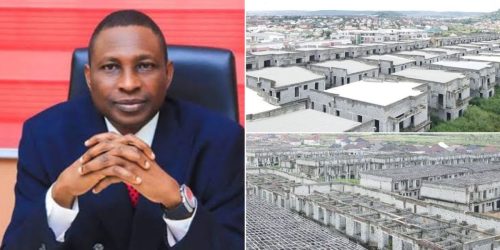
Court papers filed by the Economic and Financial Crimes Commission (EFCC)have linked the immediate-past Governor of the Central Bank of Nigeria, Godwin Emefiele, to the massive Abuja property with 753 duplexes and other apartments located in the Cadastral Zone area of the capital city JomogNews reports.

This Nigeria news platform understands that the anti-graft agency on Monday announced the recovery of the property from an unnamed ex-government top brass, describing the property as the biggest single recovery it had made in the course of fighting corruption since its establishment in 2003.

The recovery followed a ruling delivered on December 2, 2024 by Justice Jude Onwuegbuzie of the FCT High Court in Apo.

In the court documents obtained by our correspondent on Tuesday, the EFCC ran a narration linking Emefiele to the massive property spanning 150,500 square metre and identified as Plot 109, Cadazral Zone C09, Lokogoma District, Abuja.

Emefiele is currently being prosecuted by the EFCC in three separate cases before different judges.

Before Justice Hamza Mu’azu, he is being tried for procurement fraud, forgery of former President Muhammadu Buhari’s signature, and other charges.

Before Justice Rahman Oshodi at the Special Offences Court in Ikeja, Lagos, Emefiele is charged with alleged fraud involving $4.5bn and N2.8bn.

Additionally, Emefiele is before Justice Maryann Anenih of the FCT High Court in Abuja for allegedly approving the printing of N684.5m notes at the cost of N18.96bn.

According to the document, Emefiele allegedly carried out “monumental fraud” as the CBN governor with his cronies to acquire several properties including the estate.

“The commission whilst investigating the alleged monumental fraud carried out by the immediate past Governor of the CBN and his cronies traced and discovered several properties reasonably suspected to have been acquired and or developed with proceeds of unlawful activities.

“The property highlighted in Schedule A to this application is one of the said properties recovered, having been reasonably suspected to have been acquired/ developed with proceeds of unlawful activities.”

The EFCC alleged that “in the cause of this investigation, it was revealed that the erstwhile CBN governor negotiated kickbacks in return for allocation of foreign exchange to some companies who were in desperate need of foreign exchange for their lawful and legitimate businesses.

“Our investigation equally revealed that erstwhile CBN Governor received kickbacks from some contractors who were awarded contracts by the Central Bank of Nigeria.”

The anti-graft agency also alleged that Emefiele connived with several cronies, including one Ifeanyi Omeke, who “ran several errands for him, which included purchase and perfection of title documents for several properties located in highbrow areas of Lagos and Abuja.”

It said the documents for the Abuja property were recovered during a search of Omeke’s office and that investigators located the property on September 17, 2024 “with the assistance of a surveyor from the Abuja Geographical Information Systems, using search results and coordinate.”

The EFCC said its investigation “revealed that the said property has been abandoned and deserted with only a guard manning the said property since June 2023 upon the arrest of the erstwhile CBN Governor. “

JomogNews Nigeria reported that the Department of State Services arrested Emefiele in Lagos the following day he was suspended by President Bola Tinubu.

In October, the EFCC arrested Emefiele in less than an hour he regained his freedom from the DSS.

According to the EFCC, the massive property, allegedly acquired by Emefiele, through cronies, was originally meant for a mass housing development.

The EFCC said its investigation revealed that Emefiele used three companies to pay a total of N2.2bn to buy the property.

It said the seller “received the aggregate sum of N2,200,000,000.00,” adding that “the said three companies used for the payment of the property are enmeshed in criminal maneuvering of layering proceeds of illegal activities of Mr. Godwin Emiefele.”

According to the EFCC, one of the companies was used to pay N900m, the second paid N700m, while the third paid N600m, totalling N2.2bn.

It said the directors of the companies were arrested “and their statements voluntarily obtained in the course of investigation.”

“The funds used in the acquisition of the property highlighted in Schedule A to this application are not legitimate earnings of Godwin Emefiele but funds acquired through illegal and unlawful activities.

“That I know as a fact and verily believe that the source/origin of the funds used in the acquisition and/or development of the properties sought to be forfeited are proceeds of unlawful activities to wit: corrupt enrichment, receiving of gratification or kickbacks and abuse of office,” an EFCC investigator stated in the affidavit filed in court.

The EFCC noted that the court had on November 1, 2024 made an order for the temporary forfeiture of the property “after evaluating facts placed before it.”

It, therefore, urged the judge to order the permanent forfeiture of the property to the Federal Government as no one had come forward to challenge the facts placed before the court, in spite of adverting the interim forfeiture order in The PUNCH edition of November 6, 2024.

According to the EFCC, the court acceded to its request and has now permanently forfeited the property to the Federal Government.

Efforts to get the reaction of Emefiele’s legal team were unsuccessfuly. One of the lawyers, Matthew Burkaa( SAN), did not pick up calls to his line and had also yet to respond to a text message seeking Emefiele’s side of the story as of the time of filing this report.

‘Why EFCC concealed property owner’s identity’

Meanwhile, EFCC spokesman, Dele Oyewale, defended the decision by the anti-graft agency not to reveal the identity of the owner of the property to the public.

He was responding to public criticisms on the motive behind concealing the identity.

“The allegation of a cover-up of the identity of the promoters of the estate stands logic on the head in the sense that the proceedings for the forfeiture of the Estate were in line with Section 17 of the Advance Fee Fraud Act, which is a civil proceeding that allows for action-in-rem rather than action-in-personam.

“The latter allows legal actions against a property and not an individual, especially in a situation of an unclaimed property. This Act allows you to take up a forfeiture proceeding against a chattel who is not a juristic person. This is exactly what the commission did in respect of the Estate. Individual in situations of unclaimed assets,” Oyewale said.

He added that since investigation had not been concluded, releasing the suspects’identity would be the unprofessional.

“The substantive criminal investigation on the matter continues. It will be unprofessional of the EFCC to go to town by mentioning names of individuals whose identities were not directly linked to any title document of the properties,” Oyewale stated.

 

News

Oyo 2027: Adelabu Quits As Power Minister To Focus On Guber Race

Published

on

By

The Minister of Power, Adebayo Adelabu has formally resigned from his position in the Federal Government to pursue his governorship ambition in Oyo State.

In a resignation letter dated April 22, 2026, and addressed to the President, Adelabu stated that his resignation will take effect on April 30, 2026, to enable him to focus on his governorship ambition in Oyo State.

The letter, routed through the Office of the Secretary to the Government of the Federation, stated that he was stepping down with “a deep sense of honour and profound gratitude.”

He wrote, “I write with a deep sense of honour and profound gratitude to formally tender my resignation as the Honourable Minister of Power of the Federal Republic of Nigeria. This resignation is to take effect on 30th April 2026, in order to allow sufficient time for a smooth and orderly handover of responsibilities.”

Adelabu thanked the President for the opportunity to serve, describing his appointment as a privilege.

He said, “Your Excellency, I remain sincerely grateful for the privilege and confidence you reposed in me by appointing me to serve our great nation in this capacity.

“It has been a rare honour to contribute to national development under your leadership and to play a role in advancing reforms in the power sector—one of the most critical foundations of Nigeria’s industrial growth and economic transformation.”

The former minister said his resignation was to enable him focus fully on his governorship ambition in Oyo State, citing provisions of the amended electoral law.

He added, “My decision to step down is informed by my intention to focus fully on my gubernatorial ambition in Oyo State. This aspiration, which dates back to 2016 during my service as Deputy Governor of the Central Bank of Nigeria, ultimately led to my voluntary resignation from the Central Bank in 2018 in order to pursue the same goal.”

“In line with the provisions of the Amended Electoral Act 2026, which preclude political office holders from contesting elections, I consider it both appropriate and necessary to resign at this time.”

Adelabu’s exit marks a major political development ahead of the next electoral cycle, particularly in Oyo State, where he is expected to contest the governorship election.

Continue Reading

News

Wale Edun, Musa Dangiwa Resigned Voluntarily, Not Sacked – Presidency

Published

on

By

The Presidency has clarified that Wale Edun (former Finance Minister) and Ahmed Musa Dangiwa (former Housing Minister) voluntarily resigned from their positions and were not sacked by President Tinubu.

In a statement released this evening April 22, presidential media aide, Bayo Onanuga, said that contrary to public opinions, Wale Edun resigned on health grounds while Dangiwa also tendered his resignation and thanked the President for the opportunity given him to serve in the Federal Executive Council.

Onanuga stated that Edun, who clocked 70 on Monday and has battled recent ill health, fittingly submitted his resignation letter on his birthday, thanking the President for the opportunity to serve Nigeria.

“It has been a pleasure and privilege to serve your administration and the Renewed Hope Agenda, Under your leadership, Nigeria has emerged stronger, more resilient and more internationally respected. I wish you and the administration every success in the future” he wrote

Onanuga stated that on Tuesday, before the Office of the Secretary of the Government of the Federation announced his departure from the Cabinet, Edun paid a valedictory visit to the President at the Villa and held an hour-long discussion with the president and then left to focus on his private businesses.

The presidential aide stated that President Tinubu has expressed deep appreciation to Edun and Dangiwa for their dedicated service and significant contributions to the administration’s economic reform programme and wished them continued success in their future endeavours.

‘’In the same vein, the President has urged the new Minister of Finance, Taiwo Oyedele, to consolidate ongoing reforms and advance the administration’s fiscal and economic objectives with renewed focus, discipline, and innovation.

President Tinubu will shortly send the ministerial nominee for housing, Muttaqha Rabe Darma, also from Katsina, like Dangiwa, to the Senate for confirmation” the statement concluded

Continue Reading

News

Unity Bank, Experts Advocate Green Investment, Climate Innovation To Drive Economic Resilience

Published

on

By

Nigeria’s retail lender, Unity Bank Plc, alongside leading climate innovation experts, has called for increased investment in the green economy and the adoption of frontier technologies as critical pathways to driving economic resilience and reducing the impact of climate change on vulnerable populations across Africa.

The call was made during a thought-provoking webinar hosted by the Bank to commemorate this year’s Earth Day, themed “The True Cost of Climate Change and Who Pays?”. Climate experts and stakeholders convened to examine the human, economic, and institutional costs of climate change, while spotlighting practical solutions to address its growing impact.

In his opening remarks, Unity Bank’s Head of Strategy and Innovation, Ibukun Coker, emphasised the urgency of addressing climate risks from both a societal and business perspective.

He said: “Climate change is no longer a distant or abstract challenge. It is an existential threat with direct consequences for individuals, businesses, and economies. At Unity Bank, we recognise the role institutions must play in incorporating sustainability in project financing, supporting businesses and promoting solutions that build resilience in communities where we operate.”

The webinar featured Chinwe Udo-Davis, Founder and CEO of Instollar, and Oluwatosin Ajide, Programme Manager at the Nigeria Climate Innovation Centre, both of whom provided insights into the drivers of climate change and the pathways to mitigation and adaptation.

Speaking during the session, Udo-Davis highlighted the disproportionate burden which climate change places on underserved communities and the need for inclusive solutions.

“The true cost of climate change is not evenly distributed. Communities with the least resources are often the most affected, whether through energy poverty, environmental degradation, or limited access to sustainable alternatives. Addressing this imbalance requires intentional investment in clean energy solutions that are both accessible and scalable.”

Ajide underscored the importance of coordinated, system-wide approaches in tackling climate challenges, particularly through innovation and policy alignment.

“Climate change is fundamentally a structural problem, and its solution requires a paradigm shift: from innovation and policy to financing and implementation. Stakeholders must work collaboratively to drive solutions that are sustainable and inclusive.”

The session also explored emerging opportunities in climate technology, renewable energy, and ecosystem financing, reinforcing the role of innovation and cross-sector collaboration in building long-term resilience.

By hosting the webinar, Unity Bank continues to demonstrate its commitment to advancing sustainability-focused dialogue and supporting initiatives that promote responsible growth and environmental stewardship.

The initiative underscores the Bank’s broader strategic focus on environmental sustainability as well as its commitment to financial inclusion.

Continue Reading

Trending