
Connect with us

News

IGP Kicks As Abdulsalami, Jonathan, Others Canvass State Police

Published

on

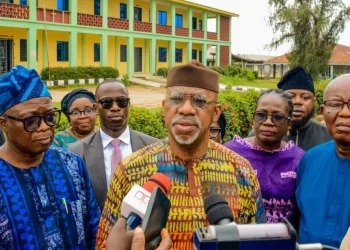
Former President Goodluck Jonathan and other stakeholders Monday supported establishment of state police as a way of addressing the security challenges in the country.

But the Inspector-General of Police, Kayode Egbetokun, argued that Nigeria was not yet ripe for state police.

They spoke in Abuja during the national dialogue on state police, with the theme ‘Pathways to Peace: Reimagining Policing in Nigeria.’

The dialogue was organised by the House of Representatives in partnership with the Policy Legislative and Advocacy Centre (PLAC) and the United Nations Development Programme (UNDP).

State police is part of the proposed amendments to the 1999 Constitution by the 10th National Assembly.

A bill seeking to alter the relevant sections of the 1999 Constitution to empower states to establish their policing outfits, sponsored by Deputy Speaker Benjamin Okezie Kalu and 14 other lawmakers in the lower chamber had, on February 20, passed second reading.

Jonathan said there was no way Nigeria could have adequate security without state police.

According to him, the question of whether to have state police is not an issue of debate, noting that the issue is how to avoid misuse of state police.

He said during the 2014 national conference organised by his administration, when the issue of state police came up, all delegates unanimously supported it alongside other proposed security measures.

He said: “The issue of the need for states to have their own police is not negotiable. There is no way we can continue with this kidnapping that is going on in this country.

“Commercial kidnapping started around 2006, I don’t want to go into that history, when I was governor. But it started in the Niger Delta. Now, it is all over the country.

“The only thing that can help us if we cannot stop it completely, at least, we reduce it to the barest minimum if the states have their police. “In Bayelsa State, when we took over, the state was almost ungovernable. Abdulsalami would remember that when elections were to be conducted in December 1998, the security situation was so bad.

“When we took over, the state was in crisis. Niger Delta agitation was there. The criminal elements were also operating in the creeks and were causing issues for market women and others until Alamieyeseigha, then the governor, set up the Bayelsa Volunteers that worked with the police. We built stations around the creeks and the boys volunteered to work with the police and that brought the situation down. So, there is no way we can manage internal security if states would not have their police.”

Jonathan asked: “How do we manage the state police and it would not be abused by state political actors? If state political actors are abusing and using state police to harass and make life miserable for people who do not belong to their political parties, would the Commander-in-Chief sit down and watch or would he order the military to go and overrun the state police? Of course, that would bring crises.

“And then the key areas that we have to debate are how do we run the state police vis-a-vis the national security architecture of the country? These things need to be done carefully. There are so many countries that have this (state police). We have also experimented before, during the First Republic.”

The former president also said the Independent National Electoral Commission (INEC) operations must be rejigged.

He also suggested that the use of police in elections be made minimal.

According to him, the laws must be strong enough to eliminate tendencies of political actors misusing the state police for their political interests or intimidate political opponents.

Politicians shouldn’t influence state police operations – Abdulsalami

General Abdulsalam Abubakar in his speech cautioned that politicians should not influence operations of state police when established.

“I think, as much as we’re talking of establishing state police, we should also look into the role vis-a-vis that of our royal fathers.

“It’s absolutely necessary for the politicians as much as possible to avoid exerting influence on the ways the police are going to operate if at all we agree to have the police,” he said.

Abdulsalami also stressed the need to review the roles of traditional institutions in addressing insecurity.

He also said that political leaders must ensure honesty, transparency and accountability in governance to engender peace and security in the country.

Ooni of Ife, Emir of Zazzau back state police

The Emir of Zazzau, Ahmad Nuhu Bamalli, said state police would tackle the security challenges better than the current centralised federal policing system.

“We’re in full support of the state police. My emirate is vulnerable to security challenges. If we can have local police, it can scale down the level of insecurity. I’m optimistic that we should key into it”, he said.

He, however, warned that politicians should not use state police with impunity.

The Ooni of Ife, Oba Adeyeye Enitan Ogunwusi, also urged the National Assembly to make state police come to reality.

He said there was no better time for the country to adopt state police than now, given the current security challenges.

A former Minister of Education, Prof. Tunde Adeniran, said the benefits of state police outweigh its demerits.

He said state police would enhance security at the grassroots.

He, however, suggested that modalities be put in place to prevent abuse of state police as well as address its funding.

IGP says Nigeria not ripe for state police

The Inspector-General of Police, Kayode Egbetokun, said Nigeria was not “mature” for state police.

The IGP, represented by Ben Okolo, an Assistant Inspector-General of Police, said the leadership of the force had resolved that Nigeria was not yet ripe for state police.

He said state governors might abuse and use state police for political gains, thereby causing abuse of power and human rights.

“It’s the submission of the leadership of the Nigeria Police Force that Nigeria is yet to be mature and ready for the establishment of state-controlled police,” he said.

The IGP said the Nigeria Security and Civil Defence Corps (NSCDC) and the Federal Road Safety Corps (FRSC) should be merged to become a department in the police.

He said the recruitment of police personnel should be increased by at least 30,000 annually to meet the minimum policing standard of the United Nations.

He also pointed out the financial requirements for establishing state police, insisting that the state government might lack adequate funding.

My commitment to police reforms unwavering – Tinubu

President Bola Ahmed Tinubu, represented by Vice President Kashim Shettima, said his administration was committed to reforming the police to enhance their efficiency and operations.

He said the broad base of stakeholders present at the dialogue underscored the significance attached to the issues of security in the country.

The president said he looked forward to inputs that would guide the government in taking actions to address security challenges in the country.

He described Jonathan and the former Head of State, General Abdulsalami Abubakar (Rtd), as men of honour who shelved personal interests to entrench democracy and guarantee Nigeria’s continued existence.

Current policing system ineffective – Abbas

The Speaker of the House of Representatives, Abbas Tajudeen, said the emerging security challenges had rendered the current unitary policing system, under the Nigeria Police Force, ineffective, leading to calls for its decentralisation by way of having state police.

He said the current security architecture had been overstretched by the security challenges.

He, however, noted that the House remained neutral in the debate for and against state police.

Abbas said evolving security challenges and other institutional and structural challenges had severely affected the general effectiveness of the police.

It must not be used as tool of oppression – Akpabio

The Senate President, Godswill Akpabio, represented by his deputy, Jibrin Barau, said state police must not be used as a tool of oppression by the powerful in the society.

He said, “If we’re to set up state police departments, we must ensure they’re free from the shackles of politics, religious extremism, tribalism and ethnicity. We must empower them to serve and protect without fear or favour.

“Let us never forget that the power of the state police should never be used as a tool of oppression. Let us ensure that political powers cannot manipulate the state police to silence dissent or target their enemies.

“Let us ensure that the influential do not exert undue influence over the state police, and that justice is blind to wealth, power, politics, or status.”

‘Why state police may not work’

Other speakers at the dialogue said establishing state police would not necessarily make any difference if the government failed to address the drivers of insecurity.

A former spokesman for the Nigerian Air Force, Group Capt. Sadeeq Shehu, urged the government to tackle unemployment, hunger, ethno-religious tensions and poverty.

Archbishop John Onaiyekan said the government should first address the problems with the current federal policing system before talking about establishing state police.

A security consultant, Kabiru Adamu, said most drivers of insecurity were embedded in bad governance, adding that if the government could tackle unemployment, lack of access to education, healthcare and other social services, the insecurity would be tamed.

Let’s not rush – Arase

A former Inspector-General of Police and chairman of the Police Service Commission, Solomon Arase, said while it was good to have conversations on state police, it must not be done in a rush.

He said successive governments had failed to show the political will to implement police reforms.

Arase said a proper groundwork should be done before creating state police so that it would not be hijacked by governors whom he described as being “very powerful.”

News

BANKING BEYOND THE BALANCE SHEET: UNION BANK’S ASBON RECOGNITION AND NIGERIA’S SMALL BUSINESS ECONOMY

Published

on

By

Union Bank of Nigeria has been named winner of the Best SME Growth Banking Initiatives Award (2025) at the Nigeria National SME Business Awards, organised by the Association of Small Business Owners of Nigeria (ASBON) in partnership with the Lagos State Government through the Ministry of Commerce, Cooperatives, Trade and Investment.


The recognition arrives at a moment when the relationship between Nigerian banks and Nigerian small businesses is being quietly redefined. Awards in this space have historically rewarded scale and product breadth. The ASBON criteria, by contrast, ask a more practical question: which banks are actually making it easier for entrepreneurs to operate?


WHY THIS AWARD, AND WHY NOW?

Across Nigeria, growth is no longer the only measure of success for a small or medium-sized enterprise. For most owners, success now looks like stability. Cashflow that holds up. Payments that clear without disruption. Financing that arrives in time to seize an opportunity rather than rescue a crisis. Operations that are not slowed by administrative friction.


That shift in what SMEs need has changed what they look for in a bank. The institutions earning their attention are the ones that take the daily reality of running a business in Nigeria seriously, not those with the longest catalogue of products. It is in that environment that the ASBON recognition reads as something more than ceremonial.

Union Bank’s SME work over the past year has been organised around a small number of practical priorities, and many of the issues SMEs cite as their biggest pain points sit at the centre of them.


FASTER ONBOARDING, MORE USABLE DIGITAL TOOLS

Account opening and customer onboarding have long been one of the slowest stages of business banking in Nigeria. For an entrepreneur trying to receive payments, pay suppliers, or qualify for a tender, days lost at this stage are days lost from the business itself.


Union Bank addressed this directly with enhancements to its Union360 platform and the rollout of a Straight-Through-Processing (STP) Digital Onboarding Platform. The intent was simple: cut the time between an SME deciding to bank with Union Bank and actually being able to transact. The improvements have meaningfully shortened onboarding, raised digital activity among SME customers, and brought in a notable cohort of new business clients.


Behind those improvements is a recognition that Nigerian SMEs are increasingly multi-channel by default. A small retailer may take payments by transfer, POS, mobile money, and online checkout in the course of a single afternoon. The bank that supports them has to be reliable across all of those rails, not just the ones that photograph well in product brochures.


FINANCING THAT MEETS BUSINESSES WHERE THEY ARE

Access to credit remains the most frequently cited barrier for Nigerian SMEs, particularly for businesses without conventional collateral or a long paper trail of audited accounts.

Union Bank’s response has been less about loosening criteria and more about widening the range of evidence that counts.


Consistent transaction history, active account use, and clear cashflow patterns now carry meaningful weight in how the Bank assesses a small business. For a generation of entrepreneurs whose operations are real but whose paperwork is light, that is a material change.


The Bank’s SME lending over the review period reflected this orientation, with funding directed at working capital, inventory, equipment, and the kind of operational expansion that sits between mere survival and genuine scale.


THE HUMAN SIDE OF THE WORK

Digital infrastructure matters, but it does not replace the value of someone an entrepreneur can actually call.

Union Bank’s SME engagement is supported by a network of relationship managers, direct sales agents, and branches across the country. The Bank’s “Adopt, Engage and Grow” campaign was designed to reach SMEs at this human level, not as a once-a-year touchpoint, but as a sustained relationship that meets businesses where they are, both physically and operationally.

The approach reflects a basic truth about small business banking in Nigeria.


Entrepreneurs operate under pressure that is rarely visible from a head office. The institutions they trust tend to be the ones whose people understand that pressure, respond when it matters, and treat the relationship as ongoing rather than transactional.


UNION BANK OF NIGERIA AND ASBON

Union Bank’s recognition is also tied to its partnership with ASBON, through the SME Empowerment Challenge run jointly by the two organisations.


The Challenge encouraged entrepreneurs to open or reactivate business accounts, maintain proper transaction records, and develop structured plans for growth. On its surface, it was a campaign. In substance, it was an attempt to nudge a behaviour that Nigerian SMEs themselves often identify as one of the hardest to sustain: the discipline of running the business as a business, with clean books, separated finances, and a clear view of where it is going.


That discipline matters because it is the gateway to almost everything else. Loans, grants, supplier credit, partnerships, and public sector contracts all depend on a business being able to show how it actually operates. By building that habit alongside ASBON, Union Bank invested in something that outlasts any single campaign cycle.


WHAT THE AWARD ACTUALLY SIGNALS

There is a tendency to read awards as endpoints. This one reads better as a signpost. Nigerian SMEs are operating in one of the most demanding business environments on the continent. They are also, collectively, the largest source of employment in the country and the most direct route to broad-based prosperity. The banks that serve them well, with patient infrastructure, accessible financing, real human engagement, and a partnership posture toward the wider SME ecosystem, have a role to play that goes well beyond commercial performance.


Union Bank’s recognition at the ASBON SME Awards 2025 is, in that sense, an acknowledgement of a posture as much as a portfolio. The work it points to, faster systems, more accessible credit, sustained engagement, and a habit of building alongside SME institutions rather than around them, is the kind of work that compounds quietly over years.

For a bank, that is the most useful kind of award to win. Not the one that celebrates a moment, but the one that confirms a direction.

Continue Reading

News

Polaris Bank Supports the Launch of NACCIMA Call Center to Drive Growth for Nigerian Exporters  

Published

on

By

Polaris Bank, Nigeria’s leading digital retail and commercial bank, has proudly facilitated the launch of the NACCIMA Export Support Call Center, a vital initiative designed to provide comprehensive support to Nigerian exporters, especially those operating in the non-oil sector and enhance their ability to access global markets.


This partnership marks a significant step in the Bank’s commitment to strengthening Nigeria’s export ecosystem.


Chris Ofikulu, Executive Director of Polaris Bank, in his address, emphasised the Bank’s commitment to empowering Nigerian businesses for global markets. He highlighted the importance of the NACCIMA Call Center as a key resource for exporters, offering valuable information, knowledge, expert guidance, and advisory services to navigate the complexities of international trade.


“Today, we are marking a pivotal moment in our mission to empower Nigerian businesses for global markets,” said Chris Ofikulu. “Through this collaboration, we are equipping exporters with the tools, infrastructure, and expertise needed to thrive in global markets.”


The NACCIMA Call Center, supported by Polaris Bank, will act as a key platform where exporters can access real-time information, technical assistance, and regulatory advisory services. This strategic initiative is in alignment with Polaris Bank’s vision to drive trade facilitation, improve market access, and support Nigeria’s economic growth.


Polaris Bank’s contribution includes providing advanced infrastructure such as laptops, a fully equipped workstation, internet-enabled modems, and high-capacity printers to support the operations of the center. This donation is aimed at ensuring the center runs smoothly and effectively meets the needs of Nigerian exporters.


During his speech, Ofikulu highlighted the importance of initiatives like the NACCIMA Call Center, emphasizing its role in bridging gaps for exporters, especially those in the non-oil export sector. “By offering exporters the right support, we are unlocking their potential to compete globally. This center is not just a call center; it is a catalyst for success, providing exporters with the resources, knowledge, and access they need to excel,” he added.


The partnership between Polaris Bank and NACCIMA also ties into the Bank’s broader mission to support Nigeria’s export sector. Polaris Bank provides a comprehensive range of solutions for exporters, including stock refinancing, working capital support, and advisory services on regulatory processes such as NXP documentation. Through its digital platform, VULTe, the Bank facilitates seamless intra-African trade, enabling faster and more efficient payments via the Pan-African Payment and Settlement System (PAPSS).


“We are excited to be part of this transformative initiative, which empowers Nigerian businesses to scale and compete on the global stage,” Ofikulu concluded. “Our focus on innovation and our dedication to supporting SMEs are central to our role in shaping the future of Nigeria’s export sector.”


Polaris Bank’s collaboration with NACCIMA reinforces its ongoing commitment to advancing Nigeria’s economic landscape by enhancing export readiness, improving access to finance, and supporting the growth of SMEs. The unveiling of the NACCIMA Call Center is a prime example of the Bank’s continuous dedication to driving positive change within Nigeria’s export ecosystem.

Continue Reading

News

2027 Elections: INEC Announces Final Registration Deadline

Published

on

By

The Independent National Electoral Commission (INEC) has announced that the third and final phase of the nationwide Continuous Voter Registration (CVR) exercise will run from Monday, 11 May 2026, to Friday, 10 July 2026.

This final window is the last opportunity for eligible Nigerians to register or update their records before the 2027 General Elections.

The announcement was contained in a statement released by the Chairman of the Information and Voter Education Committee, Mohammed Kudu Haruna.

According to the Commission, the exercise is part of efforts to ensure that all qualified Nigerians are captured in the voter register before preparations for the 2027 polls move into full gear.

INEC explained that the second phase of the registration exercise was suspended on April 17 to allow for the review and clean-up of records after the publication of claims and objections submitted by registrants.

The Commission said the final phase will run for two months and urged citizens who have attained the age of 18, as well as those who were unable to register during earlier phases, to seize the opportunity.

It stated, “The third phase of the CVR, commencing on Monday, 11th May 2026, will conclude on Friday, 10th July 2026.

“During this timeframe, eligible citizens who have reached the age of 18, as well as those who were unable to register in the previous phases, are encouraged to take advantage of this opportunity to register.”

INEC also advised already registered voters seeking to transfer their registration to new locations, replace lost or damaged Permanent Voter Cards, or correct personal details to make use of the Commission’s online portal or visit its offices in states and local government areas nationwide.

The Commission noted that following the close of registration, the voters’ register will be displayed for public scrutiny.

It added, “In continuation of the process, the Commission will display the Register of Voters for claims and objections from Thursday, 23rd July to Wednesday, 29th July 2026.

“This statutory exercise offers a significant opportunity for citizens to review the register and assist the Commission in ensuring its accuracy, completeness, and credibility.”

INEC assured Nigerians that all logistics and administrative arrangements have been concluded to guarantee a smooth exercise across the federation.

The Commission further appealed to citizens to actively participate, stressing that voter registration remains a critical step in strengthening Nigeria’s democratic process.

The fresh registration exercise is expected to draw significant participation, especially from first-time voters and Nigerians who recently relocated to new states or local government areas.


Continue Reading

Trending