
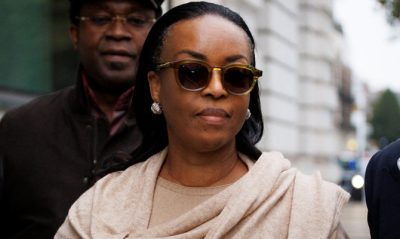
Former Nigerian Minister of Petroleum Resources, Diezani Alison-Madueke, has accused British authorities of damaging her reputation following her acquittal by a London court on bribery-related charges.
Alison-Madueke made the remarks during an interview with the BBC on Friday, two days after a jury at Southwark Crown Court in London cleared her and two co-defendants of multiple bribery-related charges.
The former minister had faced five counts of accepting bribes and conspiracy to commit bribery following a 13-year investigation conducted by the United Kingdom’s National Crime Agency (NCA).
Reacting to the verdict, Alison-Madueke described the lengthy investigation and prosecution as one of the most difficult periods of her life, saying it caused severe emotional, professional, and personal hardship.
“I’ve not been allowed to travel. I’ve not been allowed to work. They destroyed my reputation and my integrity,” she told the BBC.
The former petroleum minister, who served under former President Goodluck Jonathan between 2010 and 2015, said the restrictions placed on her throughout the investigation had taken a significant psychological toll.
“When your freedom is taken away from you, it has a very deep impact upon you psychologically,” she said.
“I knew that I had never done anything nefarious and I had never done any of the heinous things I was being accused of doing.”
Alison-Madueke was first arrested in London in 2015 but was not formally charged until 2023.
British prosecutors had alleged that she received luxury benefits from oil businessmen who secured lucrative government contracts in Nigeria. The alleged benefits included access to expensive properties, chauffeur-driven vehicles, and other high-value gifts.
However, after hearing evidence in the case, the jury returned not guilty verdicts on all counts against the former minister.
During the interview, Alison-Madueke claimed that documents she believed could have strengthened her defence had disappeared from Nigeria after security operatives searched her residence.
According to her, some of the missing records contained receipts and financial documents showing that certain payments made on her behalf had later been reimbursed.
“Those items were taken away by our intelligence forces from my Abuja residence in 2015,” she alleged.
The former OPEC president also criticised both Nigerian and British authorities for their handling of the case, arguing that investigations involving politically exposed individuals should be conducted with greater caution and fairness.
“There’s a bit of blame everywhere,” she said.
“The Nigerian authorities need to look into the processes and practices that they deploy in these cases.”
She further urged international law enforcement agencies to exercise greater sensitivity when investigating politically charged allegations across national borders.
“The long arm of the law, when you go into other countries, particularly in politically motivated cases, needs to have a lot more sensitivity,” she added.
Alison-Madueke also suggested that her gender and position within the global oil industry may have contributed to the scrutiny she faced.
“I was the first female to enter this sort of position as petroleum minister and as head of OPEC in a very misogynistic society,” she said.
Responding to her comments, a spokesperson for the National Crime Agency defended the investigation, describing it as a lengthy, detailed, and complex operation conducted in collaboration with international partners.
The agency maintained that investigators acted impartially and that prosecutors authorised charges only after reviewing the available evidence.
“A comprehensive file of evidence was presented to the Crown Prosecution Service, who authorised charges, and we respect the decision of the jury in court,” the spokesperson said.
Alison-Madueke also addressed previous asset recovery actions linked to corruption allegations involving Nigerian oil contracts.
In 2023, the United States Department of Justice announced the recovery of approximately $53 million in assets connected to two oil businessmen who were mentioned during the UK proceedings.
The former minister argued that she was never given an opportunity to challenge those allegations because she was not charged in relation to the asset forfeiture case.
“I was never given the opportunity to fight that because I wasn’t even charged,” she said.
She also questioned reports by Nigeria’s Economic and Financial Crimes Commission (EFCC) claiming that assets and properties linked to her had been recovered.
“The assets that have been forfeited were not actually traced directly to me,” she stated.
“I don’t know what has happened to these matters at all. It’s now that I’ll have the freedom to find out what exactly has gone on there.”
Her brother, Doye Agama, and oil industry executive Olatimbo Ayinde, who were also defendants in the UK trial, were equally acquitted by the court.
The verdict brings to a close one of the most high-profile international corruption cases involving a former Nigerian public official, although questions surrounding asset recovery proceedings in Nigeria and abroad are likely to continue generating debate.