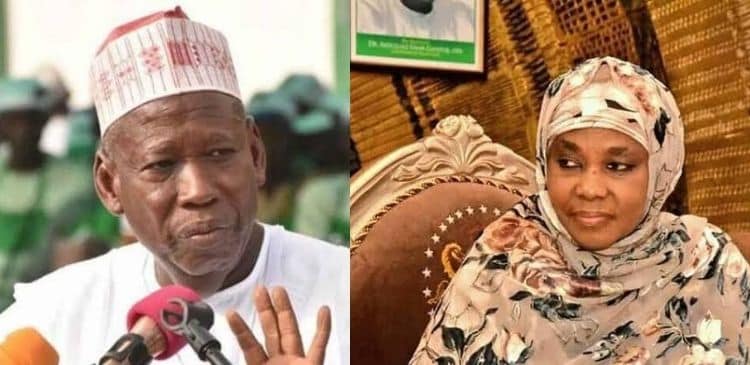

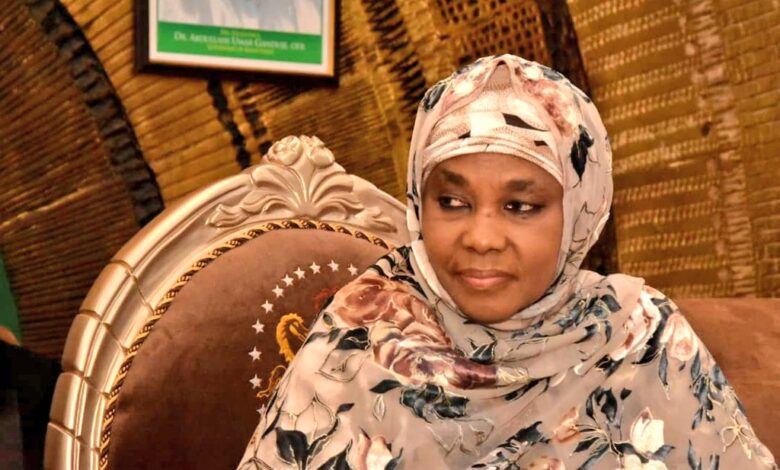
Prof. Hafsat Ganduje, wife of the Governor of Kano State, Abdullahi Ganduje, has been arrested by the Economic and Financial Crimes Commission (EFCC).
Hafsat was picked up by the anti-corruption agency based on a petition Abdulazeez, one of her sons, wrote against her.
Abdulazeez had petitioned the EFCC to investigate his mother over a bribery and land fraud case.
In his petition, Abdulazeez, the governor’s son, had said he was approached by a property developer to facilitate the acquisition of some plots of land in Kano with some hundreds of thousands of US dollars as commission.
He said three months later, the property developer discovered that the plots of land he paid for had been allocated to other buyers and he requested for refund.
Abdulazeez said the mother refused to honour the request, straining the relationship between him and the developer.
He was said to have fled abroad after filing the petition which was widely reported in the media.
Governor Ganduje’s media aide, Abubakar Ibrahim, had announced the London trip on September 14.
“Governor Abdullahi Umar Ganduje OFR, The First Lady, Prof. Hafsat Abdullahi Umar Ganduje and Family attended the Graduation of the Youngest Son to the Family, Muhammad Abdullahi Umar Ganduje who graduated from the Regent’s University London as BA. (Hons). Global Management (Enterprise & Innovation). Today, Tuesday. 14/9/2021,” the official said.
The anti-graft agency had summoned the Kano first lady but she was said to have refused to honour the invitation.
An official of the EFCC on Tuesday morning, said that Ganduje’s wife was picked up following her rejection to honour the invitation extended to her.
The senior official noted that she was quizzed immediately after her arrest Monday evening by the crack detective team of the anti-graft agency, adding that she would continue to respond to queries in relation to the subject matter on Tuesday at the commission’s headquarters.
The spokesman of the agency, Wilson Uwujaren, could not be reached for comments as his mobile phone indicated ”switched off”.
![Outraged Youths Storm Och’Idoma’s Palace with Corpses of Herdsmen Attack Victims [VIDEO]](https://jomog.com.ng/wp-content/uploads/2026/07/1000353920-350x250.jpg)