

Breaking News
BREAKING: New Bill: Protesters In Nigeria To Bag Five Years Jail Term
Protesters in Nigeria risk five years jail term according to a new bill awaiting seconding reading in the House of Reps.
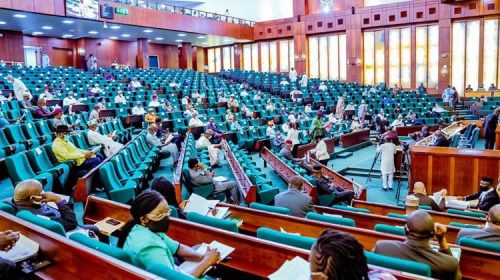
The House of Representatives has proposed a bill seeking to jail unauthorized protesters for five years in the country, JomogNews Nigeria reports.
This online news platform understands that the controversial bill which is sponsored by Rep. member, Emeka Chinedu Martins (PDP-Imo) was approved for second reading after it was presented for consideration at the House.
The legislation is entitled: “AN ACT TO AMEND THE CRIMINAL CODE ACT, CAP 38, LAWS OF THE FEDERATION OF NIGERIA, 2004 TO FURTHER PRESERVE THE SANCTITY OF HUMAN LIFE AND PROPERTY, AND TO PROVIDE SPECIFICALLY FOR MOB ACTION, PRESCRIBE PUNISHMENT AND OTHER MATTERS.”
The provisions of the proposed Act, are as follows: (1) The provisions of the Criminal Code Act, (in this Bill referred to as the “Principal Act”) is amended as set out in this Bill (2) Substitute for section 69 of the Principal Act, a new section 69.
“Definitions:
Unlawful assembly, Riot, Mob action (a) When three or more persons, with intent to carry out some common purpose, assemble in such a manner or, being assembled, conduct themselves in such a manner as to cause persons in the neighborhood to fear on reasonable grounds that the persons so assembled will tumultuously disturb the peace, or will by such assembly needlessly and without any reasonable occasion provoke other persons tumultuously to disturb the peace, they are an unlawful assembly. It is immaterial that the original assembling was lawful if, being assembled; they conduct themselves with a common purpose in such a manner as aforesaid”.
It also states that (b) “An assembly of three or more persons who assemble for the purpose of protecting any house against persons threatening to break and enter the house in order to commit a felony or misdemeanor therein is not an unlawful assembly.
“(c) When an unlawful assembly has begun to act in so tumultuous a manner as to disturb the peace, the assembly is called a riot, and the persons assembled are said to be riotously assembled.
“(d) When an unlawful assembly becomes violent as to commit unlawful acts against any person or property, the assembly is called a mob and their violent act is referred to as mob action”.
It adds that “(a) Any person who takes part in a riot is guilty of a felony and is liable to imprisonment for three years.
“(b) Any person who takes part in a mob action is guilty of a felony and is liable to imprisonment for five years.
(4) Substitute for Section 76 of the Principal Act, a new section 76:
(a) Section 76. Mob action against any person or property.
“Any persons who assembled together as a mob to commit violent act against any person or property are guilty of a felony and each of them is liable to imprisonment for life”.
The Bill explains that it “seeks to amend the Criminal Code Act, Cap 38, Laws of the Federation of Nigeria, 2004 to further preserve the sanctity of human life and property, and to provide specifically for the crime of mob action, prescribe punishment and other matters connected therewith”.
The sponsor of the piece of legislation against unlawful protesters, in his lead debate, said: “Mr. Speaker, my highly respected colleagues, permit me to lead the debate on this very important Bill titled the Criminal Code Act Amendment Bill, 2021.
“This bill was read for the first time in this Hallowed Chamber. Mr. Speaker, my honourable colleagues, this Bill seeks to amend the Criminal Code Act Cap 38, Laws of the Federation of Nigeria, 2004, to provide specifically for the crime of mob action, prescribe punishment, and for other related matters.
“Mr. Speaker, every now and then we hear and read in the news of mobs moving against people and properties.
“The word “mob” connotes a disorderly crowd of people, intent on causing trouble or violence. It is usually triggered spontaneously by accusations of a bystander, then joined by another, and then another till it turns into a crowd of vengeful people causing carnage and destruction on its path.
“The danger with mob action is that participants typically believe they are punishing an accused of violation of the law, when in fact they are delivering jungle justice to an accused who may be totally innocent and has not been given an opportunity to be fairly heard. They serve as accusers, judges, and executors.
“Most participants in mob actions are usually not informed first-hand about the situation before joining the destructive crowd in blind rage to carry out their orgy of violence.
“There have been records of crowds inflicting fatal injuries on their targets and destroying and looting properties based on unfounded accusations of theft of an item, allegations of missing genitals, witchcraft, and blasphemy.
“As quickly as the mob causes carnage, the participants disperse in all directions, making it difficult for them to be apprehended.
“A notable case is that of the Aluu Four in 2012, involving four male students from the University of Port Harcourt who went to recover a debt, but were set up and accused of theft leading to their gruesome murder by a mob in Aluu, Rivers State.
“More recently in 2016, a man accused of homosexuality was beaten to death in Ondo State. Another man was also lynched in Ebonyi State, over accusations of theft of motorcycle. There have also been records of similar incidents this year.
“The failure of our law enforcement agents to prevent mob justice or punish those who participate in it has lent an air of acceptability to this vile practice. How often people resort to jungle justice as a form of punishment to alleged offenders is also a testament to the fact that people have lost faith in the criminal justice system. Ever too often the participants in mob actions go unpunished.
“The Criminal Code Act in section 69 defines riot as when an unlawful assembly turns tumultuous as to disturb the peace but did not provide for when the unlawful assembly turns violent against persons and property.
“This amendment to the Bill seeks to remedy that by providing for specific amendments to sections 69, 71, and 76 of the Criminal Code Act dealing with mob action and further prescribing punishment for the crime.
“The amendment to the Act will encourage our law enforcement agencies to go after persons involved in mob action and give impetus to the criminal justice system to bring such offenders to book.
“If more participants in mob action are apprehended and publicly prosecuted it will serve as a deterrent to others.
“I therefore humbly urge you to support the second reading of this Bill and its legislative proposal”.
The Bill seeking to jail protesters was approved by the House for a second reading.
Breaking News
EFCC Detains Former Skye Bank Chairman Tunde Ayeni Over Alleged ₦36bn, $30m Fraud
The Economic and Financial Crimes Commission (EFCC) has arrested Tunde Ayeni, the former chairman of the defunct Skye Bank Plc, over an alleged fraud involving N36.5 billion and $30 million.
Ayeni was reportedly picked up in Abuja on Thursday, April 23, 2026, and is currently in custody as investigations proceed.
The EFCC is investigating the alleged diversion and misappropriation of funds estimated at N36.5 billion and $30 million.
The amount is said to have been obtained from Polaris Bank Plc through companies linked to him.
According to sources, the funds, secured as loans for specific projects, were diverted to other accounts and used for other purposes.
The loans originally meant for financing marine security, electricity distribution contract, estate development, were allegedly channeled into the acquisition of telecom assets linked to NITEL/MTEL through a NATCOM account.
The commission is also investigating about 12 companies linked to Ayeni, which were allegedly used to obtain the loans from Polaris Bank.
Ayeni is expected to be arraigned upon the conclusion of investigations.
When contacted, Dele Oyewale, EFCC spokesperson, confirmed the arrest but declined to provide further details.
Details shortly…
Breaking News
Tinubu Appoints New Ministers, Sacks Edun, Dangiwa In Minor Shake-Up
President Bola Tinubu has approved a minor reshuffle of the Federal Executive Council, removing the Minister of Finance and Coordinating Minister of the Economy, Wale Edun, and the Minister of Housing and Urban Development, Ahmed Dangiwa.
This was disclosed in a statement on Tuesday by the Special Adviser on Media and Publicity to the Secretary to the Government of the Federation, Yomi Odunuga, citing a memo signed by SGF George Akume.
According to the memo, Taiwo Oyedele has been appointed as the new Minister of Finance and Coordinating Minister of the Economy.
Also appointed is Dr. Muttaqha Darma as Minister-designate for Housing and Urban Development.
The memo directed the outgoing ministers to complete handover processes to their respective successors or supervising officials.
It stated that all handing over and taking over activities must be concluded on or before the close of business on Thursday, 23rd April, 2026.
Explaining the decision, Akume said the changes were aimed at improving coordination and strengthening delivery across key sectors of the economy under the Renewed Hope Agenda.
“These changes are aimed at strengthening cohesion, synergy in governance as well as achieving more impactful delivery on the economy to Nigerians, through the Renewed Hope Agenda,” Akume stated.
He added that President Tinubu acted in line with his constitutional powers as provided under Sections 147 and 148 of the 1999 Constitution (as amended).
The SGF also conveyed the President’s appreciation to the outgoing ministers for their service to the nation and wished them well in their future endeavours, noting that the process of cabinet reinvigoration would remain continuous.
The statement further noted that Taiwo Oyedele was appointed as Minister of State for Finance in March 2026, while Edun was among the ministers appointed on August 16, 2023.
Breaking News
Tax Reform Expert Taiwo Oyedele Nominated As Minister Of State For Finance
President Bola Ahmed Tinubu has officially nominated Chairman of the Presidential Committee on Fiscal Policy and Tax Reforms, Dr. Taiwo Oyedele as the new Minister of State for Finance.
Oyedele replaces Dr. Doris Anite-Uzoka, who has been redeployed to the Ministry of Budget and National Planning as Minister of State, her third portfolio in the administration.
The President on Tuesday conveyed Oyedele’s nomination to the Senate for confirmation in a letter to the Senate President, Godswill Akpabio, according to a statement by his Special Adviser on Information and Strategy, Bayo Onanuga, on Tuesday.
Until Tinubu nominated him as a minister, Oyedele from Ikaram, Akoko, Ondo State, was the chairman of the Presidential Committee on Fiscal Policy and Tax Reforms, which overhauled Nigeria’s tax system.
The 50-year-old is an economist, accountant, and public policy expert who led the comprehensive overhaul of Nigeria’s tax system through the Presidential Committee on Fiscal Policy and Tax Reforms.
The committee, inaugurated in August 2023, delivered four executive bills that consolidated over 60 taxes into fewer than 10 statutes and introduced significant reforms, including zero income tax for Nigerians earning N800,000 annually or less.
The Tax Reform Acts, which became effective on January 1, 2026, also exempted small businesses with turnover below N50m from company income tax, capital gains tax, and development levy.
Other provisions include a 50 per cent tax deduction for companies hiring new workers for three years, a 50 per cent deduction for wage increases to the lowest-paid employees, and a five-year corporate tax holiday for agricultural enterprises.
Oyedele attended Yaba College of Technology, where he obtained a Higher National Diploma in Accountancy and Finance, before proceeding to Oxford Brookes University for a BSc in Applied Accounting.
He also completed executive education programmes at the London School of Economics, Yale University, the Gordon Institute of Business Science, and the Harvard Kennedy School.
Oyedele spent 22 years at PricewaterhouseCoopers, joining in 2001 and rising to become the Fiscal Policy Partner and Africa Tax Leader before his appointment to head the tax reform committee.
He is currently a professor at Babcock University in Ogun State and a visiting scholar at the Lagos Business School.
As Minister of State for Finance, Oyedele is expected to oversee the implementation of the tax reforms he championed, particularly as the government seeks to improve revenue generation and deepen economic reforms.
Anite-Uzoka, who is being redeployed to the Ministry of Budget and National Planning, previously served as Minister of State for Industry, Trade and Investment before her appointment as Minister of State for Finance.
The Senate is expected to screen and confirm Oyedele’s nomination in the coming weeks, following which he will be sworn in to assume his ministerial duties.
The Finance Ministry, currently led by Wale Edun as substantive minister, oversees fiscal policy, revenue mobilisation, debt management, and economic planning.
-
News2 days agoZENITH BANK CROSSES N1 TRILLION MARK IN Q1 2026 GROSS EARNINGS
-
News2 days agoYahaya Bello: Court Never Ordered Abuja School to Refund Fees to EFCC, Witness Tells Court
-
News2 days agoAkpabio Declares ADC “Dead” Amid Massive NASS Defections
-
News1 day agoOshiomhole Demands MTN, DStv Ban Following Xenophobic Attacks In SA
-
News17 hours ago2027 Elections: INEC Announces Final Registration Deadline
-
News20 hours agoCoup Trial: Islamic Cleric Denies Treason, Says ₦10m Was For Spiritual Intercession
-
News18 hours agoWike Accuses Fubara Of Chasing 2027 Re-election While Neglecting State Budget
-
News18 hours agoFG Declares ‘Dr’ Prefix For Honorary Awardees Illegal; Labels Unauthorized Use Academic Fraud