
News
Electoral Act 2026: 2-Year Prison Term For RECs Over Result Manipulation
The National Assembly has officially rolled out the Electoral Act 2026, introducing aggressive reforms aimed at securing the 2027 general elections.
Key highlights include a two-year prison sentence for any INEC Resident Electoral Commissioner (REC) who refuses to release essential election documents, and the launch of a dedicated fund to bolster the commission’s financial independence.
These changes, detailed by Senate Leader Opeyemi Bamidele on Sunday, come amid heavy pushback from opposition parties. Critics argue that the new rules specifically those regarding candidate primaries, campaign spending, and election schedules are unfairly structured to benefit the ruling All Progressives Congress (APC).
Bamidele’s attempt to highlight the benefits of the electoral reform comes barely 24 hours after opposition parties fumed that provisions in the 2026 Act on primaries, campaign funding, and election timelines tilted the playing field in favour of the ruling All Progressives Congress.
While the Presidency and the APC have defended the amendments as necessary reforms to deepen democracy and strengthen electoral integrity, opposition figures insisted the changes were skewed to weaken political competition.
The Senate leader, however, argued that there were several merits that many Nigerians were not considering in the new Electoral Act.
He said, “The new electoral governance framework equally mandates the INEC to deploy a Bimodal Voters Accreditation System; recommend two-year jail imprisonment for the Resident Electoral Commissioner (REC) who withholds vital documents; establish an electronic register of voters and review campaign funds upward for different elective offices.”
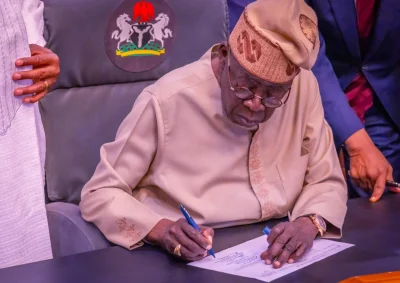
The Electoral Bill 2026 was harmonised by both chambers of the National Assembly — particularly over contentious Clause 60(3) — before it was transmitted to President Bola Tinubu for assent to avert any constitutional crisis in the build-up to the next general election.
The President signed the bill into law within 24 hours of its passage, completing what lawmakers described as a painstaking two-year process of recrafting Nigeria’s electoral framework.
Although some civil society organisations questioned the speed of the presidential assent, the Senate leadership maintained that the process had been inclusive and exhaustive.
According to Bamidele, the making of the new regime “is a collective work that involves nearly all critical stakeholders. The National Assembly worked with such different stakeholders as OAGF, CSOs, INEC and our development partners, among others, before we eventually completed the process.
“As we were making progress, the stakeholders too were making their input, and all the inputs were incorporated in the Act.
“In view of the time constraint we are facing now, I do not believe the Executive requires days or weeks to review it before assent since we all contributed to it. Its outcome is not a unilateral effort of the parliament, but of Nigerians at large,” he stated.
Under Section 3 of the new law, a dedicated fund has been established for INEC to ensure financial autonomy, operational stability and administrative continuity.
The provision also mandates that election funds be released at least six months before a general election.
With this measure, Bamidele said INEC would operate with greater independence and quicker corrective powers, including expanded authority to review questionable result declarations made under duress or procedural violations.
He noted that the new framework is “designed to strengthen institutional independence, enhance transparency in election management, improve technological integration, and reinforce accountability mechanisms in the country’s electoral system.”
Section 60(3) now makes electronic transmission of results to the INEC Result Viewing Portal mandatory, while Section 60(6) prescribes “a six-month imprisonment or a fine of N500,000 or both against any presiding officer who willfully frustrates the electronic transmission of election results.”
er rattles NNPC, PDP heads to court over FCT poll, INEC officials risk jail and other top stories
Bamidele said, “This provision is consistent with the public demands. It also stipulates another measure of consequence if any presiding officer refuses to electronically transmit the results from each polling unit to IREV.
“We must equally understand that iRev is not a collation platform. It was designed to enhance transparency in our electoral process. An electronic collating system is a project that requires its own planning,” Bamidele clarified.
He explained further that the law conditionally permitted a resort to Form EC8A where electronic transmission failed due to communication challenges, as prescribed by INEC.
In a move aimed at curbing administrative bottlenecks and electoral impunity, Section 74(1) mandates a REC to release a certified true copy of any requested document within 24 hours after payment. Failure to comply attracts a minimum imprisonment of two years without the option of a fine.
Similarly, Section 72(2) provides that a certified true copy of a court order shall suffice for swearing in any candidate declared a winner by the court where INEC fails or neglects to issue a certificate of return.
Under Section 125(1-2), the Act stiffens penalties against vote-buying, impersonation and result manipulation, recommending a two-year imprisonment or a fine ranging between N500,000 and N2m both upon conviction.
Unlike the repealed 2022 Electoral Act, the new law phases out indirect primaries, retaining only direct and consensus primaries under Section 84(1-2) to broaden participation and curb the monetisation of party delegates.
Section 77(1-7) further mandates political parties to maintain a digital register of members, issue membership cards, and submit such registers to INEC at least 21 days before primaries, congresses or conventions.
A political party “shall not use any other register for party primaries, congresses and conventions than the register submitted to the INEC.
“Besides, any political party that fails to submit the membership register within the stipulated time shall not be eligible to field a candidate for that election.
“These are indeed consequential restraint measures that will deepen internal democracy and reduce the monetisation of politics in the country,” Bamidele said.
The new regime also reviews the spending limits for elective offices under Section 92(1-8).
Bamidele said, “The presidential spending cap has been raised from N5bn to N10bn; governorship from N1bn to N3bn; Senate from N500m to N1bn; House of Representatives from N70m to N250m; House of Assembly from N30m to N100m; Area Council from N30m to N60m; and councillorship from N5m to N10m.”
Other notable provisions include gender-sensitive queue arrangements in areas where culture requires separation of men and women, support mechanisms for persons with visual impairment, and a N10m fine for political parties that fail to submit accurate audited returns within the stipulated period.
Summing up the impact of the reforms, the Senate leader declared: “The Electoral Act, 2026, represents a consolidation and refinement of the country’s electoral governance framework. In all, the Act seeks to enhance electoral credibility, reduce disputes, and strengthen democratic governance in Nigeria.
“The Act emphasises financial and operational independence of INEC; technological integration with procedural safeguards; transparency in collation and declaration; stricter penalties for electoral offences and stronger regulation of political parties.”
News
Opposition Leaders Reject Alleged Plan To Make Tinubu Sole 2027 Candidate
Opposition leaders in Nigeria have issued a communique vowing to resist any attempts by the ruling All Progressives Congress (APC) to make President Bola Tinubu the sole candidate for the 2027 general elections.
This statement followed a National Summit of opposition parties held in Ibadan, Oyo State, where several key political figures including Atiku Abubakar (PDP), Peter Obi (LP), and Rabiu Kwankwaso (NNPP) gathered to discuss a united front.
The opposition political figures made this declaration via a communique issued at the end of a meeting christened “National Summit of Opposition Political Party Leaders”.
The meeting was hosted by governor Seyi Makinde of Oyo State in Ibadan on Saturday.
It was attended by former Vice President, Alhaji Atiku Abubakar, former Senate President, David Mark, former Minister of Information, Professor Jerry Gana, Aisha Yesufu, Professor Pat Utomi and a former Minister of Sports, Solomon Dalung.
Others are former governor of Osun State, Rauf Aregbesola, former governor of Sokoto State, Aminu Tambuwal, former governor of Kano, Rabiu Kwankwanso, former governor of Kwara State, Abdulfatai Ahmed, former governor of Rivers State, Rotimi Amechi, former governor of Niger State, Babangida Aliyu among others.
The leaders of the opposition political parties in the communique vowed to resist all machinations by the ruling All Progressives Congress to foist a one-party State on Nigeria.
They vowed to resist all attempts to make Tinubu the sole presidential candidate in the 2027 general elections.
The opposition political figures also disclosed that the Chairman of Independent National Electoral Commission INEC, Professor Joash Amupitan should not be allowed to conduct the forthcoming general elections in 2027.
The communique partly read, “That we shall resist all machinations by the APC to foist a one-party State on Nigeria and fight for the survival of multi-party democracy in our country.
“That despite the onslaughts and maneuverings of the ruling party, the APC to impose President Bola Tinubu as the sole Presidential candidate in 2027; we shall field candidates and contest the 2027 Presidential and other elections.
“That we shall work towards fielding one Presidential Candidate for the 2027 elections, which shall be agreed and supported by all participating opposition parties to rescue our nation and her long suffering masses”.
News
Nigerian Army Recovers Remains Of Personnel Murdered During Wedding Trip
The Nigerian Army said troops from the 82 Division has recovered the suspected remains of a soldier couple, Master Warrant Officer Linus Musa Audu and Private Gloria Mathew, who were murdered in May 2022.
In a statement shared on its official X handle, the Army said the troops acted on credible intelligence to carry out the operations on 24 April 2026 along the Ubaha Orsu axis of Orsu Local Government Area.
The operation was part of a strategic clearance and search mission aimed at dismantling the IPOB/ESN hideout in the region and locating the remains of two Nigerian Army personnel, Master Warrant Officer Linus Musa Audu and Private Gloria Mathew, who were brutally abducted and murdered by terrorists in May 2022 while on their way to their traditional wedding.
Upon receiving credible intelligence, the army reported that its troops advanced towards a suspected IPOB/ESN hideout, where they encountered heavy fire from armed criminals.
The statement said the troops engaged the terrorists decisively, successfully repelling multiple ambushes and forcing the criminals to retreat in chaos.
“The encounter further revealed the desperation and criminal nature of the group, which continues to target innocent citizens and security personnel alike,” the statement said.
After successfully clearing the camp, the Nigerian Army said the troops conducted a comprehensive search of the area, leading to the discovery of shallow graves believed to contain the remains of the slain personnel.
“The graves were carefully excavated, and the suspected remains were recovered,” the statement said.
The Nigerian Army confirmed that the recovered remains have been secured for detailed forensic analysis, including DNA testing, to definitively establish their identities.
“Efforts are also ongoing to liaise with the families of the fallen personnel to ensure proper identification and facilitate befitting burial arrangements in honour of their sacrifice.
“This operation not only underscores the Nigerian Army’s unwavering commitment to ensuring justice for fallen heroes but also highlights the continued degradation of IPOB/ESN criminal networks and infrastructure across the South East.
“The discovery of shallow graves within their camp further exposes the group’s heinous atrocities and disregard for human life.”
The Nigerian Army reassured the general public that ongoing operations will continue until all criminal elements are neutralised and lasting peace is restored across the region.
“We appreciate the law-abiding citizens for the information and urge you remain vigilant and continue to support security agencies with timely and credible information,” it added.
News
South Africa and Xenophobia: A Crisis of Unity and Memory – By Dr George Ogunjimi
Xenophobia in South Africa has become a deeply troubling issue, raising questions about unity, historical memory, and the values that once defined the African struggle for liberation.
While concerns about illegal immigration and documentation are valid, they cannot justify the violence, hostility, and loss of life that have increasingly targeted foreign nationals, particularly fellow Africans.
The recurring outbreaks of violence—such as the 2008 South African xenophobic riots—highlight a pattern that continues to resurface. Incidents like the recent killing of a Nigerian taxi driver, widely shared in disturbing videos, serve as painful reminders of how severe and personal this crisis has become. These acts not only harm individuals and communities but also damage the broader vision of African solidarity.
Historically, many African nations, including Nigeria, stood firmly against Apartheid, offering financial, political, and moral support to movements like the African National Congress. This shared struggle fostered a sense of continental unity—an idea that now seems under strain.
Figures like Julius Malema have spoken about African unity and condemned xenophobic violence, though the broader political and social landscape remains complex. The persistence of these attacks suggests deeper underlying issues, including economic inequality, unemployment, and social frustration.
Ultimately, xenophobia in South Africa is not just a national issue—it is an African one. It challenges the continent to reflect on its shared history, its responsibilities to one another, and the urgent need to rebuild a sense of unity and mutual respect.
George Ogunjimi Esq
Juris Republic
jurisrepubliclegal@gmail.com
24/04/2026.
-
Breaking News1 day agoEFCC Detains Former Skye Bank Chairman Tunde Ayeni Over Alleged ₦36bn, $30m Fraud
-
News1 day agoFidelity Bank Strengthens SME Support with High Impact Masterclasses on Pricing, Digital Growth and Global Expansion
-
News1 day agoSouth Africa and Xenophobia: A Crisis of Unity and Memory – By Dr George Ogunjimi
-
News2 days agoSterling, Partners Drive Nationwide Cleanup Movement
-
News2 days agoProvidus Bank Expands Footprint with Ekiti Branch, Reaffirms Capital Strength
-
News2 days agoFG Approves Massive Pay Hike, Gratuity For Civil Servants
-
News1 day agoExclusive: Actress Rosy Meurer Moves to Legally Dissolve Marriage to Businessman Olakunle Churchill
-
News2 days agoEx-Super Eagles Striker Michael Eneramo Dies At 40