
Connect with us

News

Dangote Fires Entire Nigerian Staff After They Form PENGASSAN Union

Published

on

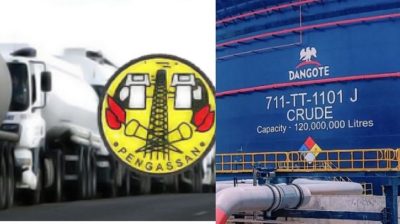
The management of Dangote Petroleum Refinery has reportedly terminated the employment of all its Nigerian staff, less than 24 hours after 90 per cent of them joined the Petroleum and Natural Gas Senior Staff Association of Nigeria (PENGASSAN).


In a memo dated September 25, 2025, and signed by the Chief General Manager of Human Asset Management, Femi Adekunle, the refinery explained that the decision was part of a “total re-organisation exercise.


The internal notice alleged that the drastic step became necessary after “reported cases of sabotage” were discovered in different units of the plant.


The memo instructed the affected employees to surrender all company property in their possession to their respective line managers and obtain exit clearance.


It further directed the finance department to compute outstanding benefits and entitlements for immediate payment, in accordance with the terms of employment.


“Management appreciates your services while in our employment and wishes you success in your future endeavours,” Daily Post quoted the notice as stating.


The refinery and PENGASSAN have been locked in a trade dispute in recent months over the unionisation of staff. The mass sack is widely seen as a fallout of that standoff.


Labour leaders have yet to issue an official response at the time of filing this report.

News

BANKING BEYOND THE BALANCE SHEET: UNION BANK’S ASBON RECOGNITION AND NIGERIA’S SMALL BUSINESS ECONOMY

Published

on

By

Union Bank of Nigeria has been named winner of the Best SME Growth Banking Initiatives Award (2025) at the Nigeria National SME Business Awards, organised by the Association of Small Business Owners of Nigeria (ASBON) in partnership with the Lagos State Government through the Ministry of Commerce, Cooperatives, Trade and Investment.


The recognition arrives at a moment when the relationship between Nigerian banks and Nigerian small businesses is being quietly redefined. Awards in this space have historically rewarded scale and product breadth. The ASBON criteria, by contrast, ask a more practical question: which banks are actually making it easier for entrepreneurs to operate?


WHY THIS AWARD, AND WHY NOW?

Across Nigeria, growth is no longer the only measure of success for a small or medium-sized enterprise. For most owners, success now looks like stability. Cashflow that holds up. Payments that clear without disruption. Financing that arrives in time to seize an opportunity rather than rescue a crisis. Operations that are not slowed by administrative friction.


That shift in what SMEs need has changed what they look for in a bank. The institutions earning their attention are the ones that take the daily reality of running a business in Nigeria seriously, not those with the longest catalogue of products. It is in that environment that the ASBON recognition reads as something more than ceremonial.

Union Bank’s SME work over the past year has been organised around a small number of practical priorities, and many of the issues SMEs cite as their biggest pain points sit at the centre of them.


FASTER ONBOARDING, MORE USABLE DIGITAL TOOLS

Account opening and customer onboarding have long been one of the slowest stages of business banking in Nigeria. For an entrepreneur trying to receive payments, pay suppliers, or qualify for a tender, days lost at this stage are days lost from the business itself.


Union Bank addressed this directly with enhancements to its Union360 platform and the rollout of a Straight-Through-Processing (STP) Digital Onboarding Platform. The intent was simple: cut the time between an SME deciding to bank with Union Bank and actually being able to transact. The improvements have meaningfully shortened onboarding, raised digital activity among SME customers, and brought in a notable cohort of new business clients.


Behind those improvements is a recognition that Nigerian SMEs are increasingly multi-channel by default. A small retailer may take payments by transfer, POS, mobile money, and online checkout in the course of a single afternoon. The bank that supports them has to be reliable across all of those rails, not just the ones that photograph well in product brochures.


FINANCING THAT MEETS BUSINESSES WHERE THEY ARE

Access to credit remains the most frequently cited barrier for Nigerian SMEs, particularly for businesses without conventional collateral or a long paper trail of audited accounts.

Union Bank’s response has been less about loosening criteria and more about widening the range of evidence that counts.


Consistent transaction history, active account use, and clear cashflow patterns now carry meaningful weight in how the Bank assesses a small business. For a generation of entrepreneurs whose operations are real but whose paperwork is light, that is a material change.


The Bank’s SME lending over the review period reflected this orientation, with funding directed at working capital, inventory, equipment, and the kind of operational expansion that sits between mere survival and genuine scale.


THE HUMAN SIDE OF THE WORK

Digital infrastructure matters, but it does not replace the value of someone an entrepreneur can actually call.

Union Bank’s SME engagement is supported by a network of relationship managers, direct sales agents, and branches across the country. The Bank’s “Adopt, Engage and Grow” campaign was designed to reach SMEs at this human level, not as a once-a-year touchpoint, but as a sustained relationship that meets businesses where they are, both physically and operationally.

The approach reflects a basic truth about small business banking in Nigeria.


Entrepreneurs operate under pressure that is rarely visible from a head office. The institutions they trust tend to be the ones whose people understand that pressure, respond when it matters, and treat the relationship as ongoing rather than transactional.


UNION BANK OF NIGERIA AND ASBON

Union Bank’s recognition is also tied to its partnership with ASBON, through the SME Empowerment Challenge run jointly by the two organisations.


The Challenge encouraged entrepreneurs to open or reactivate business accounts, maintain proper transaction records, and develop structured plans for growth. On its surface, it was a campaign. In substance, it was an attempt to nudge a behaviour that Nigerian SMEs themselves often identify as one of the hardest to sustain: the discipline of running the business as a business, with clean books, separated finances, and a clear view of where it is going.


That discipline matters because it is the gateway to almost everything else. Loans, grants, supplier credit, partnerships, and public sector contracts all depend on a business being able to show how it actually operates. By building that habit alongside ASBON, Union Bank invested in something that outlasts any single campaign cycle.


WHAT THE AWARD ACTUALLY SIGNALS

There is a tendency to read awards as endpoints. This one reads better as a signpost. Nigerian SMEs are operating in one of the most demanding business environments on the continent. They are also, collectively, the largest source of employment in the country and the most direct route to broad-based prosperity. The banks that serve them well, with patient infrastructure, accessible financing, real human engagement, and a partnership posture toward the wider SME ecosystem, have a role to play that goes well beyond commercial performance.


Union Bank’s recognition at the ASBON SME Awards 2025 is, in that sense, an acknowledgement of a posture as much as a portfolio. The work it points to, faster systems, more accessible credit, sustained engagement, and a habit of building alongside SME institutions rather than around them, is the kind of work that compounds quietly over years.

For a bank, that is the most useful kind of award to win. Not the one that celebrates a moment, but the one that confirms a direction.

Continue Reading

News

Polaris Bank Supports the Launch of NACCIMA Call Center to Drive Growth for Nigerian Exporters  

Published

on

By

Polaris Bank, Nigeria’s leading digital retail and commercial bank, has proudly facilitated the launch of the NACCIMA Export Support Call Center, a vital initiative designed to provide comprehensive support to Nigerian exporters, especially those operating in the non-oil sector and enhance their ability to access global markets.


This partnership marks a significant step in the Bank’s commitment to strengthening Nigeria’s export ecosystem.


Chris Ofikulu, Executive Director of Polaris Bank, in his address, emphasised the Bank’s commitment to empowering Nigerian businesses for global markets. He highlighted the importance of the NACCIMA Call Center as a key resource for exporters, offering valuable information, knowledge, expert guidance, and advisory services to navigate the complexities of international trade.


“Today, we are marking a pivotal moment in our mission to empower Nigerian businesses for global markets,” said Chris Ofikulu. “Through this collaboration, we are equipping exporters with the tools, infrastructure, and expertise needed to thrive in global markets.”


The NACCIMA Call Center, supported by Polaris Bank, will act as a key platform where exporters can access real-time information, technical assistance, and regulatory advisory services. This strategic initiative is in alignment with Polaris Bank’s vision to drive trade facilitation, improve market access, and support Nigeria’s economic growth.


Polaris Bank’s contribution includes providing advanced infrastructure such as laptops, a fully equipped workstation, internet-enabled modems, and high-capacity printers to support the operations of the center. This donation is aimed at ensuring the center runs smoothly and effectively meets the needs of Nigerian exporters.


During his speech, Ofikulu highlighted the importance of initiatives like the NACCIMA Call Center, emphasizing its role in bridging gaps for exporters, especially those in the non-oil export sector. “By offering exporters the right support, we are unlocking their potential to compete globally. This center is not just a call center; it is a catalyst for success, providing exporters with the resources, knowledge, and access they need to excel,” he added.


The partnership between Polaris Bank and NACCIMA also ties into the Bank’s broader mission to support Nigeria’s export sector. Polaris Bank provides a comprehensive range of solutions for exporters, including stock refinancing, working capital support, and advisory services on regulatory processes such as NXP documentation. Through its digital platform, VULTe, the Bank facilitates seamless intra-African trade, enabling faster and more efficient payments via the Pan-African Payment and Settlement System (PAPSS).


“We are excited to be part of this transformative initiative, which empowers Nigerian businesses to scale and compete on the global stage,” Ofikulu concluded. “Our focus on innovation and our dedication to supporting SMEs are central to our role in shaping the future of Nigeria’s export sector.”


Polaris Bank’s collaboration with NACCIMA reinforces its ongoing commitment to advancing Nigeria’s economic landscape by enhancing export readiness, improving access to finance, and supporting the growth of SMEs. The unveiling of the NACCIMA Call Center is a prime example of the Bank’s continuous dedication to driving positive change within Nigeria’s export ecosystem.

Continue Reading

News

2027 Elections: INEC Announces Final Registration Deadline

Published

on

By

The Independent National Electoral Commission (INEC) has announced that the third and final phase of the nationwide Continuous Voter Registration (CVR) exercise will run from Monday, 11 May 2026, to Friday, 10 July 2026.

This final window is the last opportunity for eligible Nigerians to register or update their records before the 2027 General Elections.

The announcement was contained in a statement released by the Chairman of the Information and Voter Education Committee, Mohammed Kudu Haruna.

According to the Commission, the exercise is part of efforts to ensure that all qualified Nigerians are captured in the voter register before preparations for the 2027 polls move into full gear.

INEC explained that the second phase of the registration exercise was suspended on April 17 to allow for the review and clean-up of records after the publication of claims and objections submitted by registrants.

The Commission said the final phase will run for two months and urged citizens who have attained the age of 18, as well as those who were unable to register during earlier phases, to seize the opportunity.

It stated, “The third phase of the CVR, commencing on Monday, 11th May 2026, will conclude on Friday, 10th July 2026.

“During this timeframe, eligible citizens who have reached the age of 18, as well as those who were unable to register in the previous phases, are encouraged to take advantage of this opportunity to register.”

INEC also advised already registered voters seeking to transfer their registration to new locations, replace lost or damaged Permanent Voter Cards, or correct personal details to make use of the Commission’s online portal or visit its offices in states and local government areas nationwide.

The Commission noted that following the close of registration, the voters’ register will be displayed for public scrutiny.

It added, “In continuation of the process, the Commission will display the Register of Voters for claims and objections from Thursday, 23rd July to Wednesday, 29th July 2026.

“This statutory exercise offers a significant opportunity for citizens to review the register and assist the Commission in ensuring its accuracy, completeness, and credibility.”

INEC assured Nigerians that all logistics and administrative arrangements have been concluded to guarantee a smooth exercise across the federation.

The Commission further appealed to citizens to actively participate, stressing that voter registration remains a critical step in strengthening Nigeria’s democratic process.

The fresh registration exercise is expected to draw significant participation, especially from first-time voters and Nigerians who recently relocated to new states or local government areas.


Continue Reading

Trending