
Connect with us

News

Polaris Bank Supports the Launch of NACCIMA Call Center to Drive Growth for Nigerian Exporters  

Published

on

Polaris Bank, Nigeria’s leading digital retail and commercial bank, has proudly facilitated the launch of the NACCIMA Export Support Call Center, a vital initiative designed to provide comprehensive support to Nigerian exporters, especially those operating in the non-oil sector and enhance their ability to access global markets.


This partnership marks a significant step in the Bank’s commitment to strengthening Nigeria’s export ecosystem.


Chris Ofikulu, Executive Director of Polaris Bank, in his address, emphasised the Bank’s commitment to empowering Nigerian businesses for global markets. He highlighted the importance of the NACCIMA Call Center as a key resource for exporters, offering valuable information, knowledge, expert guidance, and advisory services to navigate the complexities of international trade.


“Today, we are marking a pivotal moment in our mission to empower Nigerian businesses for global markets,” said Chris Ofikulu. “Through this collaboration, we are equipping exporters with the tools, infrastructure, and expertise needed to thrive in global markets.”


The NACCIMA Call Center, supported by Polaris Bank, will act as a key platform where exporters can access real-time information, technical assistance, and regulatory advisory services. This strategic initiative is in alignment with Polaris Bank’s vision to drive trade facilitation, improve market access, and support Nigeria’s economic growth.


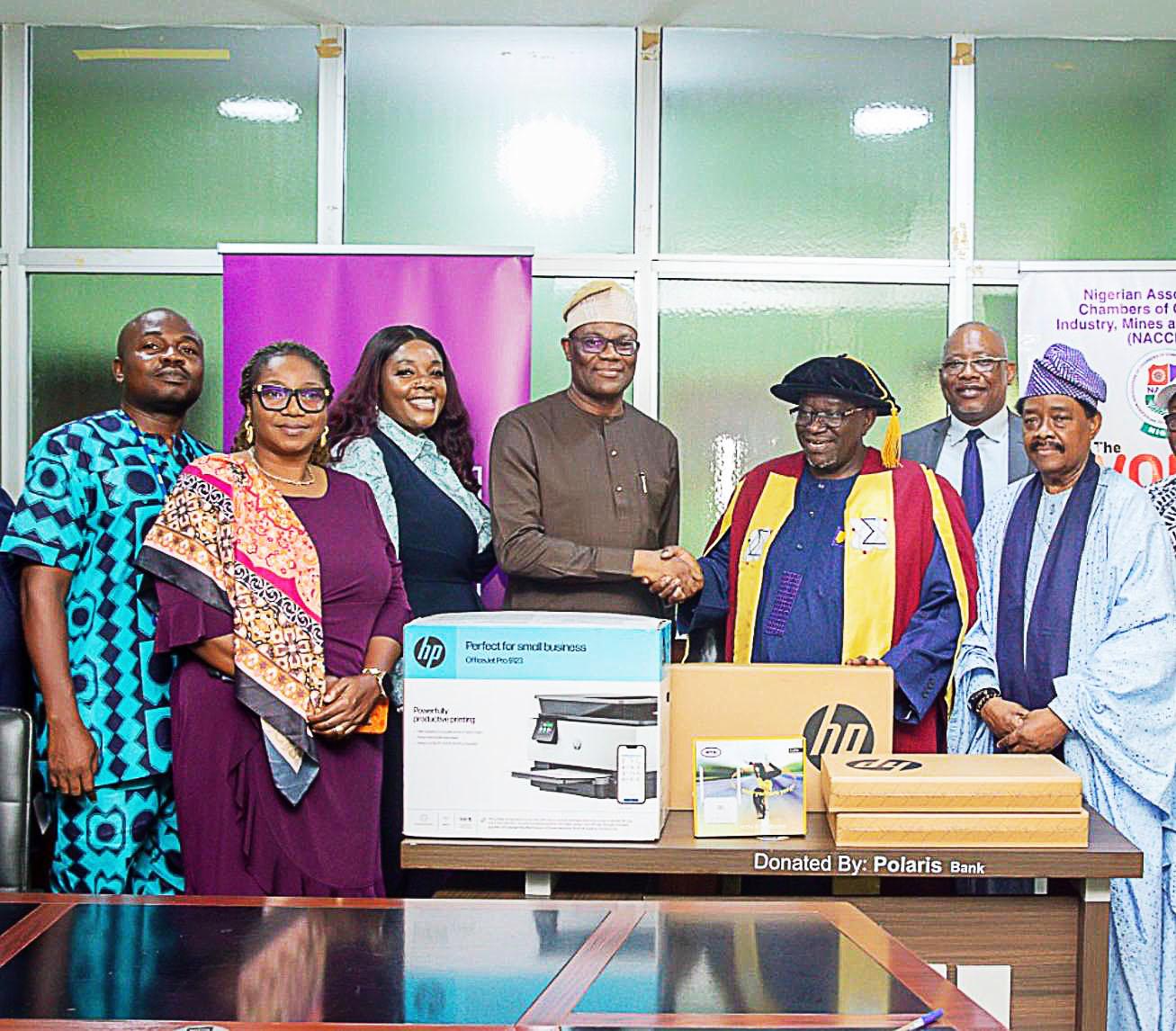
Polaris Bank’s contribution includes providing advanced infrastructure such as laptops, a fully equipped workstation, internet-enabled modems, and high-capacity printers to support the operations of the center. This donation is aimed at ensuring the center runs smoothly and effectively meets the needs of Nigerian exporters.


During his speech, Ofikulu highlighted the importance of initiatives like the NACCIMA Call Center, emphasizing its role in bridging gaps for exporters, especially those in the non-oil export sector. “By offering exporters the right support, we are unlocking their potential to compete globally. This center is not just a call center; it is a catalyst for success, providing exporters with the resources, knowledge, and access they need to excel,” he added.


The partnership between Polaris Bank and NACCIMA also ties into the Bank’s broader mission to support Nigeria’s export sector. Polaris Bank provides a comprehensive range of solutions for exporters, including stock refinancing, working capital support, and advisory services on regulatory processes such as NXP documentation. Through its digital platform, VULTe, the Bank facilitates seamless intra-African trade, enabling faster and more efficient payments via the Pan-African Payment and Settlement System (PAPSS).


“We are excited to be part of this transformative initiative, which empowers Nigerian businesses to scale and compete on the global stage,” Ofikulu concluded. “Our focus on innovation and our dedication to supporting SMEs are central to our role in shaping the future of Nigeria’s export sector.”


Polaris Bank’s collaboration with NACCIMA reinforces its ongoing commitment to advancing Nigeria’s economic landscape by enhancing export readiness, improving access to finance, and supporting the growth of SMEs. The unveiling of the NACCIMA Call Center is a prime example of the Bank’s continuous dedication to driving positive change within Nigeria’s export ecosystem.


News

2027 Elections: INEC Announces Final Registration Deadline

Published

on

By

The Independent National Electoral Commission (INEC) has announced that the third and final phase of the nationwide Continuous Voter Registration (CVR) exercise will run from Monday, 11 May 2026, to Friday, 10 July 2026.

This final window is the last opportunity for eligible Nigerians to register or update their records before the 2027 General Elections.

The announcement was contained in a statement released by the Chairman of the Information and Voter Education Committee, Mohammed Kudu Haruna.

According to the Commission, the exercise is part of efforts to ensure that all qualified Nigerians are captured in the voter register before preparations for the 2027 polls move into full gear.

INEC explained that the second phase of the registration exercise was suspended on April 17 to allow for the review and clean-up of records after the publication of claims and objections submitted by registrants.

The Commission said the final phase will run for two months and urged citizens who have attained the age of 18, as well as those who were unable to register during earlier phases, to seize the opportunity.

It stated, “The third phase of the CVR, commencing on Monday, 11th May 2026, will conclude on Friday, 10th July 2026.

“During this timeframe, eligible citizens who have reached the age of 18, as well as those who were unable to register in the previous phases, are encouraged to take advantage of this opportunity to register.”

INEC also advised already registered voters seeking to transfer their registration to new locations, replace lost or damaged Permanent Voter Cards, or correct personal details to make use of the Commission’s online portal or visit its offices in states and local government areas nationwide.

The Commission noted that following the close of registration, the voters’ register will be displayed for public scrutiny.

It added, “In continuation of the process, the Commission will display the Register of Voters for claims and objections from Thursday, 23rd July to Wednesday, 29th July 2026.

“This statutory exercise offers a significant opportunity for citizens to review the register and assist the Commission in ensuring its accuracy, completeness, and credibility.”

INEC assured Nigerians that all logistics and administrative arrangements have been concluded to guarantee a smooth exercise across the federation.

The Commission further appealed to citizens to actively participate, stressing that voter registration remains a critical step in strengthening Nigeria’s democratic process.

The fresh registration exercise is expected to draw significant participation, especially from first-time voters and Nigerians who recently relocated to new states or local government areas.


Continue Reading

News

FG Declares ‘Dr’ Prefix For Honorary Awardees Illegal; Labels Unauthorized Use Academic Fraud

Published

on

By

Nigeria’s Federal Government has officially banned honorary degree recipients from using the “Dr” prefix before their names, declaring that such usage now constitutes academic fraud.

It declared that the use of the title by such recipients constitutes a misrepresentation of academic credentials, which will henceforth be treated as academic fraud, with attendant legal and reputational consequences.

The Minister of Education, Tunji Alausa, announced this directive on Wednesday, stating that the decision was approved by the Federal Executive Council (FEC) to restore integrity to Nigeria’s academic system and curb the “indiscriminate conferment” of titles for political or financial gain.

Alausa, who appeared alongside the Minister of State for Education, Prof Suwaiba Ahmad, said the FEC approved a uniform policy for the award and use of honorary degrees by Nigerian universities.

The policy, he explained, is designed to end what he described as decades of indiscriminate conferral of degrees for political patronage and financial gain, and to restore public confidence in the integrity of academic titles.

He said, “The recent trend we’ve seen with the award of honorary degrees has revealed a growing abuse and politicisation of this academic privilege.

“We’ve seen awards being used for political patronage, for financial gain, as well as the conferral of awards on serving public officials, which, as part of the ethics of honorary degree awards, should not happen.”

Under the new policy, recipients of honorary degrees may no longer put “Dr” before their names.

Instead, they must cite the full honorary designation after their name.

Giving examples, Alausa explained, “For instance, you can use Chief Louis Clark, D.Lit. (Doctor of Literature, Honoris Causa)” or “Mrs Miriam Adamu, LL.D. Hons.”

Alausa said this format clearly reflects the honorary rather than earned academic nature of the award.

“Recipients shall not prefix doctor to their names in official, academic or professional usage,” the minister said, adding, “Misrepresentation of honorary degrees as earned academic credentials shall be considered academic fraud and subject to legal and reputational consequences.”

The policy also restricts the types of honorary degrees Nigerian universities can confer to four: Doctor of Laws (LL.D), Doctor of Letters (D.Lit), Doctor of Science (D.Sc), and Doctor of Humanities (D.Arts).

It further bars universities without active PhD-awarding programmes from conferring honorary degrees at all.

Alausa said the restriction was aimed at addressing the proliferation of newer institutions that have been awarding honorary doctorates despite being less than five years old and lacking postgraduate research programmes.

The minister noted that all honorary degrees must carry the words “honorary” or “Honoris Causa” on the award certificate and in all references.

For over a decade, concerns over the commercialisation and politicisation of honorary degrees have been raised in Nigeria’s academic community, with universities often accused of awarding the degrees to wealthy donors and public officials in exchange for financial patronage rather than merit.

In 2012, the Association of Vice-Chancellors of Nigerian Universities attempted to address the challenge in what became known as the Keffi Declaration.

The declaration outlined guiding principles for the award of honorary degrees. However, it had no legal or executive backing and was therefore largely ignored, Alausa said on Wednesday.

He explained, “The association doesn’t have any legal backing to enforce anything.

“That is why we brought this to the Federal Executive Council, which now gives it legal and executive backing.”

The minister said the Federal Ministry of Education and the National Universities Commission (NUC) will issue a circular to all vice-chancellors, registrars, and governing councils in this regard.

He also noted that convocation programmes will be monitored for compliance with the policy, and the government will collaborate with the media to discourage improper attribution of academic titles to honorary recipients.

The ministry will also publish annually a list of legitimate honorary degree recipients to protect the integrity of earned academic qualifications, Alausa said.

He noted that the NUC has the statutory power to enforce the policy.

Continue Reading

News

Wike Accuses Fubara Of Chasing 2027 Re-election While Neglecting State Budget

Published

on

By

The Minister of the Federal Capital Territory (FCT), Nyesom Wike has publicly criticised Rivers State Governor Siminalayi Fubara for allegedly neglecting governance to focus on his 2027 re-election bid.

Wike accused the governor of prioritising his second-term ambition while failing to present the state’s budget to the Rivers State House of Assembly.

Speaking during a media briefing in Abuja on Wednesday, the minister expressed concern over what he termed misplaced priorities.

“The governor is yet to submit his budget to the House of Assembly, but he is busy pursuing his second-term ambition,” Wike said.

He warned that the delay in presenting the budget could hamper the smooth running of government activities and the delivery of essential services to residents.

The dispute is rooted in the ongoing political rift between Fubara and Wike, which has polarised the Rivers State House of Assembly into rival factions.

In December 2024, Fubara presented a N1.1 trillion 2025 budget proposal to the Victor Oko-Jumbo-led faction of the Assembly, which is loyal to him.

However, on February 28, the Supreme Court affirmed a Federal High Court judgment barring the Central Bank of Nigeria and the Accountant-General of the Federation from releasing statutory allocations to Rivers State.

The apex court also directed the Central Bank to withhold the state’s allocations until the governor presents the appropriation bill to the Martin Amaewhule-led faction of the Assembly, which is aligned with Wike.

Following the judgment and reconciliation efforts by President Bola Tinubu, Fubara wrote to the Amaewhule-led Assembly requesting a new date for the presentation of the 2025 budget.

In the letter dated March 13 and personally signed by the governor, he proposed a convenient date in March for the presentation.

However, when he arrived at the Assembly quarters in Port Harcourt with some commissioners on the scheduled day, they were denied access despite prior notice.

Fubara maintained that his actions were in compliance with the Supreme Court directive mandating him to present the budget to the Assembly.

However, the Rivers State House of Assembly, on Sunday, accused Fubara of insincerity in the implementation of the recent Supreme Court judgment, ordering him to present the 2025 budget afresh.

The lawmakers, who are loyal to Wike, alleged that, contrary to Fubara’s claim that he wrote to the House for budget presentation, they had not received any correspondence from him.


Continue Reading

Trending