
Connect with us

News

Sterling Bank Charts Way Forward For Nigeria’s Transport, Logistics Sector

Published

on

Industry leaders, policymakers, financiers, and innovators convened in Lagos today for the inaugural Nigeria Transport & Logistics Summit (NTLS) 2026, hosted by Sterling Bank at Eko Hotel & Suites, to forge actionable strategies for building a faster, more connected Nigeria through transport, mobility, and logistics.


Held under the theme “Funding the Engine of Growth,” the summit positioned Nigeria’s transport and logistics sector as a critical but under-leveraged driver of productivity, regional integration, and economic growth. Transport, mobility, and logistics collectively form the backbone of the Nigerian economy, yet chronic underinvestment, infrastructure deficits, and limited access to financing have long constrained its potential.


Transport, mobility, and logistics collectively form the backbone of Nigeria’s economy. While the logistics sub-sector alone contributes approximately ₦1 trillion to national GDP, experts estimate that the broader transport and logistics market exceeds ₦15 trillion in potential value. Yet persistent infrastructure gaps, inefficiencies, financing constraints, and policy fragmentation continue to limit the sector’s full impact.


NTLS 2026 brought together senior government officials, regulators, infrastructure operators, investors, development partners, and private sector leaders to address critical priorities including multimodal connectivity, airport and road modernization, energy-efficient mobility, digital trade facilitation, and innovative financing frameworks.


Speaking at the summit, Sterling Bank’s Managing Director and CEO, Mr. Abubakar Suleiman, represented by Sterling One Foundation CEO, Mrs. Olapeju Ibekwe, called for urgent, coordinated action to fix the systems that move Nigeria’s economy forward.

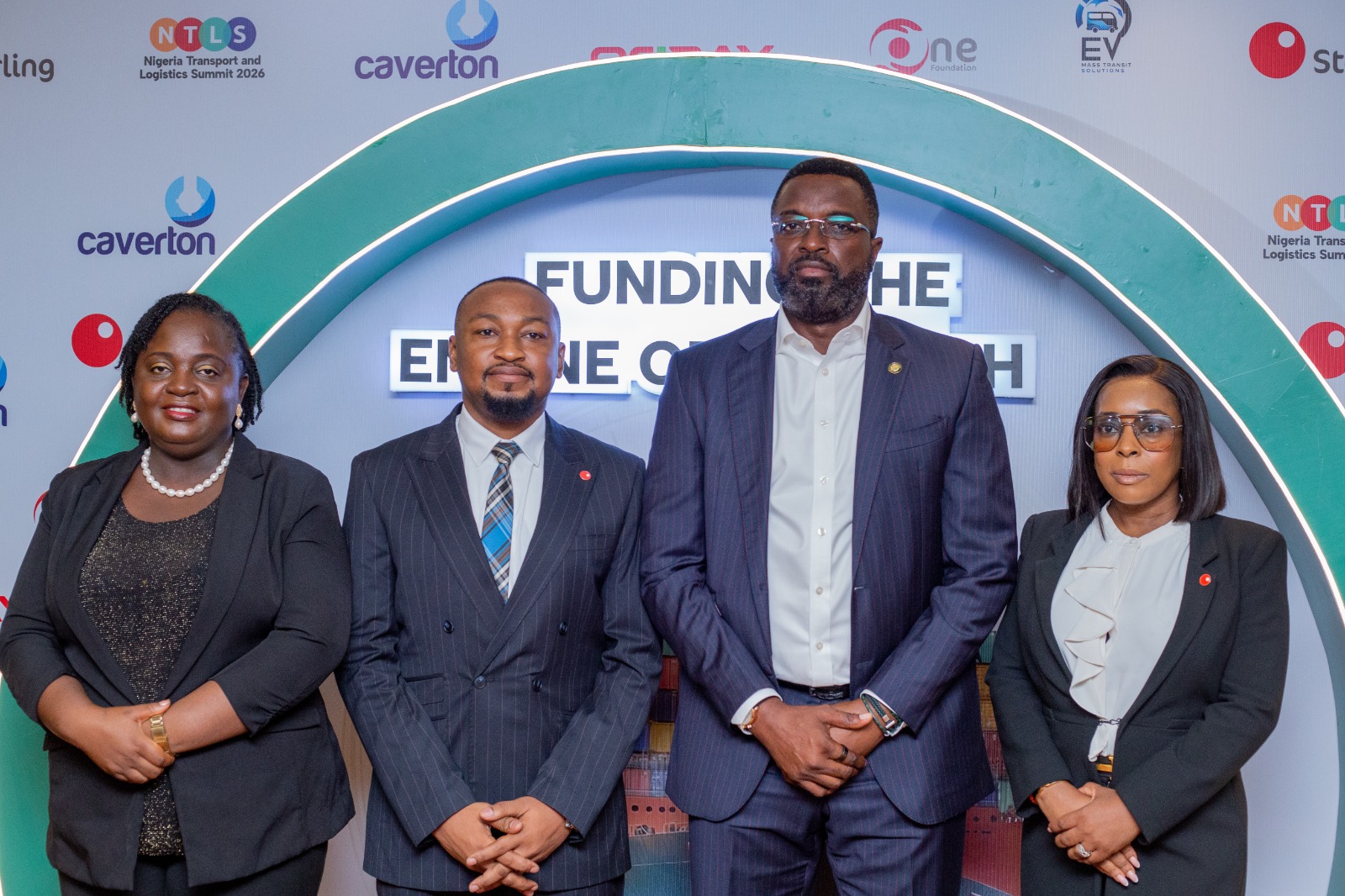
L-R Olapeju Ibekwe, CEO, Sterling One Foundation; Darlington Nwankwo, Divisional Head, Renewable Energy, Mobility and Tourism, Sterling Bank; Oluwaseun Osiyemi, Honorable Commissioner for Transportation, Lagos State: and Moyomade Akinyosoye, Divisional Head, Institutional Banking, Sterling Bank, at the recently concluded Nigeria Transport and Logistics Summit, hosted by Sterling Bank in Lagos recently.

He emphasized that while Nigeria’s transport and logistics challenges, ranging from port congestion to inefficient corridors and high operating costs, are well documented the real opportunity lies in effective execution.


“We must move beyond diagnosing the problem to building integrated, modern logistics systems that can power productivity at scale. This means fixing our ports, strengthening logistics corridors, improving road and rail connectivity, and embedding efficiency across the value chain.”


“Nigeria’s competitiveness, both regionally and globally will increasingly depend on how effectively we move goods, people, and services. The time for incremental change has passed; what is required now is bold, coordinated execution across public and private sectors,” Abubakar concluded.


Also speaking at the event, the Divisional Head, Renewable Energy, Mobility and Tourism at Sterling Bank, Mr. Darlington Nwankwo, described logistics as the backbone of trade, industry, and national competitiveness.


He noted that while the sector contributes just under four percent to Nigeria’s GDP, estimated at approximately ₦15trillion, its true economic impact is significantly larger when viewed as an enabler of productivity across agriculture, manufacturing, and trade.


“We must be deliberate about fixing the logistics backbone of the economy if we are to unlock the growth we need. Nigeria’s trade competitiveness is directly linked to the efficiency of its logistics corridors, from ports to inland distribution networks.”


“At Sterling, we see our role as connecting capital to execution, designing financing solutions that do not just fund infrastructure but unlock entire value chains. This includes supporting multimodal transport systems, enabling cleaner mobility solutions, and partnering with both government and private sector players to reduce investment risk. The opportunity before us is not just to fix what is broken, but to build a logistics ecosystem that is faster, more efficient, and globally competitive.”


Lagos State Commissioner for Transportation, Mr. Oluwaseun Osiyemi, echoed the call for bold ideas, strategic investments, and forward-looking policies, describing the summit as a vital platform to shape the future of movement, trade, and connectivity in Nigeria. He urged policymakers to move swiftly from planning to implementation, called on investors to support infrastructure and innovation, and encouraged industry leaders to champion efficiency, sustainability, and accountability.


In his keynote address, Professor Biodun Adedipe grounded these ambitions in hard realities, noting that with nearly 90 percent of Nigeria’s logistics dependent on road transport, the country faces mounting congestion and maintenance costs that demand diversification into rail and more durable infrastructure. He cautioned that economic transformation requires patience, with meaningful results unlikely to materialise in under 18 months.


Panel discussions throughout the day focused on reducing logistics costs, strengthening aviation and road integration, modernizing downstream energy distribution, and accelerating the adoption of cleaner and more sustainable mobility solutions.


The summit concluded with a call for sustained public-private collaboration, stronger regulatory coordination, and the creation of structured financing vehicles to de-risk infrastructure investments.


As Nigeria seeks to strengthen its regional trade position and unlock non-oil export growth, NTLS 2026 marks a decisive step toward building a more integrated, resilient, and globally competitive transport and logistics ecosystem.




News

Court Mandates Interim Forfeiture Of Nine Assets Associated With Timipre Sylva

Published

on

By

A Federal High Court in Abuja, presided over by Justice Obiora Egwuatu has ordered the interim forfeiture of nine properties linked to Timipre Sylva, the former Minister of State for Petroleum Resources, to the Federal Government.

The order follows an ex parte application by the Economic and Financial Crimes Commission (EFCC), which alleges the assets are proceeds of “unlawful activities”.

Justice Obiora Egwuatu made the order after the Economic and Financial Crimes Commission counsel, Oluwaleke Atolagbe, moved an ex parte motion to the effect.

The News Agency of Nigeria reports that though Justice Egwuatu delivered the ruling on April 24, the enrolled order was sighted on Wednesday, May 6.

The affected assets are located across high-value areas in Abuja.

They include four blocks of terraces at Dakibiyu; a duplex with penthouse and office complex at No. 3, Niger Street, MStreet; one standalone duplex at Villa 1, Unit 1, Palm Springs Estate, Mpape; and a block of flats with 10 units of flats at No. 8, Sefadu Street, Wuse Zone 4, Abuja.

Others are blocks of flats with six units of flats at No. 1, Mubi Close, Garki, Abuja; two blocks with 12 units of flats at Plot 1181, Thaba Tseka Crescent, Wuse II, Abuja; one standalone duplex at No. 18, Nile Lake, Plot 1271, Maitama, Abuja,

The ninth property is a two-block building, which is currently occupied by the National Information Technology Development Agency, and is located at No. 5, Aguta Street, Garki, Abuja.

The judge said: “It is hereby ordered as follows: An interim order of this honourable court is made forfeiting the properties listed in the schedule attached herein, being properties suspected to be proceeds of some unlawful activities pending the publication and hearing of the motion on notice for final forfeiture order of the said properties.

“An order of this honourable court is made directing the publication of the interim order under order (1) above for anyone who is interested in the property to appear before this honourable court to show cause within 14 days why the final order of forfeiture should not be made in favour of the Federal Government of Nigeria.”

Justice Egwuatu also granted the EFCC’s request that the publication of the order shall be made in any two of the following newspapers: Thisday, Guardian, PUNCH, Vanguard, Tribune or Independent Newspapers within seven days from the receipt of the certified true copy of the order.

The judge then adjourned the matter until May 25 for a report of compliance.

The commission had, in the suit marked: FHC/ABJ/CS/607/2026, filed the application under provisions of the Advance Fee Fraud and Other Related Offences Act, 2006.

Moving the motion, Atolagbe sought an interim order, forfeiting the properties to the Federal Government pending the publication and hearing of the motion on notice for a final forfeiture order of the said properties.

He said the properties were suspected to be proceeds of some unlawful activities.

The lawyer urged the court to direct the anti-graft agency to make the publication of the order in any national newspaper for anyone who is interested in the properties to show cause within 14 days why the final order of forfeiture should not be made in favour of the Federal Government.

The PUNCH reports that Sylva, a former governor of Bayelsa State, has also been mentioned in connection with an alleged failed coup plot against President Bola Tinubu, though he has not been formally charged in that case and is reportedly still at large.

Nathaniel Shaibu is a correspondent at The PUNCH with three years of professional journalism experience. He covers the Federal Capital Territory (FCT), civil society, religion, and the Ministries of Women Affairs and Youth Development. In addition to his primary beats, Nathaniel also reports on politics, metro, security, and judicial matters, bringing clarity and balance to a wide range of public-interest stories. His work reflects hands-on newsroom experience, strong beat knowledge, and a commitment to accurate, responsible journalism.


Continue Reading

News

BANKING BEYOND THE BALANCE SHEET: UNION BANK’S ASBON RECOGNITION AND NIGERIA’S SMALL BUSINESS ECONOMY

Published

on

By

Union Bank of Nigeria has been named winner of the Best SME Growth Banking Initiatives Award (2025) at the Nigeria National SME Business Awards, organised by the Association of Small Business Owners of Nigeria (ASBON) in partnership with the Lagos State Government through the Ministry of Commerce, Cooperatives, Trade and Investment.


The recognition arrives at a moment when the relationship between Nigerian banks and Nigerian small businesses is being quietly redefined. Awards in this space have historically rewarded scale and product breadth. The ASBON criteria, by contrast, ask a more practical question: which banks are actually making it easier for entrepreneurs to operate?


WHY THIS AWARD, AND WHY NOW?

Across Nigeria, growth is no longer the only measure of success for a small or medium-sized enterprise. For most owners, success now looks like stability. Cashflow that holds up. Payments that clear without disruption. Financing that arrives in time to seize an opportunity rather than rescue a crisis. Operations that are not slowed by administrative friction.


That shift in what SMEs need has changed what they look for in a bank. The institutions earning their attention are the ones that take the daily reality of running a business in Nigeria seriously, not those with the longest catalogue of products. It is in that environment that the ASBON recognition reads as something more than ceremonial.

Union Bank’s SME work over the past year has been organised around a small number of practical priorities, and many of the issues SMEs cite as their biggest pain points sit at the centre of them.


FASTER ONBOARDING, MORE USABLE DIGITAL TOOLS

Account opening and customer onboarding have long been one of the slowest stages of business banking in Nigeria. For an entrepreneur trying to receive payments, pay suppliers, or qualify for a tender, days lost at this stage are days lost from the business itself.


Union Bank addressed this directly with enhancements to its Union360 platform and the rollout of a Straight-Through-Processing (STP) Digital Onboarding Platform. The intent was simple: cut the time between an SME deciding to bank with Union Bank and actually being able to transact. The improvements have meaningfully shortened onboarding, raised digital activity among SME customers, and brought in a notable cohort of new business clients.


Behind those improvements is a recognition that Nigerian SMEs are increasingly multi-channel by default. A small retailer may take payments by transfer, POS, mobile money, and online checkout in the course of a single afternoon. The bank that supports them has to be reliable across all of those rails, not just the ones that photograph well in product brochures.


FINANCING THAT MEETS BUSINESSES WHERE THEY ARE

Access to credit remains the most frequently cited barrier for Nigerian SMEs, particularly for businesses without conventional collateral or a long paper trail of audited accounts.

Union Bank’s response has been less about loosening criteria and more about widening the range of evidence that counts.


Consistent transaction history, active account use, and clear cashflow patterns now carry meaningful weight in how the Bank assesses a small business. For a generation of entrepreneurs whose operations are real but whose paperwork is light, that is a material change.


The Bank’s SME lending over the review period reflected this orientation, with funding directed at working capital, inventory, equipment, and the kind of operational expansion that sits between mere survival and genuine scale.


THE HUMAN SIDE OF THE WORK

Digital infrastructure matters, but it does not replace the value of someone an entrepreneur can actually call.

Union Bank’s SME engagement is supported by a network of relationship managers, direct sales agents, and branches across the country. The Bank’s “Adopt, Engage and Grow” campaign was designed to reach SMEs at this human level, not as a once-a-year touchpoint, but as a sustained relationship that meets businesses where they are, both physically and operationally.

The approach reflects a basic truth about small business banking in Nigeria.


Entrepreneurs operate under pressure that is rarely visible from a head office. The institutions they trust tend to be the ones whose people understand that pressure, respond when it matters, and treat the relationship as ongoing rather than transactional.


UNION BANK OF NIGERIA AND ASBON

Union Bank’s recognition is also tied to its partnership with ASBON, through the SME Empowerment Challenge run jointly by the two organisations.


The Challenge encouraged entrepreneurs to open or reactivate business accounts, maintain proper transaction records, and develop structured plans for growth. On its surface, it was a campaign. In substance, it was an attempt to nudge a behaviour that Nigerian SMEs themselves often identify as one of the hardest to sustain: the discipline of running the business as a business, with clean books, separated finances, and a clear view of where it is going.


That discipline matters because it is the gateway to almost everything else. Loans, grants, supplier credit, partnerships, and public sector contracts all depend on a business being able to show how it actually operates. By building that habit alongside ASBON, Union Bank invested in something that outlasts any single campaign cycle.


WHAT THE AWARD ACTUALLY SIGNALS

There is a tendency to read awards as endpoints. This one reads better as a signpost. Nigerian SMEs are operating in one of the most demanding business environments on the continent. They are also, collectively, the largest source of employment in the country and the most direct route to broad-based prosperity. The banks that serve them well, with patient infrastructure, accessible financing, real human engagement, and a partnership posture toward the wider SME ecosystem, have a role to play that goes well beyond commercial performance.


Union Bank’s recognition at the ASBON SME Awards 2025 is, in that sense, an acknowledgement of a posture as much as a portfolio. The work it points to, faster systems, more accessible credit, sustained engagement, and a habit of building alongside SME institutions rather than around them, is the kind of work that compounds quietly over years.

For a bank, that is the most useful kind of award to win. Not the one that celebrates a moment, but the one that confirms a direction.

Continue Reading

News

Polaris Bank Supports the Launch of NACCIMA Call Center to Drive Growth for Nigerian Exporters  

Published

on

By

Polaris Bank, Nigeria’s leading digital retail and commercial bank, has proudly facilitated the launch of the NACCIMA Export Support Call Center, a vital initiative designed to provide comprehensive support to Nigerian exporters, especially those operating in the non-oil sector and enhance their ability to access global markets.


This partnership marks a significant step in the Bank’s commitment to strengthening Nigeria’s export ecosystem.


Chris Ofikulu, Executive Director of Polaris Bank, in his address, emphasised the Bank’s commitment to empowering Nigerian businesses for global markets. He highlighted the importance of the NACCIMA Call Center as a key resource for exporters, offering valuable information, knowledge, expert guidance, and advisory services to navigate the complexities of international trade.


“Today, we are marking a pivotal moment in our mission to empower Nigerian businesses for global markets,” said Chris Ofikulu. “Through this collaboration, we are equipping exporters with the tools, infrastructure, and expertise needed to thrive in global markets.”


The NACCIMA Call Center, supported by Polaris Bank, will act as a key platform where exporters can access real-time information, technical assistance, and regulatory advisory services. This strategic initiative is in alignment with Polaris Bank’s vision to drive trade facilitation, improve market access, and support Nigeria’s economic growth.


Polaris Bank’s contribution includes providing advanced infrastructure such as laptops, a fully equipped workstation, internet-enabled modems, and high-capacity printers to support the operations of the center. This donation is aimed at ensuring the center runs smoothly and effectively meets the needs of Nigerian exporters.


During his speech, Ofikulu highlighted the importance of initiatives like the NACCIMA Call Center, emphasizing its role in bridging gaps for exporters, especially those in the non-oil export sector. “By offering exporters the right support, we are unlocking their potential to compete globally. This center is not just a call center; it is a catalyst for success, providing exporters with the resources, knowledge, and access they need to excel,” he added.


The partnership between Polaris Bank and NACCIMA also ties into the Bank’s broader mission to support Nigeria’s export sector. Polaris Bank provides a comprehensive range of solutions for exporters, including stock refinancing, working capital support, and advisory services on regulatory processes such as NXP documentation. Through its digital platform, VULTe, the Bank facilitates seamless intra-African trade, enabling faster and more efficient payments via the Pan-African Payment and Settlement System (PAPSS).


“We are excited to be part of this transformative initiative, which empowers Nigerian businesses to scale and compete on the global stage,” Ofikulu concluded. “Our focus on innovation and our dedication to supporting SMEs are central to our role in shaping the future of Nigeria’s export sector.”


Polaris Bank’s collaboration with NACCIMA reinforces its ongoing commitment to advancing Nigeria’s economic landscape by enhancing export readiness, improving access to finance, and supporting the growth of SMEs. The unveiling of the NACCIMA Call Center is a prime example of the Bank’s continuous dedication to driving positive change within Nigeria’s export ecosystem.

Continue Reading

Trending