
Connect with us

News

Nigeria, UK Forge Stronger Security, Economic Bonds At Windsor

Published

on

President Bola Tinubu has reaffirmed Nigeria’s commitment to strengthening bilateral relations with the United Kingdom, with emphasis on security cooperation, economic growth, and shared democratic values between both nations.

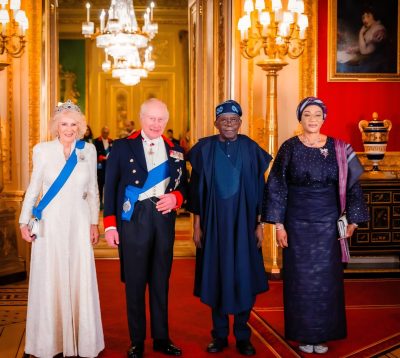
Tinubu stated this on Wednesday night at a State Banquet hosted in his honour by King Charles III at Windsor Castle, as part of his ongoing state visit.

The president described the engagement as a historic moment, noting that it reaffirmed enduring ties rooted in shared history, mutual respect, and a collective vision for progress and global stability.

“It is a profound honour to stand before you today, representing the people of Nigeria as we reaffirm the enduring bonds of friendship, history, and shared purpose.”

He noted that Nigeria and the UK share common democratic ideals, adding that both countries must continue to work together to advance peace, prosperity, and institutional development.

Tinubu highlighted the importance of the rule of law, tracing its roots to foundational legal traditions such as the Magna Carta, which continue to influence modern democratic governance globally.

He said Nigeria’s legal and institutional frameworks have drawn significantly from British traditions, including parliamentary practices, civil service structures, and judicial systems adapted to national realities.

The president emphasised that beyond institutions, people-to-people connections remain the strongest link between both countries, citing the contributions of Nigerians in the United Kingdom across critical sectors.

According to him, Nigerians in the UK have continued to make remarkable impact in healthcare, business, academia, sports, and public service, strengthening bilateral relations through human capital and cultural exchange.

He stressed that Nigeria remains committed to playing a leading role within the Commonwealth, leveraging the platform to advance cooperation, trade, and collective development among member states.

Tinubu also underscored the importance of enhanced security collaboration, noting that Nigeria faces complex terrorism challenges in the West African sub-region, particularly linked to instability in the Sahel.

“In confronting these threats, partnership with the United Kingdom remains essential.

“Our partnership remains essential as we confront threats to regional stability and safeguard peace in West Africa,” he said, expressing optimism ahead of his meeting with Prime Minister Keir Starmer.

The president expressed confidence in Nigeria’s future, describing the country as a nation of resilient, innovative, and youthful population determined to realise its full economic and social potential.

He also expressed gratitude to the UK for its historical support to Nigeria during the pro-democracy struggle, recalling his personal experience during the period of military rule.

Tinubu reaffirming Nigeria’s commitment to deepening ties with the UK, expressing optimism that both countries would continue to build a stronger and mutually beneficial partnership.

In his remarks, King Charles III described Nigeria as an economic powerhouse and cultural force with growing global influence.

He noted that Nigerians in the UK have made remarkable contributions across sectors including business, healthcare, education, law, technology and the arts.

“We are blessed that so many people of Nigerian heritage are now at the heart of British life,” the monarch said.

The King highlighted deepening economic ties, noting increasing trade, investment flows and partnerships between institutions and businesses in both countries.

He also acknowledged historical complexities in the relationship between both nations, while emphasising the importance of building a future anchored on trust, cooperation and shared values.

The monarch commended Nigeria’s role in promoting interfaith harmony and regional stability, noting that the country’s experience offers lessons for peaceful coexistence globally.

The banquet which was attended by First Lady Oluremi Tinubu, Queen Camilla and top government officials concluded with a toast to the enduring friendship between both countries and a shared commitment to building a prosperous future together.


(NAN)(www.nannews.ng)

News

FORCE LEADERSHIP ORDERS DISMISSAL, PROSECUTION OF OFFICERS INVOLVED IN EFFURUN SHOOTING

Published

on

By

The Nigeria Police Force hereby provides an update on the disciplinary actions taken following the fatal shooting incident of 26th April 2026 in Effurun, Delta State, which resulted in the death of Mr Mene Ogidi.


Sequel to the earlier directive of the Inspector-General of Police, IGP Olatunji Rilwan Disu, psc(+), NPM, all officers connected to the incident were immediately withdrawn from the Delta State Command and transferred to Force Headquarters, Abuja, where they were subjected to expedited disciplinary proceedings.


The Force Disciplinary Committee (FDC), alongside other internal disciplinary processes, has concluded its review. Findings established unequivocally that the principal officer, ASP Nuhu Usman, acted in gross violation of Force Order 237 and other extant regulations governing the use of firearms. His actions were unlawful, unprofessional, and a clear betrayal of the oath to protect life and uphold the law.


Consequently, the FDC has recommended the immediate dismissal of ASP Nuhu Usman and other officers found culpable. The Inspector-General of Police has approved the recommendations and forwarded same to the Police Service Commission for ratification in line with due process.


Upon completion of the administrative procedures, the affected officers will be handed over to the appropriate judicial authorities for prosecution for their roles in the extrajudicial shooting.


The Inspector-General of Police reiterates, in the strongest terms, that the Nigeria Police Force maintains a zero-tolerance stance on extra-judicial actions and abuse of power. No uniform confers the right to take life outside the provisions of the law. Any officer who violates this fundamental principle will face the full weight of disciplinary and legal consequences.


The IGP extends his deepest and most solemn condolences to the family of the deceased, Mr Mene Ogidi. He acknowledges the pain and loss suffered and assures the family that this tragic incident will not be treated lightly. The Force is fully committed to ensuring that justice is not only served but seen to be served, in a manner that reinforces public confidence and institutional accountability.


Members of the public are urged to remain calm and law-abiding, as the Nigeria Police Force remains steadfast in its commitment to discipline, professionalism, and the protection of the rights and dignity of all citizens while ensuring accountability at all levels.


DCP ANTHONY OKON PLACID, psc(+), mni

Force Public Relations Officer

Force Headquarters, Abuja

29th April 2026

Continue Reading

News

Lagos 2027: Samuel Ajose Defies APC Consensus, Buys ₦50m Nomination Form

Published

on

By

All Progressives Congress (APC) governorship aspirant Samuel Ajose has officially purchased the party’s ₦50 million expression of interest and nomination forms for the 2027 Lagos State governorship election.

The Badagry-born philanthropist picked the forms personally in Abuja hours after the Governance Advisory Council (GAC), the apex leadership body of APC in Lagos; Lagos State Governor, Babajide Sanwo-Olu, and other chieftains of the Lagos APC endorsed the Deputy governor, Dr Obafemi Hamzat, as their preferred aspirant for the party’s ticket.

Ajose explained that his resolve remains rooted in service, anchored in a clear vision, and driven by one conviction that Lagos deserves development.

In a statement on his verified X handle formerly Twitter, Ajose said: “I have officially picked up my nomination and expression of interest forms, taking a definitive step forward in my aspiration to serve as Governor of Lagos State on the platform of our great party, the APC.

“This moment is bigger than a political process. It is a personal commitment to purposeful leadership, inclusive governance, and the kind of progress that every Lagosian can feel and point to.

“My resolve is rooted in service, anchored in a clear vision, and driven by one conviction; that Lagos deserves development which reaches every community, creates real opportunities for its people, and leaves no one behind.

“I begin this journey with humility, courage, and complete faith in God and in the good people of Lagos. Together, we are building something this state will be proud of.”


Continue Reading

News

Major Blow For ADC Faction As Court Restrains INEC Over State Congresses

Published

on

By

A Federal High Court in Abuja, presided over by Justice Joyce Abdulmalik, has restrained the Independent National Electoral Commission (INEC) from recognising or participating in any state congresses organized by the caretaker leadership of the African Democratic Congress (ADC).

The court, in a judgment delivered by Justice Joyce Abdulmalik, also barred former Senate President, David Mark, and other prominent figures in the party from interfering with the functions and tenure of elected state executives.

The ruling is the latest development in the festering leadership dispute within the ADC, with clear implications for the control of party structures ahead of future political activities.

The case arose from an originating summons filed by Norman Obinna and six others on behalf of state chairpersons and executive committees of the party.

The plaintiffs challenged the legality of actions taken by a caretaker or interim national leadership, particularly the move to organise state congresses through an appointed committee.

They argued that the caretaker body lacked constitutional authority to organise such congresses or to appoint any committee for that purpose.

According to them, only duly elected party organs recognised under the party’s constitution possess the power to conduct congresses.

The plaintiffs, therefore, asked the court to affirm the tenure of the state executive committees and restrain any parallel processes that could undermine their authority.

In resolving the dispute, Justice Abdulmalik held that the claims brought before the court were valid and deserving of judicial consideration, especially in view of alleged breaches of constitutional and statutory provisions.

She stated that she found “the issue in the originating summons meritorious”.

The judge framed the central issue as whether the second to sixth defendants, including Mark, had the constitutional or statutory authority to assume the powers of elected state organs of the ADC, whose tenure is guaranteed under the party’s constitution.

She relied on section 223 of the 1999 Constitution, which mandates political parties to conduct periodic elections based on democratic principles, as well as Article 23 of the ADC Constitution, which provides that national and state officers shall hold office for a maximum of two terms spanning eight years.

According to her, “the question is whether there is any infraction committed by Mr Mark and co-defendants when they convened meetings and appointed a body known as a congress committee to organise state congresses.”

On the defence raised by the defendants that the matter was an internal affair of a political party and therefore outside the jurisdiction of the court, the judge acknowledged the settled legal position but clarified its limits.

She held that while courts are generally reluctant to interfere in internal party matters, they will intervene where there is a clear allegation of violation of constitutional or statutory provisions.

“The law is settled that courts will not interfere. However, where there is an allegation of breach of constitutional or statutory provisions, the court has a duty to intervene,” she ruled.

“Where a party alleges that its constitution has been violated, the court is bound to adjudicate. Any argument that this court lacks jurisdiction on that basis fails,” she added.

Justice Abdulmalik stressed that political parties must operate strictly within the confines of their constitutions, noting that any deviation from prescribed procedures, particularly in leadership matters, cannot be justified under the guise of internal autonomy.

She found that the procedure adopted by the defendants, including the appointment of a “congress committee,” was not recognised by the ADC constitution and therefore invalid.

Consequently, the court held that the tenure of the state executive committees remains valid and must be allowed to run its full course without interference.

The judge further ruled that only those elected structures have the authority to organise state congresses, effectively nullifying any process initiated by the caretaker leadership.

In a set of far-reaching orders, the court set aside the appointment of the congress committee and restrained INEC from recognising any congress organised by it.

The court also restrained Mark and the other defendants from organising congresses or conventions outside the provisions of the party’s constitution.

Additionally, they were barred from taking any steps capable of undermining or disrupting the authority of the state executive committees.

The PUNCH reports that the plaintiffs, led by Obinna, instituted the suit in a representative capacity on behalf of ADC state chairmen and executive committees across the country.

The defendants in the matter include the ADC, David Mark, Patricia Akwashiki, Malam Bolaji Abdullahi, Ogbeni Rauf Aregbesola, Oserheimen Osunbor, and INEC.

In their submissions, the plaintiffs challenged the legality of caretaker or interim national working committees and urged the court to restrain INEC from recognising or participating in any congress conducted under such arrangements.

They maintained that under both the ADC constitution and the 1999 Constitution (as amended), the tenure of state executive committees subsists until valid congresses are conducted in accordance with laid-down procedures.

They further argued that any attempt to bypass the elected structures undermines internal party democracy and erodes the rule of law within the party.

However, the defendants opposed the suit through preliminary objections, counter-affidavits and written addresses.

Mark and the other defendants contended that the dispute related strictly to the internal affairs of the party and was therefore not justiciable.

They also argued that the plaintiffs lacked locus standi to institute the action and that the suit was incompetent.

They further submitted that the plaintiffs failed to exhaust internal dispute resolution mechanisms before approaching the court.


Continue Reading

Trending