
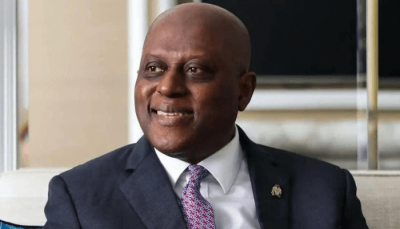
Central Bank of Nigeria (CBN) Governor Olayemi Cardoso recently announced that Nigeria’s net foreign reserves surged by approximately 772% over a two-year period, rising from $3.99 billion at the end of 2023 to $34.80 billion by the end of 2025.
Foreign reserves refer to the savings a country keeps in foreign currencies such as the US dollar to help it pay for imports, meet international financial obligations, and stabilise its currency during economic pressure.
Cardoso said the strong increase shows that Nigeria now has a larger financial buffer to support the economy when needed.
He also explained that the net reserves recorded at the end of 2025 were even higher than the total gross reserves Nigeria had at the end of 2023.
At the end of 2023, Nigeria’s gross foreign reserves stood at $33.22 billion.
The CBN governor had earlier announced during the press briefing after the Monetary Policy Committee meeting on February 24, 2026, that Nigeria’s gross external reserves had reached $50.45 billion as of February 16, 2026.
In a statement issued in Abuja, Cardoso said the increase in reserves reflects improvements in the country’s economic fundamentals and the impact of reforms introduced by the central bank.
“Nigeria’s gross and net foreign reserves showed significant improvement at the end of 2025, reflecting stronger external sector fundamentals and sustained policy reforms,” Cardoso said.
He explained that the growth in reserves was supported by efforts to make the management of Nigeria’s foreign exchange more transparent and credible.
According to him, when investors see that the foreign exchange system is transparent and properly managed, they are more willing to bring their money into the country.
Cardoso said the reforms have helped boost investor confidence and attract more foreign exchange inflows into Nigeria.
“These figures emphasise the benefits of increased transparency and credibility in foreign exchange management, boosting investor confidence, attracting stronger foreign exchange inflows and improving reserve management practices aimed at preserving capital, ensuring liquidity and supporting long-term sustainability,” he said.
He added that the increase in reserves means Nigeria now has more financial strength to handle international payments and economic shocks.
The CBN governor also explained year-by-year how the reserves improved.
According to him, Nigeria’s net foreign reserves rose from $23.11 billion at the end of 2024 to $34.80 billion by the end of 2025.
Gross reserves also increased within the same period, rising from $40.19 billion in 2024 to $45.71 billion at the end of 2025.
This represents an increase of $5.52 billion in gross reserves within one year.
Cardoso said the stronger reserves will help Nigeria meet its obligations to other countries and international financial institutions.
He also said the improved reserve position gives the country more ability to support stability in the foreign exchange market.
According to him, when a country has stronger foreign reserves, it is better able to manage pressure on its currency and maintain confidence in the economy.
Cardoso described the reserve level recorded at the end of 2025 as evidence that the central bank’s policy reforms are producing results.
He said the reforms are designed to strengthen Nigeria’s economy and ensure that the country can better manage its foreign exchange resources.
The CBN governor assured that the central bank will continue to focus on maintaining strong reserves to support the economy.