
News
Technology Crucial To Success Of New Tax Laws — NRS chair, Adedeji

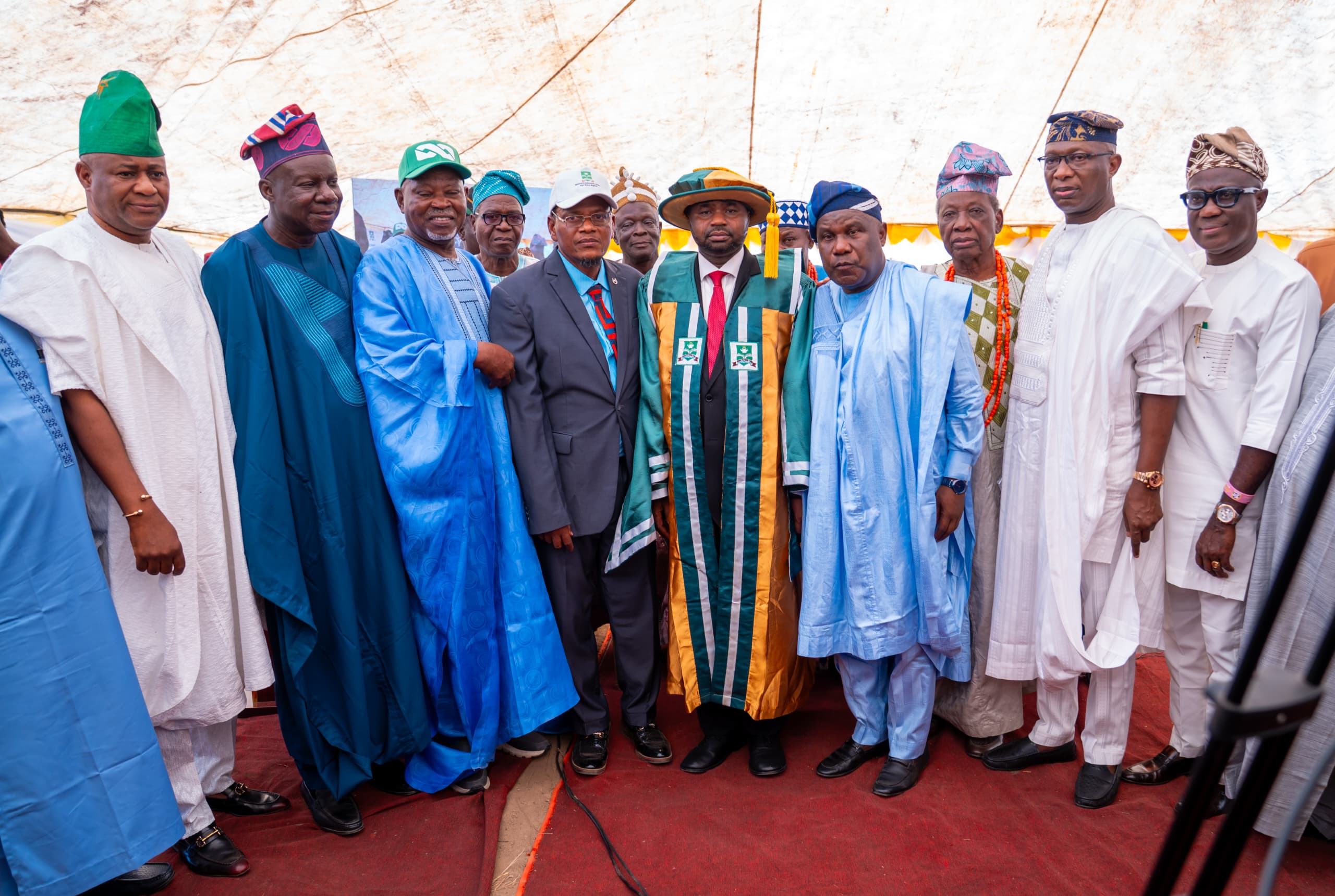
The Executive Chairman of the Nigerian Revenue Service (NRS), Zacch Adedeji, has described technology as a crucial factor in the implementation of the new tax laws in the country.
Adedeji stated this on Wednesday while delivering the maiden convocation lecture of the Federal Polytechnic, Ayede, Ogo-Oluwa Local Government Area of Oyo State.
In a statement by his Technical Assistant on Print Media, Sikiru Akinola, Adedeji listed some of the most fundamental challenges confronting taxation to include infrastructure, skills, trust and resistance.
In the lecture entitled ‘The Role of Technology in Implementing Nigeria’s New Tax Laws: Challenges, Prospects, and Implications for National Development,’ the NRS chairman said each of these challenges would be addressed with the imminent upgrading of the country’s tax system for a digital environment.
“Nigeria has recently enacted a new set of tax laws, representing the most significant restructuring of our nation’s fiscal legislation in 50 years. While public conversation often frames these changes as legal reforms, and that is true, it is also an incomplete picture.
“These laws are not merely changing rates, definitions, or administrative powers. They are quietly redefining how authority operates within the tax system. This is a complete structural overhaul, signaling the end of tax collection as a manual task and the beginning of tax intelligence.
“If you read the new laws carefully, you will notice a subtle but profound assumption woven throughout their fabric. They presuppose the existence of reliable taxpayer identification, integrated data across institutions, traceable transactions, automated processes, and scalable enforcement.
“In other words, these laws are built for a digital environment. They cannot function properly in a manual, fragmented, paper-based system. The implication is clear: without technology, the laws remain aspirational. With technology, they become operational.
“This transition is central to the mandate of the Nigeria Revenue Service as we implement this new legal framework. Historically, tax administration relied heavily on human discretion over who is registered, who is assessed, who is audited, and who is penalized.
“While discretion is not inherently evil, excessive discretion creates inconsistency, which in turn breeds mistrust and drives non-compliance,” Adedeji said.
Speaking further, he noted that when infrastructure improves, capacity grows, trust is protected, and resistance is managed just as technology begins to do what policy alone cannot.
“One of the most important prospects of a technology-driven tax administration is the ability to expand the tax base without increasing tax rates. This matters deeply in a society where citizens already feel overburdened.
“By improving visibility and bringing previously unseen economic activity into view, technology levels the playing field. When compliance broadens, the pressure on the existing base reduces,
fairness improves, and legitimacy grows. This is how modern tax systems grow revenue sustainably,’ he added.
In his remark, the Speaker of the House of Representatives, Tajudeen Abass, encouraged the graduating students to be good ambassadors of the institution.
Represented by AbdulFatai Buhari, senator representing Oyo North, Abass charged them not to relent in their bid to acquire more knowledge.
He also commended the tax boss for leading the change in tax administration in the country.
The institution’s governing council chair, Yakubu Datti commended Adedeji for leading the re-engineering of Nigeria’s tax architecture.
The Rector of the institution, Dr. Taofeek Adekunle Abdul-Hameed, charged the graduating students to emulate Adedeji who, he said, began his journey from a polytechnic.




Oceangate Engineering Oil & Gas Limited has said it will appeal to the recent ruling of the Federal High Court ordering the forfeiture of certain assets.
Barr. Nnenna Onyeaso, the Company Secretary said in a statement on Thursday insisting that neither the company nor its leadership was found guilty of any wrongdoing.
Onyeaso said that the firm has described the court’s decision as a civil asset forfeiture order based on suspicion rather than proof, stressing that the judgment did not establish any criminal liability against the organisation.
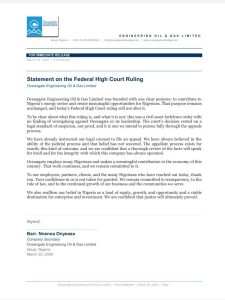
According to her, the company maintain that it has already directed its legal team to file an appeal, expressing confidence in the judicial process and the outcome of a thorough review of the case.
“To be clear, this ruling is a civil asset forfeiture order with no finding of wrongdoing against Oceangate or its leadership.
“The court’s decision rested on a legal standard of suspicion, not proof, and it is one we intend to pursue fully through the appeals process,” she said in a statement.
The firm secretary also said that Oceangate has reiterated its belief in the rule of law, noting that the appellate system exists to address such outcomes.
She added that the company remained confident that the facts of the case will ultimately affirm its integrity and business practices.
Onyeaso said that the firm also emphasised that its operations remained unaffected, stating that it continues to provide employment for many Nigerians while contributing to the country’s energy sector and broader economy.
“We have always believed in the ability of the judicial process, and that belief has not wavered,” she added.
She noted that Oceangate further expressed appreciation to its employees, partners, and clients for their continued support amid the development, assuring stakeholders of its commitment to transparency and accountability.
The Secretary said that the company reaffirmed its confidence in Nigeria as a viable destination for investment, describing the country as a land of equity, growth, and opportunity.
“We remain committed to the continued growth of our business and the communities we serve as we are optimistic that justice will prevail at the end of the legal process.
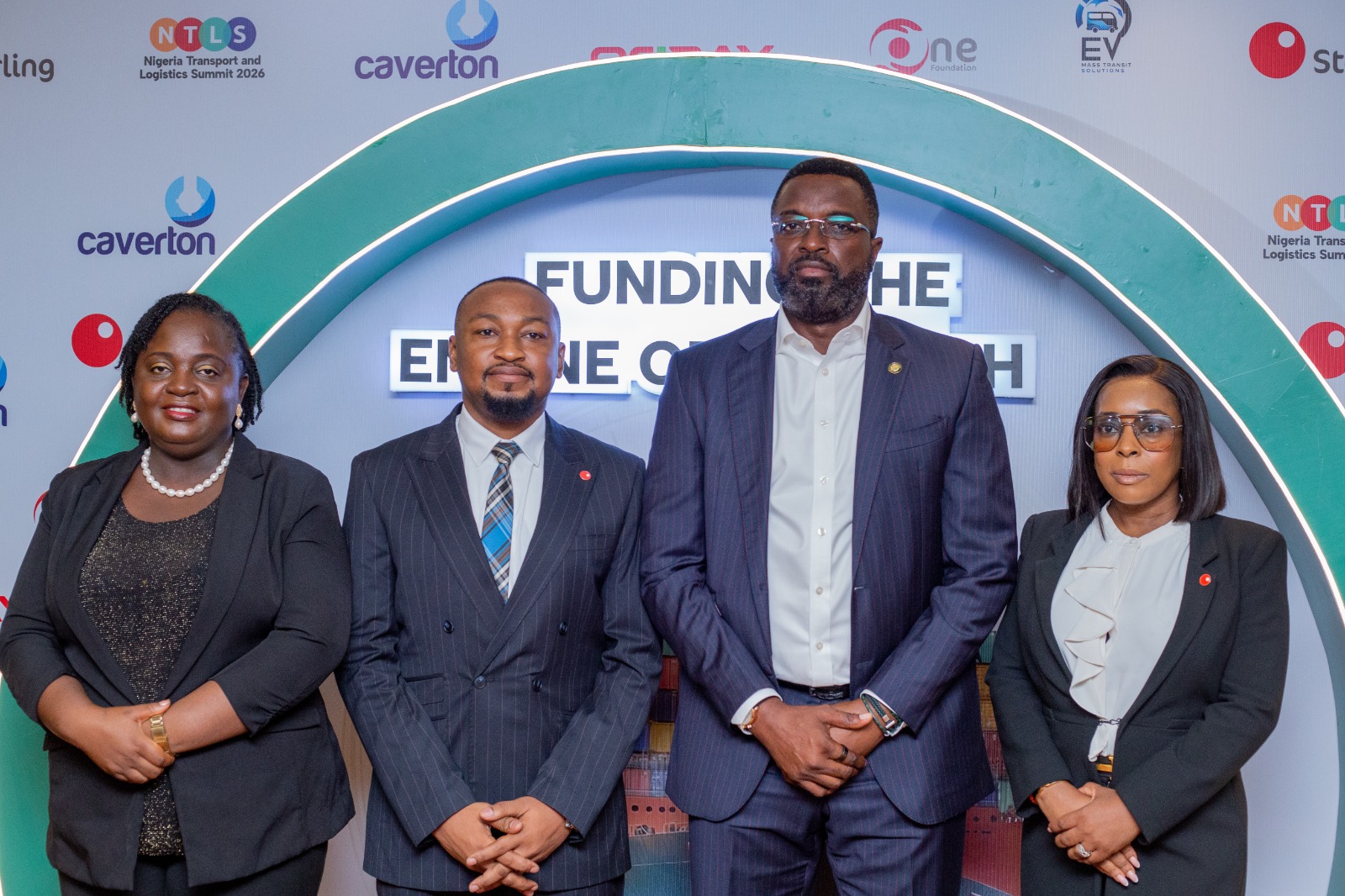
Industry leaders, policymakers, financiers, and innovators convened in Lagos today for the inaugural Nigeria Transport & Logistics Summit (NTLS) 2026, hosted by Sterling Bank at Eko Hotel & Suites, to forge actionable strategies for building a faster, more connected Nigeria through transport, mobility, and logistics.
Held under the theme “Funding the Engine of Growth,” the summit positioned Nigeria’s transport and logistics sector as a critical but under-leveraged driver of productivity, regional integration, and economic growth. Transport, mobility, and logistics collectively form the backbone of the Nigerian economy, yet chronic underinvestment, infrastructure deficits, and limited access to financing have long constrained its potential.
Transport, mobility, and logistics collectively form the backbone of Nigeria’s economy. While the logistics sub-sector alone contributes approximately ₦1 trillion to national GDP, experts estimate that the broader transport and logistics market exceeds ₦15 trillion in potential value. Yet persistent infrastructure gaps, inefficiencies, financing constraints, and policy fragmentation continue to limit the sector’s full impact.
NTLS 2026 brought together senior government officials, regulators, infrastructure operators, investors, development partners, and private sector leaders to address critical priorities including multimodal connectivity, airport and road modernization, energy-efficient mobility, digital trade facilitation, and innovative financing frameworks.
Speaking at the summit, Sterling Bank’s Managing Director and CEO, Mr. Abubakar Suleiman, represented by Sterling One Foundation CEO, Mrs. Olapeju Ibekwe, called for urgent, coordinated action to fix the systems that move Nigeria’s economy forward.

L-R Olapeju Ibekwe, CEO, Sterling One Foundation; Darlington Nwankwo, Divisional Head, Renewable Energy, Mobility and Tourism, Sterling Bank; Oluwaseun Osiyemi, Honorable Commissioner for Transportation, Lagos State: and Moyomade Akinyosoye, Divisional Head, Institutional Banking, Sterling Bank, at the recently concluded Nigeria Transport and Logistics Summit, hosted by Sterling Bank in Lagos recently.
He emphasized that while Nigeria’s transport and logistics challenges, ranging from port congestion to inefficient corridors and high operating costs, are well documented the real opportunity lies in effective execution.
“We must move beyond diagnosing the problem to building integrated, modern logistics systems that can power productivity at scale. This means fixing our ports, strengthening logistics corridors, improving road and rail connectivity, and embedding efficiency across the value chain.”
“Nigeria’s competitiveness, both regionally and globally will increasingly depend on how effectively we move goods, people, and services. The time for incremental change has passed; what is required now is bold, coordinated execution across public and private sectors,” Abubakar concluded.
Also speaking at the event, the Divisional Head, Renewable Energy, Mobility and Tourism at Sterling Bank, Mr. Darlington Nwankwo, described logistics as the backbone of trade, industry, and national competitiveness.
He noted that while the sector contributes just under four percent to Nigeria’s GDP, estimated at approximately ₦15trillion, its true economic impact is significantly larger when viewed as an enabler of productivity across agriculture, manufacturing, and trade.
“We must be deliberate about fixing the logistics backbone of the economy if we are to unlock the growth we need. Nigeria’s trade competitiveness is directly linked to the efficiency of its logistics corridors, from ports to inland distribution networks.”
“At Sterling, we see our role as connecting capital to execution, designing financing solutions that do not just fund infrastructure but unlock entire value chains. This includes supporting multimodal transport systems, enabling cleaner mobility solutions, and partnering with both government and private sector players to reduce investment risk. The opportunity before us is not just to fix what is broken, but to build a logistics ecosystem that is faster, more efficient, and globally competitive.”
Lagos State Commissioner for Transportation, Mr. Oluwaseun Osiyemi, echoed the call for bold ideas, strategic investments, and forward-looking policies, describing the summit as a vital platform to shape the future of movement, trade, and connectivity in Nigeria. He urged policymakers to move swiftly from planning to implementation, called on investors to support infrastructure and innovation, and encouraged industry leaders to champion efficiency, sustainability, and accountability.
In his keynote address, Professor Biodun Adedipe grounded these ambitions in hard realities, noting that with nearly 90 percent of Nigeria’s logistics dependent on road transport, the country faces mounting congestion and maintenance costs that demand diversification into rail and more durable infrastructure. He cautioned that economic transformation requires patience, with meaningful results unlikely to materialise in under 18 months.
Panel discussions throughout the day focused on reducing logistics costs, strengthening aviation and road integration, modernizing downstream energy distribution, and accelerating the adoption of cleaner and more sustainable mobility solutions.
The summit concluded with a call for sustained public-private collaboration, stronger regulatory coordination, and the creation of structured financing vehicles to de-risk infrastructure investments.
As Nigeria seeks to strengthen its regional trade position and unlock non-oil export growth, NTLS 2026 marks a decisive step toward building a more integrated, resilient, and globally competitive transport and logistics ecosystem.
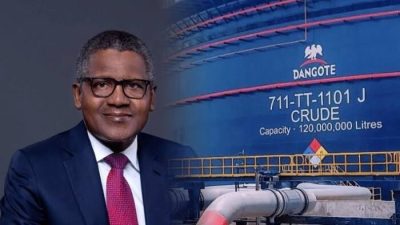
Dangote Petroleum Refinery and Petrochemicals has cut its gantry price for Premium Motor Spirit (PMS) to N1,200 per litre, setting the coastal price at N1,153 per litre.
The move is expected to influence fuel supply costs across Nigeria’s downstream distribution network.
Anthony Chiejina, spokesperson for the Dangote Group, said the revision reflects a downward adjustment in the refinery’s pricing structure.
He noted that the change came amid heightened uncertainty in the global oil market, driven by geopolitical tensions in the Middle East.
“Dangote Petroleum Refinery & Petrochemicals has reduced its gantry price for petrol to N1,200 per litre and its coastal price to N1,153 per litre, a move that comes amid ongoing tensions in the Middle East that continue to influence global oil markets.
“The adjustment marks a downward review in the refinery’s pricing structure and is expected to influence fuel supply costs across distribution channels, including depots and retail outlets,” Chiejina said.
With the new N1,200 per litre gantry price, marketers are expected to adjust their landing costs, particularly those relying on local sourcing rather than imports.
The coastal price of N1,153 per litre is also set to impact marine deliveries to coastal depots, offering an alternative supply route for distributors operating along southern corridors.
Details shortly…

Oceangate Engineering To Appeal Federal High Court Ruling over Forfeiture of Assets

Sterling Bank Charts Way Forward For Nigeria’s Transport, Logistics Sector

Fuel Price Relief: Dangote Refinery Announces Major Cut

Court Remands 30-Year-Old For Fatal Stabbing Of Elderly Mother

Ogun Nurse Remanded Over Abortion, Murder Of NYSC Member

FULL LIST: New UK Visa and Citizenship Costs For Nigerians, Global Applicants

Tinubu Govt Only Detained El-Rufai Because They Fear Him – Dalung

Ondo Court Sentences 21-Year-Old Emmanuel Akpan To Death For Employer’s Murder

Polaris Bank Positions Gender Equity As Growth Strategy At IWD 2026

18 Terrorist Logistics Suppliers Busted In Borno
-
 News2 days ago
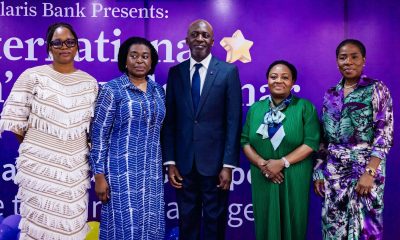
Polaris Bank Positions Gender Equity As Growth Strategy At IWD 2026
-
 News2 days ago
Ondo Court Sentences 21-Year-Old Emmanuel Akpan To Death For Employer’s Murder
-
 News23 hours ago
Tinubu Govt Only Detained El-Rufai Because They Fear Him – Dalung
-
 News23 hours ago
FULL LIST: New UK Visa and Citizenship Costs For Nigerians, Global Applicants
-
 Security & Crime15 hours ago
Court Remands 30-Year-Old For Fatal Stabbing Of Elderly Mother
-
 News16 hours ago
Ogun Nurse Remanded Over Abortion, Murder Of NYSC Member
-
 News12 hours ago
Fuel Price Relief: Dangote Refinery Announces Major Cut
-
 News2 hours ago
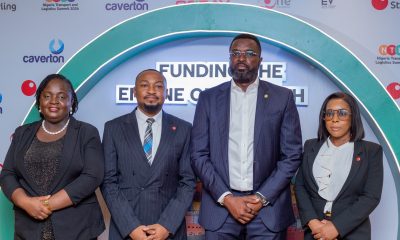
Sterling Bank Charts Way Forward For Nigeria’s Transport, Logistics Sector