
News
NRS Gets N40.71trillion Revenue Target For 2026

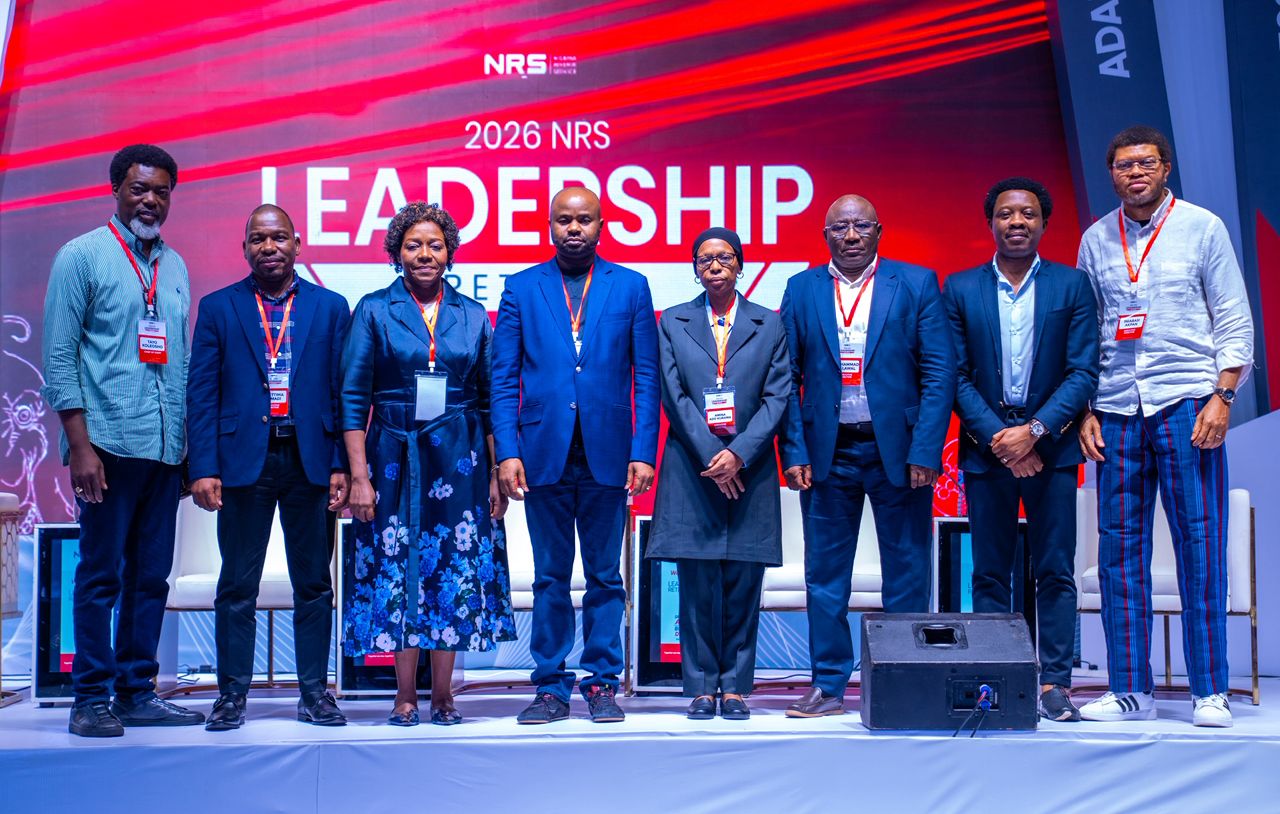
. Surpasses 2025 target of N25.2 trillion, rakes in N28.3 trillion
. Edun, Adedeji, Tegbe reiterate hope in new tax laws
The Nigeria Revenue Service (NRS), formerly known as the Federal Inland Revenue Service (FIRS), broke its record revenue collection performance, posting N28.3 trillion to surpass the set target of N25.2 trillion for the year 2025.
This was disclosed on behalf of the NRS executive chairman, Zacch Adedeji, by the Executive Director, Government and Large Taxpayers Group, Ms Amina Ado Kurawa, at the opening of a two-day management retreat with the theme “Designed to Adapt, Built to Deliver” held at the Congress Hall, Transcorp Hilton Hotel in Abuja, on Tuesday.
Ms Ado, according to a statement signed by Dare Adekanmbi, Special Adviser (Media) to the NRS chairman, also revealed that the revenue collection target for the revenue administration agency for 2026 has been set at N40.71 trillion, 44 per cent higher than the target for 2025.
Speaking earlier, the NRS chairman charged the management and staff members of the agency to do away with old beliefs, noting that the credibility of Nigeria’s revenue architecture and confidence in the Nigerian economy rest on their hands.
Adedeji said, “If we walk into the future with rigid beliefs, we will build walls where bridges are required. But if we lead with honesty, courage, and an open mind, we will build an institution worthy of this moment.
“Recently, I reflected deeply on an article in the Harvard Business Review titled ‘The Hidden Beliefs That Hold Leaders Back.’ Its central argument is both simple and confronting: leaders rarely fail because they lack intelligence, experience, or strategy. More often, they fall short because of the invisible beliefs they carry about themselves, about others, and about what leadership should look like, beliefs that quietly shape decisions, behaviours, and outcomes.
“The Nigeria Revenue Service will not be defined by what we say in this room. It will be defined by who we become after we leave it.”
The Executive Director, while giving a breakdown of the 2025 collection figures and how the agency surpassed the last target by 12 per cent, said non-oil taxes accounted for N21.4 trillion of the collection, against N18 trillion projected.
Total oil tax collection, according to her, came to N6.8 trillion, representing 95 per cent of the N7.2 trillion target set for the sector.
Both oil and non-oil tax revenue grew year on year by 19 per cent and 35 per cent, respectively.
“For the year 2025, oil tax revenue totalled N6.6trillion, representing a growth of 19 per cent over the N5.8 trillion realized during the corresponding period in 2024.
“Non-oil tax revenue for 2025 exceeded the 2024 total, reaching N21.5 trillion compared to N15.9 trillion for the same period in 2024—representing a growth of 35 per cent.
“This growth was driven by administrative enhancements, broadening of the Withholding system, digitalization efforts, improved tax compliance initiatives and stronger enforcement tactics introduced by NRS,” the statement said.
The statement added that the 44 per cent increase in the target for the agency was based on the expanded mandate of NRS to be a revenue system integrator for the country, including the collection of royalty hitherto the responsibility of the Nigerian Upstream Petroleum Regulatory Commission (NUPRC) and so on.
Earlier, the Minister of Finance and Coordinating Minister of the Economy, Mr Wale Edun, who joined the event virtually, charged Nigerians to rely more on made-in-Nigeria products, saying this would reduce revenue losses.
“We talk about buying from West Africa or trading with Africa as a whole, but intra-Nigerian trade is critical. We all know what spending in Nigeria does for the economy; we know what it does for the revenue targets of NRS.
“The debt service that was paid by the developing countries in 2024 was 163 billion dollars, while the overseas development assistance that came in was 42 billion dollars. The foreign direct investment and the private sector funding that came in from abroad to developing countries were just 97 billion dollars.
“So, you can see that, as developing countries, the flow of funding. What we are giving out is more than we are getting through these various categories.
“Clearly, it is what we do for ourselves internally that is going to be important at this time,” he said.
He reiterated the government’s desire to deliver in the areas of fiscal reforms and revenue mobilisation, saluting the management and staff of NRS for not just the pivotal but indispensable role they play in domestic revenue mobilisation.
Also speaking, the chairman of the National Tax Policy Implementation Committee, Joseph Tegbe, stressed the need for clinical delivery and execution of the tax laws.
Tegbe said that the quality of execution would ultimately determine whether the reform would succeed or merely join a long list of well-intentioned initiatives that failed to transform outcomes.
He explained that the country’s continued dependence on what he described as volatile oil revenues exposes it to shocks beyond control, “while rising public expenditure demands stable, predictable, and sustainable domestic revenue.
“History will judge this reform not simply by the revenues it generates, but by the trust it rebuilds between the Nigerian state and its citizens.
“It is essential that we are clear about the role of the Nigeria Revenue Service. NRS is not just another agency. It is the nation’s revenue system integrator,” he said.




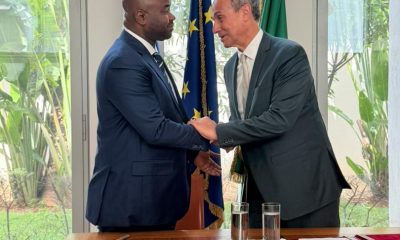

Oceangate Engineering Oil & Gas Limited has said it will appeal to the recent ruling of the Federal High Court ordering the forfeiture of certain assets.
Barr. Nnenna Onyeaso, the Company Secretary said in a statement on Thursday insisting that neither the company nor its leadership was found guilty of any wrongdoing.
Onyeaso said that the firm has described the court’s decision as a civil asset forfeiture order based on suspicion rather than proof, stressing that the judgment did not establish any criminal liability against the organisation.
According to her, the company maintain that it has already directed its legal team to file an appeal, expressing confidence in the judicial process and the outcome of a thorough review of the case.
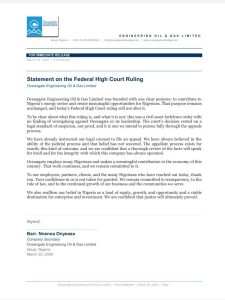
“To be clear, this ruling is a civil asset forfeiture order with no finding of wrongdoing against Oceangate or its leadership.
“The court’s decision rested on a legal standard of suspicion, not proof, and it is one we intend to pursue fully through the appeals process,” she said in a statement.
The firm secretary also said that Oceangate has reiterated its belief in the rule of law, noting that the appellate system exists to address such outcomes.
She added that the company remained confident that the facts of the case will ultimately affirm its integrity and business practices.
Onyeaso said that the firm also emphasised that its operations remained unaffected, stating that it continues to provide employment for many Nigerians while contributing to the country’s energy sector and broader economy.
“We have always believed in the ability of the judicial process, and that belief has not wavered,” she added.
She noted that Oceangate further expressed appreciation to its employees, partners, and clients for their continued support amid the development, assuring stakeholders of its commitment to transparency and accountability.
The Secretary said that the company reaffirmed its confidence in Nigeria as a viable destination for investment, describing the country as a land of equity, growth, and opportunity.
“We remain committed to the continued growth of our business and the communities we serve as we are optimistic that justice will prevail at the end of the legal process.
The Rivers State chapter of the All Progressives Congress (APC) has suspended a prominent member, Fubara Dagogo, following his legal attempts to halt the party’s national convention.
The decision was taken by the Ward 4 Executive Committee after allegations of anti-party activities and gross misconduct were levelled against the party chieftain.
The crisis arose after Dagogo took legal action against the APC over its upcoming national convention.
He approached a Federal High Court in Abuja, requesting an order to halt the party’s planned event.
In his suit, Dagogo alleged that he was unjustly prevented from contesting for the position of National Vice-Chairman (South-South).
Although Dagogo reportedly paid N5.1 million for the nomination form, he claimed the party refused to provide the required documents to formalize his candidacy.
He subsequently petitioned the court to suspend the South-South zonal congress and recognize his eligibility for the position.
Additionally, he sought the nullification of any election conducted without his participation and demanded N100 million in damages for what he described as marginalization.
However, the leadership of his ward in Bonny viewed this legal move as a direct violation of the party’s internal discipline.
The Ward Chairman, Richard Ibani, announced the suspension, stating that the resolution was passed during a committee meeting held on March 16.
The document confirming his removal was signed by the Ward Secretary, Donald Jumbo, and 21 other executive members.
The ward leaders maintained that Dagogo’s actions were an embarrassment to the party and a breach of the APC Constitution 2022 as amended. Specifically, they cited Article 21.2 (I), (II), and (VII), which deal with party discipline and the conduct of members.
In a strongly worded statement, the committee noted that they had previously cautioned members against acts that could ridicule the party.
They stated: “The ward exco has always advised its members to desist from actions capable of ridiculing our party, but your recent actions have shown that you are not willing to respect and abide by the constitution and actions of our great party.”
The suspension is indefinite and took effect immediately.
The ward leadership has also called on the state secretariat to uphold the resolution and apply further necessary actions.
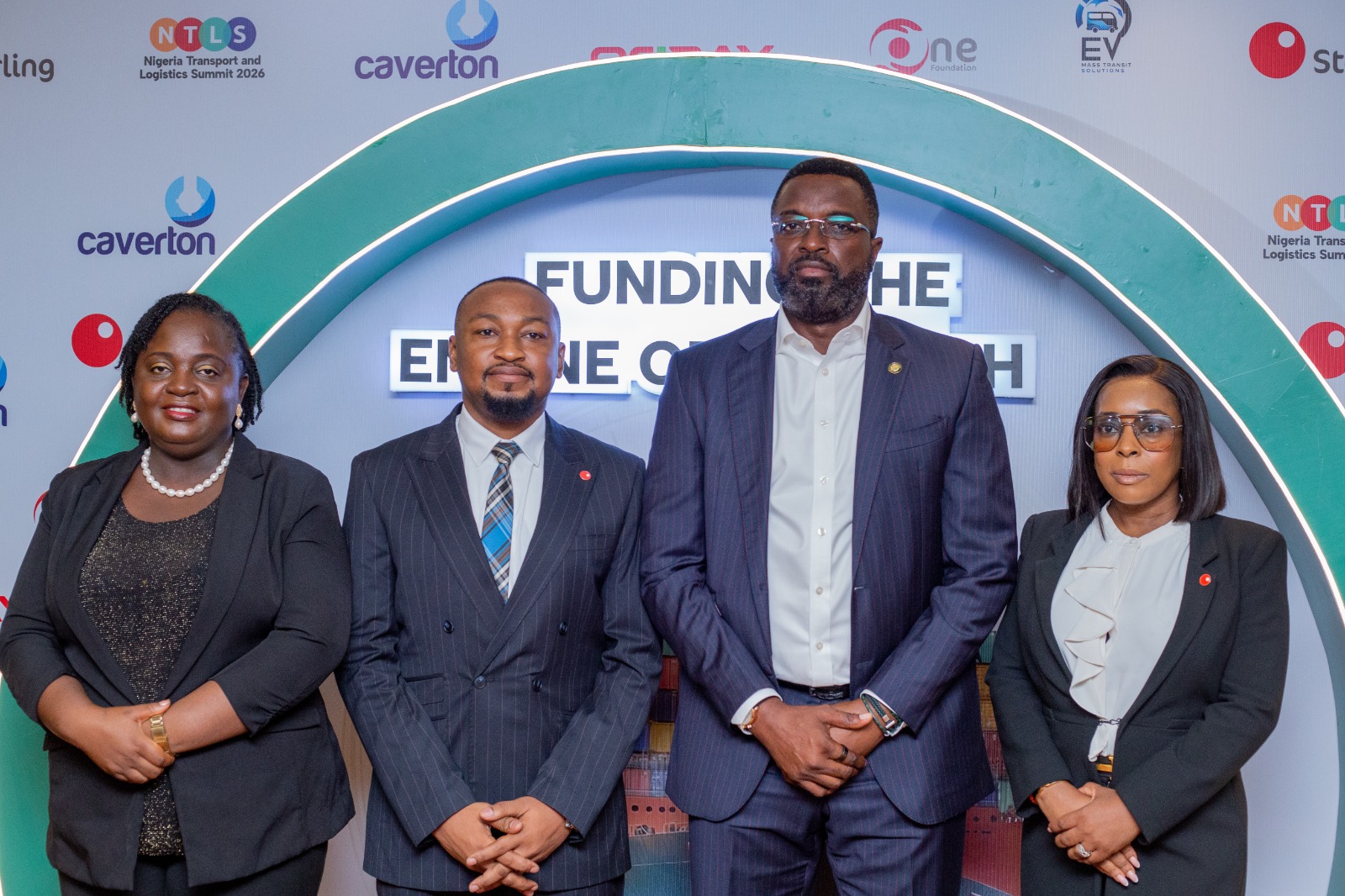
Industry leaders, policymakers, financiers, and innovators convened in Lagos today for the inaugural Nigeria Transport & Logistics Summit (NTLS) 2026, hosted by Sterling Bank at Eko Hotel & Suites, to forge actionable strategies for building a faster, more connected Nigeria through transport, mobility, and logistics.
Held under the theme “Funding the Engine of Growth,” the summit positioned Nigeria’s transport and logistics sector as a critical but under-leveraged driver of productivity, regional integration, and economic growth. Transport, mobility, and logistics collectively form the backbone of the Nigerian economy, yet chronic underinvestment, infrastructure deficits, and limited access to financing have long constrained its potential.
Transport, mobility, and logistics collectively form the backbone of Nigeria’s economy. While the logistics sub-sector alone contributes approximately ₦1 trillion to national GDP, experts estimate that the broader transport and logistics market exceeds ₦15 trillion in potential value. Yet persistent infrastructure gaps, inefficiencies, financing constraints, and policy fragmentation continue to limit the sector’s full impact.
NTLS 2026 brought together senior government officials, regulators, infrastructure operators, investors, development partners, and private sector leaders to address critical priorities including multimodal connectivity, airport and road modernization, energy-efficient mobility, digital trade facilitation, and innovative financing frameworks.
Speaking at the summit, Sterling Bank’s Managing Director and CEO, Mr. Abubakar Suleiman, represented by Sterling One Foundation CEO, Mrs. Olapeju Ibekwe, called for urgent, coordinated action to fix the systems that move Nigeria’s economy forward.
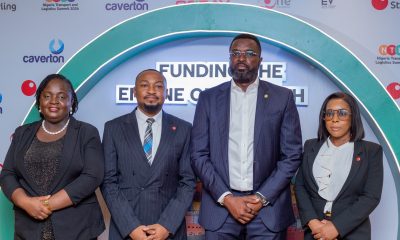
L-R Olapeju Ibekwe, CEO, Sterling One Foundation; Darlington Nwankwo, Divisional Head, Renewable Energy, Mobility and Tourism, Sterling Bank; Oluwaseun Osiyemi, Honorable Commissioner for Transportation, Lagos State: and Moyomade Akinyosoye, Divisional Head, Institutional Banking, Sterling Bank, at the recently concluded Nigeria Transport and Logistics Summit, hosted by Sterling Bank in Lagos recently.
He emphasized that while Nigeria’s transport and logistics challenges, ranging from port congestion to inefficient corridors and high operating costs, are well documented the real opportunity lies in effective execution.
“We must move beyond diagnosing the problem to building integrated, modern logistics systems that can power productivity at scale. This means fixing our ports, strengthening logistics corridors, improving road and rail connectivity, and embedding efficiency across the value chain.”
“Nigeria’s competitiveness, both regionally and globally will increasingly depend on how effectively we move goods, people, and services. The time for incremental change has passed; what is required now is bold, coordinated execution across public and private sectors,” Abubakar concluded.
Also speaking at the event, the Divisional Head, Renewable Energy, Mobility and Tourism at Sterling Bank, Mr. Darlington Nwankwo, described logistics as the backbone of trade, industry, and national competitiveness.
He noted that while the sector contributes just under four percent to Nigeria’s GDP, estimated at approximately ₦15trillion, its true economic impact is significantly larger when viewed as an enabler of productivity across agriculture, manufacturing, and trade.
“We must be deliberate about fixing the logistics backbone of the economy if we are to unlock the growth we need. Nigeria’s trade competitiveness is directly linked to the efficiency of its logistics corridors, from ports to inland distribution networks.”
“At Sterling, we see our role as connecting capital to execution, designing financing solutions that do not just fund infrastructure but unlock entire value chains. This includes supporting multimodal transport systems, enabling cleaner mobility solutions, and partnering with both government and private sector players to reduce investment risk. The opportunity before us is not just to fix what is broken, but to build a logistics ecosystem that is faster, more efficient, and globally competitive.”
Lagos State Commissioner for Transportation, Mr. Oluwaseun Osiyemi, echoed the call for bold ideas, strategic investments, and forward-looking policies, describing the summit as a vital platform to shape the future of movement, trade, and connectivity in Nigeria. He urged policymakers to move swiftly from planning to implementation, called on investors to support infrastructure and innovation, and encouraged industry leaders to champion efficiency, sustainability, and accountability.
In his keynote address, Professor Biodun Adedipe grounded these ambitions in hard realities, noting that with nearly 90 percent of Nigeria’s logistics dependent on road transport, the country faces mounting congestion and maintenance costs that demand diversification into rail and more durable infrastructure. He cautioned that economic transformation requires patience, with meaningful results unlikely to materialise in under 18 months.
Panel discussions throughout the day focused on reducing logistics costs, strengthening aviation and road integration, modernizing downstream energy distribution, and accelerating the adoption of cleaner and more sustainable mobility solutions.
The summit concluded with a call for sustained public-private collaboration, stronger regulatory coordination, and the creation of structured financing vehicles to de-risk infrastructure investments.
As Nigeria seeks to strengthen its regional trade position and unlock non-oil export growth, NTLS 2026 marks a decisive step toward building a more integrated, resilient, and globally competitive transport and logistics ecosystem.

Oceangate Engineering To Appeal Federal High Court Ruling over Forfeiture of Assets

Anti-Party Activities: Rivers APC Takes Disciplinary Action Against Fubara

Sterling Bank Charts Way Forward For Nigeria’s Transport, Logistics Sector

Fuel Price Relief: Dangote Refinery Announces Major Cut

Court Remands 30-Year-Old For Fatal Stabbing Of Elderly Mother

Ogun Nurse Remanded Over Abortion, Murder Of NYSC Member

FULL LIST: New UK Visa and Citizenship Costs For Nigerians, Global Applicants

Tinubu Govt Only Detained El-Rufai Because They Fear Him – Dalung

Ondo Court Sentences 21-Year-Old Emmanuel Akpan To Death For Employer’s Murder

Polaris Bank Positions Gender Equity As Growth Strategy At IWD 2026
-
 News2 days ago
Polaris Bank Positions Gender Equity As Growth Strategy At IWD 2026
-
 News2 days ago
Ondo Court Sentences 21-Year-Old Emmanuel Akpan To Death For Employer’s Murder
-
 News1 day ago
Tinubu Govt Only Detained El-Rufai Because They Fear Him – Dalung
-
 News1 day ago
FULL LIST: New UK Visa and Citizenship Costs For Nigerians, Global Applicants
-
 Security & Crime17 hours ago
Court Remands 30-Year-Old For Fatal Stabbing Of Elderly Mother
-
 News18 hours ago
Ogun Nurse Remanded Over Abortion, Murder Of NYSC Member
-
 News14 hours ago
Fuel Price Relief: Dangote Refinery Announces Major Cut
-
 News4 hours ago
Sterling Bank Charts Way Forward For Nigeria’s Transport, Logistics Sector