
Connect with us

News

Supreme Court Dismisses Suit By 19 States Challenging Constitutionality Of EFCC, ICPC, NFIU

Published

on

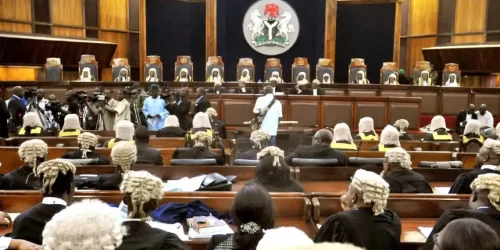
The Supreme Court, on Friday, dismissed the suit instituted by 19 states against the Attorney-General of the Federation, challenging the constitutionality of the Acts establishing the Economic and Financial Crimes Commission, EFCC, and two other anti-corruption agencies.

The plaintiffs had argued that the Supreme Court, in Dr Joseph Nwobike Vs Federal Republic of Nigeria, had held that it was a UN Convention Against Corruption that was reduced into the EFCC Establishment Act and that in enacting the law in 2004, the provision of Section 12 of the 1999 Constitution, as amended, was not followed.

They argued that, in bringing a Convention into the Nigerian law, the provision of Section 12 must be complied with.

According to them, the provision of the Constitution necessitated the majority of the states’ Houses of Assembly agreeing to bringing the Convention in before passing the EFCC Act and others, which was allegedly never done.

While delivering judgment on Friday, Justice Uwani Abba-Aji, who led a seven-member panel of justices, held that “the EFCC Act, which is not a treaty but a Convention, does not need the ratification of the Houses of Assembly”.

“Let me first look at the constitutional provision. The plaintiffs rely on Section 12 of the Constitution in their argument. Treaty is an agreement reached by two or more countries which has to be ratified.

“Convention: Conventions are agreed by a larger number of nations. Conventions only come into force when a larger number of countries agree.

“Therefore, the EFCC Act, which is not a treaty but a Convention does not need the ratification of the Houses of Assembly.

“A Convention would have been ratified by member states and the National Assembly can make laws from it, which will be binding on all the states in Nigeria as it is the case of EFCC Establishment Act,” the judge added.

The Supreme Court dismissed the suit in its entirety and resolved the case against the plaintiffs.

“In a country like Nigeria, the federating units do not have absolute power. The NFIU guideline is to present a benchmark and not to control the funds.

“Where an Act of law is made by the National Assembly like the NFIU and its guideline, it is binding on all. Any Act that has been competently enacted by the National Assembly cannot be said to be inconsistent.

“Where the National Assembly has enecated several laws on corruption, money laundering, etc, no state has the right to make laws to compete with it. The investigative power of the EFCC cannot be said to be in conflict with legislative powers of the State Assembly.

“I must agree with the AGF that the plaintiffs’ argument – that is, the Houses of Assembly of the plaintiff states – is not tenable in law,” the Supreme Court added.

The Court ruled that the NFIU guideline had not contravened the provisions of the Constitution on the powers of states to manage their funds, and resolved the issues against the plaintiffs.

All other judges agreed with the lead judgment, saying all the issues raised in the states’ suit had no merit “and are accordingly dismissed”.

The Court had earlier dismissed all objections of the Federal Government to the suit filed by the states.

Justice Abba-Aji said the plaintiffs case was against the Attorney-General of the Federation and not any of the agencies mentioned, hence, the Supreme Court has jurisdiction to determine it.

“Since the AGF is assumed to be the chief law officer of the federation, he is by all means the proper and necessary party.

“The AGF has locus standi to institute action against any one And the AGF can be sued in any civil matter against the government.

“It is clear that the Federal Government has legal tussle with the states based on the directive of the NFIU which the states are contending. The preliminary objection is hereby dismissed,” he ruled.

Reacting, the Counsel to Kogi State, Abdulwahab Mohammed, SAN, said, “This is an issue we have raised before the FHC, it was not addressed.

“We raised it at the Appeal Court and was not addressed. This is going to enrich our jurisprudence. We thank your lordship for hearing us out.”

Representative of the AGF, Rotimi Oyedepo, SAN, said, “We convey our gratitude to the court for your wisdom. Your lordship has permanently settled the legality of the anti-corruption agency in fighting corruption.”


News

How 2018 Federal Legal Advice Exonerated Saraki In Offa Robbery Case

Published

on

By

In light of the Kwara State Government’s fresh prosecution of Dr. Abubakar Bukola Saraki and his successor over the Offa robbery, fresh facts have emerged on why the Director of Public Prosecutions of the Federation, Mr. E. U. (Etsu Umar) Mohammed gave the duo a clean bill of health.

The Federal Director of Public Prosecutions cleared former Senate President Bukola Saraki of involvement in the Offa bank robbery in 2018, citing no evidence of a connection.

It was gathered that the DPP reviewed a 16-page police report prepared and signed by Abba Kyari, a Deputy Commissioner of Police and then head of the Inspector-General of Police Intelligence Response Team (IGP-IRT) at Force Headquarters, Abuja. The report detailed investigations into the April 5, 2018, multiple bank robbery attack in Offa, Kwara State.

The DPP in his first report dated June 22, 2018 and signed on behalf of the Attorney General of the Federation and Minister of Justice, prepared a five page legal advice in which he noted in paragraph 5 (f) that “for the Senate President (Saraki) and the Kwara State Governor (Ahmed), his office is unable to establish from the evidence in the interim report a nexus between the alleged offence and the suspects. Hence, it is our advice that further and thorough investigation in this regard be carried out”.

Following the submission of a second report by the police investigating team to his office on July 27, 2018, the DPP prepared a second legal advice, which was dated August 23, 2018. The three-page legal advice also has only three paragraphs.

In paragraph 3 (vi), he noted that “with regards to the Senate President, Senator Bukola Saraki, since there is no departure from the earlier findings in the interim report, this office is still unable to establish any prima facie case against him for any offences of criminal conspiracy, armed robbery, and culpable homicide punishable with death”.

Both legal advices had recommended six people for prosecution. They are: Ayoade Akinnibosun, Ibikunle Ogunleye, Adeola Ibrahim, Salawudeen Azeez, Niyi Ogundiran, and Michael Adiukwu.

One of the suspects, Michael Adiukwu, later died in police custody, while the other five had since been tried at the High Court in Ilorin.

During the trial, the suspects revealed how they were coerced into incriminating Senator Bukola Saraki.

They mentioned several inducements dangled before them, including money and the promise of a visa to travel out of the country.

The suspects have since been convicted and their convictions confirmed by the Court of Appeal. The matter is now pending before the apex court, the Supreme Court of Nigeria.

Continue Reading

News

₦400m Ransom Demanded As Gunmen Abduct Another Kwara Ruler

Published

on

By

Terrorists have abducted a traditional ruler in Olayinka community, located in the Ifelodun Local Government Area of Kwara State, Oba Salman Olátúnjí Aweda and are demanding a ₦400 million ransom for his release.

The abduction occurred on April 18, 2026, when armed men, suspected to be militia herdsmen, invaded the community and took the monarch, his wife, and another resident into the forest.

According to JomogNews, residents who witnessed the incident said the terrorists, numbering over 10, invaded the monarch’s residence around Saturday midnight, forced the door open, and abducted him alongside another person in the house.

The assailants reportedly led both victims into the bush.

Chairman of Ifelodun Local Government Area, Mr Abdulrasheed Femi Yusuf, visited the community on Saturday on a sympathy visit and assured residents that efforts were underway to secure the monarch’s release.

“We are deeply concerned about this incident, and we are taking swift and decisive action in collaboration with security agencies,” he said.

Continue Reading

News

Living Faith Church Founder Declares Week Of Vengeance Against Insecurity Sponsors

Published

on

By

Bishop David Oyedepo, General Overseer of Living Faith Church Worldwide, has declared that bandits and their sponsors will face divine judgment and retribution within seven days.

Speaking on Sunday, April 19, 2026, during a service themed “Covenant Day of Vengeance” at the church’s headquarters in Ota, Ogun State, the cleric stated that those responsible for killings and kidnappings would face imminent consequences.

“I declare judgement on those who caused these tragedies and their supporters in the name of Jesus,” he said.

The cleric further asserted that divine retribution would occur within a short timeframe.

“Unless I am not sent, this will happen in the next seven days,” he added.

Oyedepo also expressed confidence that Nigerians would soon witness outcomes of what he described as divine intervention, noting that the coming days would bring “testimonies of vengeance.”


Continue Reading

Trending