
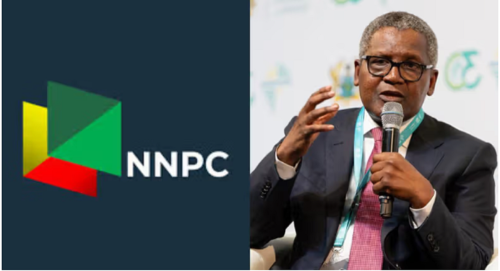
JomogNews Nigeria reports that the price of Premium Motor Spirit, popularly called petrol, produced by the Dangote Petroleum Refinery and released by the Nigerian National Petroleum Company Limited on Monday may justify the importation of the commodity into Nigeria, oil marketers have said.
Dealers also stated that vessels of imported petrol should start arriving in Nigeria from Tuesday (today) as they called for transparency in the pricing of the PMS produced by the Dangote refinery.
This came as the Organised Private Sector faulted the role of NNPC as the sole off-taker of petrol from the $20bn Lekki-based refinery. They called for competition in the space, adding that NNPC’s role as sole off-taker would not encourage this.
On Monday, NNPC announced that it would sell the petrol lifted from the Dangote refinery at a price above N1,000/litre in the far north.
Its spokesperson, Olufemi Soneye, in a statement titled, ‘NNPC Ltd Releases Estimated Pump Prices of PMS from Dangote Refinery Based on September 2024 Pricing’.
Soneye explained that the price may go for as high as N1,019/litre in Borno State and N999.22 in Abuja, Sokoto, Kano, and others.
In Oyo, Rivers and other areas in the South, it will be N960/litre. The lowest price, according to an info graphic released by the NNPC, is N950 in Lagos and its environs.
“The NNPC Ltd has released estimated prices of Premium Motor Spirit, also known as petrol (obtained from the Dangote refinery) in its retail stations across the country.
“The NNPC Ltd also wishes to state that, in line with the provisions of the Petroleum Industry Act, PMS prices are not set by the government, but negotiated directly between parties at an arm’s length,” he stated.
The company explained that the product it loaded on Sunday was paid for in dollars.
“The NNPC Ltd can confirm that it is paying Dangote Refinery in USD for September 2024 PMS offtake, as naira transactions will only commence on October 1, 2024.
“The NNPC Ltd assures that if the quoted pricing is disputed, it will be grateful for any discount from the Dangote Refinery, which will be passed on 100 per cent to the general public,” the statement added.
Soneye stated that the estimated pump prices of PMS were obtained from the Dangote refinery and would be across NNPC retail stations in Nigeria based on September 2024 pricing.
Recall that the Dangote Group had disagreed with NNPC on Sunday on the N898/litre PMS cost announced by NNPC as the price at which Dangote sold the commodity.
Petrol importation
Major oil marketers stated that the high price of the Dangote petrol released by NNPC would encourage the importation of the commodity, as they noted that some PMS vessels might arrive in Nigeria today (Tuesday).
“As it is now, I don’t know what magic they (NNPC and Dangote) are going to perform because a lot of companies are surely going to be involved in the importation of PMS. This is because whatever is going to come out of that place (Dangote refinery), it is either there will not be enough transparency in the allocation of the product, or there will be other issues.
“Also, some big players may not get enough quantity from the plant and they will have to complete this with imported products. Like I told you, all things being equal, from September 17 (today), PMS vessels by marketers, not NNPC, should start coming into the country,” a major marketer, who spoke on condition of anonymity due to lack of authorisation to speak on the matter, stated.
The source added, “Let me also state that as it is now, you will see PMS for N1,200/litre in some stations, this can also happen in Lagos because, at N950 and N1,019/litre, there will be a market for imported products. Yes, you will see a price of N950 here and in another location, you will get it at about N1,200. It now depends on the customers.
“Those who can queue may opt for the cheaper prices and wait in the queues, while people in haste will drive into stations that sell at higher rates to buy the product. So, the price by Dangote will encourage importation. And like I told you earlier, a lot of marketers are having their cargoes before the end of the month.”
IPMAN reacts
JomogNews Nigeria reports that the Independent Petroleum Marketers Association of Nigeria raised concerns over the pricing of petrol from the Dangote refinery, urging NNPC to ensure that the product was not sold at a higher price than imported fuel.
IPMAN argued that such a disparity would be counterproductive to the nation’s drive for energy self-sufficiency and could negatively impact consumers and marketers alike.
According to IPMAN on Monday, the pricing strategy for locally refined petrol should reflect the advantages of domestic production, offering Nigerians a more affordable option.
The association emphasised that maintaining competitive pricing was crucial for the success of the Dangote refinery and for fostering a sustainable fuel market in the country.
IPMAN National Welfare Officer, John Kekeocha, stated this on Channels Television’s The Morning Brief breakfast programme on Monday.
“If NNPC can sell Dangote products higher than the imported products then it doesn’t make sense. What is the celebration we are having all these while then?” he queried.
The NNPC began loading the first batch of petrol from the Dangote Refinery on Sunday, saying it got petrol at N898 per litre from the private refinery.
Before lifting petrol from the Dangote Refinery on Sunday, NNPC retail outlets in Lagos sold petrol for around N855 but said a litre of Dangote petrol would sell for N950/litre in Lagos and N1,019 in Borno.
However, Dangote refinery denied selling petrol to NNPC at N898. A spokesman for the refinery Anthony Chiejina in a statement late Sunday described the claim by the NNPC as “misleading and mischievous.”
Terrifying price
Reacting to the price list released by NNPC, the President of the Petroleum Products Retail Outlets Owners Association of Nigeria, Billy Gillis-Harry, described it as “terrifying.”
He, however, noted that the breakdown of the prices by the national oil company was clear, adding that “NNPC did not even tell us if they are making any profit from the Dangote selling price.”
Gillis-Harry stated, “This is the kind of transparency that we are requesting that the industry should be inundated with. We need this transparency so that the public will understand what they are engaged in.
“However, whatever it is, the good news is that PMS will be rolling out into the tanks of commuters and that businesses will not be grounded to a halt due to scarcity. But as for the pricing, I believe there will be a stakeholder review about it and we will make our input known.”
The PETROAN president called for minimal importation of PMS while the country should try to stabilise the supply of products from the Dangote refinery.
He again pointed out this would be achieved when there was transparency, accurate and timely information from both NNPC and Dangote refinery.
OPS expresses concern
The President of the Nigerian Association of Chambers of Commerce, Industry, Mines and Agriculture, Dele Oye, said NACCIMA members were concerned about NNPC’s role as the sole off-taker for the Dangote refinery.
He said, “The arrangement whereby NNPC is the sole buyer from the Dangote refinery does indeed create a monopolistic situation, which appears to contradict the principles of a deregulated market and is in conflict with the government’s current position that they have deregulated the sector. This raises concerns about the potential distortion of pricing mechanisms and the limited opportunities for other stakeholders to participate in the market.
“The conflicting statements between Dangote refinery and NNPC further underscore the need for clarity and transparency in the fuel pricing process. The public deserves a clear explanation of the rationale behind the pricing decisions to enhance trust and confidence in our energy sector. The recent price increase, while necessary, has had a significant impact on the already challenging inflationary situation, and has led to some businesses and even some state governments resorting to remote work arrangements.”
He asserted that the NNPC needed to open the market by allowing multiple buyers from Dangote refinery.
He added, “This would not only enhance competition but also ensure that prices reflected true market realities rather than being solely dictated by regulatory control.
“Furthermore, it is imperative that the NNPCL provide a clear timeline for the completion and commencement of operations at the Port Harcourt Refinery. This would introduce much-needed competition among the local refineries, thereby strengthening our energy security.
“The current uncertainty and perceived lack of transparency, as well as the perceived lack of demonstrated support for the Dangote Refinery, may send negative signals to potential foreign and existing local investors. This could undermine President Tinubu’s efforts to attract foreign direct investment and drive economic growth. It is essential that we address these issues promptly to build a more favourable investment climate that encourages sustainable development and prosperity for our nation.”
The President of the Lagos Chamber of Commerce and Industry, Gabriel Idahosa, said NNPC could not prevent Dangote refinery from selling PMS to other marketers.
Idahosa noted that independent marketers had called on the NNPC to allow them decide whether they could afford to buy at whatever price Dangote would sell and then sell accordingly.
He said, “If we can sell at N900 and make a profit, that’s our problem. If we cannot sell, and we are forced to sell above N898, and there are Nigerian buyers in various parts of the country who are willing to buy because they are not ready to stay in long queues at NNPC stations that are selling at N898, so be it.”
Idahosa observed that while independent oil marketers were not restrained from buying Dangote’s PMS, they may be hesitant to compete with NNPC’s pump prices in the open market.
“What NNPC can do, and it has done, is to say whatever price we and Dangote have agreed to pay is a private treaty between the supplier Dangote and the buyer NNPC. And NNPC will sell to you and me at the pump at N898, which is the price they announced.
“So, they have yet to fix the price for Dangote to sell its products, but they have sealed the price that you and me can buy from the pump,” he continued.
The LCCI president noted that NNPC’s increase in pump price to a minimum of N898 following its purchase of PMS from the Dangote refinery came at a time when Nigerians were enmeshed in hardship and hunger worsened by declining average income levels
“It is difficult for the majority of Nigerians to afford it easily. That point is not in dispute,” Idahosa said. “The only point is, how do we gradually begin to see a reduction in the pump price of petrol?
“We have travelled through this road before (about) the high price of diesel and aviation fuel, but because the market was deregulated, it gradually and steadily came down. So, how can we see that for petrol? I think that is everyone’s primary concern,” Idahosa added.