

President Bola Tinubu says the Federal Government decided to remove fuel subsidy and abolish multiple foreign exchange rates to grow the economy for national development.
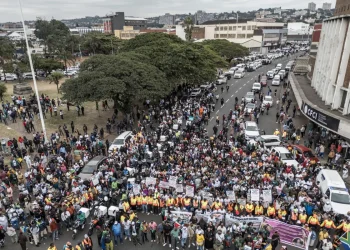
The president said this while addressing the nation in a broadcast on Sunday on the ongoing nationwide protest.
He said that the Nigerian economy had remained anaemic for decades and taken a dip because of many misalignments that had stunted its growth.
“Just over a year ago, our dear country, Nigeria, reached a point where we couldn’t afford to continue the use of temporary solutions to solve long-term problems for the sake of now and our unborn generations,” he said.
He explained that he took the painful decision to remove fuel subsidies and abolish multiple foreign exchange systems that blocked the greed and the profits that smugglers and rent-seekers made.
Tinubu added that the action also blocked the undue subsidies the country had extended to neighbouring countries to the detriment of its people, rendering the economy prostrate.
“These decisions I made were necessary if we must reverse the decades of economic mismanagement that didn’t serve us well.
“Yes, I agree, the buck stops on my table. But I can assure you that I am focused fully on delivering the governance to the people – good governance for that matter,” the president said
He explained that in the past 14 months, his government had made significant strides in rebuilding the foundation of the economy to carry Nigerians into a future of plenty and abundance.
“On the fiscal side, aggregate government revenues have more than doubled, hitting over N9.1 trillion in the first half of 2024 compared to the first half of 2023.
“This was due to our efforts at blocking leakages, introducing automation, and mobilising funding creatively without additional burden on the people.
“Productivity is gradually increasing in the non-oil sector, reaching new levels and taking advantage of the opportunities in the current economic ambience,” the president stated.
He said that his government had in the last 13 months reduced revenue spent on debt servicing to 68 per cent as against 97 per cent previously.
“We have also cleared legitimate outstanding foreign exchange obligations of about 5 billion dollars without any adverse impact on our programmes.
“This has given us more financial freedom and the room to spend more money on you, our citizens, to fund essential social services like education and healthcare.
“It has also led to our state, and local governments receiving the highest allocations ever in our country’s history from the Federation Account,” Tinubu said.
The president said that his government had also embarked on major infrastructure projects across the country.
He said the government was working to complete inherited projects critical to the country’s economic prosperity, including roads, bridges, railways, power, and oil and gas developments.
“Notably, the Lagos-Calabar Coastal Highway and Sokoto-Badagry Highway projects will open up 16 connecting states, creating thousands of jobs and boosting economic output through trade, tourism and cultural integration.
“Our once-declining oil and gas industry is experiencing a resurgence on the back of the reforms I announced in May 2024 to address the gaps in the Petroleum Industry Act.
“Last month, we increased our oil production to 1.61 million barrels per day, and our gas assets are receiving the attention they deserve.
“Investors are coming back, and we have already seen two Foreign Direct Investments signed of over half a billion dollars since then,” said Tinubu.
The president said he met a country that was dependent solely on petrol and neglected its gas resources to power the economy.
He added the government was also using its hard-earned foreign exchange to pay for, and subsidise its use.
“To address this, we immediately launched our Compressed Natural Gas Initiative (CNG) to power our transportation economy and bring costs down.
“This will save more than N2 trillion a month, being used to import PMS and AGO and free up our resources for more investment in healthcare and education.
“To this end, we will be distributing a million kits of extremely low or no cost to commercial vehicles that transport people and goods and who currently consume 80 per cent of the imported PMS and AGO,” he said
The president said his government had started the distribution of conversion kits and setting up of conversion centres across the country in conjunction with the private sector.
Tinubu believed that the CNG initiative would reduce transportation costs by approximately 60 per cent and help to curb inflation.
He was emphatic that his administration had shown its commitment to the youth by setting up the student loan scheme.
“To date, N45.6 billion has already been processed for payment to students and their respective institutions.
“I encourage more of our vibrant youth population to take advantage of this opportunity,” said the president.
Tinubu also said his administration established the Consumer Credit Corporation with more than N200 billion to help Nigerians to acquire essential products without immediate cash payments, making life easier for millions of households.
This, he said, would consequently reduce corruption and eliminate cash and opaque transactions.
“This week, I ordered the release of an additional N50 billion each for NELFUND – the student loan, and Credit Corporation — from the proceeds of crime recovered by the EFCC.
“Additionally, we have secured 620 million dollars under the Digital and Creative Enterprises (IDiCE) – a programme to empower our young people, creating millions of IT and technical jobs that will make them globally competitive.
“These programmes include the 3 million Technical Talents scheme. Unfortunately, one of the digital centres was vandalised during the protests in Kano. What a shame!” he said.
In addition, Tinubu said the government had introduced the Skill-Up Artisans Programme (SUPA); the Nigerian Youth Academy (NIYA); and the National Youth Talent Export Programme (NATEP).
He also said more than N570 billion had been released to the 36 states to expand livelihood support to their citizens, while 600,000 nano-businesses had benefited from nano-grants.
He stated that an additional 400,000 nano-businesses were expected to benefit from the programme.
“Furthermore, 75,000 beneficiaries have been processed to receive our N1 million Micro and Small Business single-digit interest loans, starting this month.
“We have also built 10 MSME hubs within the past year, created 240,000 jobs through them and five more hubs are in progress, which will be ready by October this year,” he said.
According to Tinubu, payments of N1 billion each are also being made to large manufacturers under single-digit loans to boost manufacturing output and stimulate growth.
He said he signed the National Minimum Wage into law last week, and the lowest-earning workers would now earn at least N70,000 a month.
Tinubu said six months ago he inaugurated the first phase of his administration’s ambitious housing initiative, the Renewed Hope City and Estate in Karsana, Abuja.
“This project is the first of six we have planned across the nation’s geopolitical zones. Each of these cities will include a minimum of 1,000 housing units, with Karsana itself set to deliver 3,212 units.
“In addition to these city projects, we are also launching the Renewed Hope Estates in every state, each comprising 500 housing units.
“Our goal is to complete a total of 100,000 housing units over the next three years.
“This initiative is not only about providing homes but also about creating thousands of jobs across the nation as well as stimulating economic growth,” said the president.
He also stated that his administration was providing incentives to farmers to increase food production at affordable prices.
In line with this, he directed that tariffs and other import duties should be removed on rice, wheat, maize and sorghum.
Tinubu said drugs and other pharmaceutical and medical supplies were also included in the initiative for the next six months, in the first instance, to help drive down the prices.
“I have been meeting with our Governors and key Ministers to accelerate food production. We have distributed fertilisers. Our target is to cultivate more than 10 million hectares of land to grow what we eat.
“The Federal Government will provide all necessary incentives for this initiative, whilst the states provide the land, which will put millions of our people to work and further increase food production.
“In the past few months, we have also ordered mechanised farming equipment such as tractors and planters, worth billions of Naira from the United States, Belarus, and Brazil.
“I can confirm to you that the equipment is on the way,” he said.
The president urged Nigerians not to let anybody misinform and misinform them about the country or tell them that the government did not care about them.
Tinubu said although there had been many dashed hopes in the past, he assured Nigerians that they were in a new era of Renewed Hope.
“We are working hard for you, and the results will soon be visible and concrete for everyone to see, feel and enjoy.
“Let us work together to build a brighter future for ourselves and for generations to come.
“Let us choose hope over fear, unity over division, and progress over stagnation,” appealed the President.
He said the economy was recovering, and urged Nigerians not to shut out its oxygen.
“Now that we have been enjoying democratic governance for 25 years, do not let the enemies of democracy use you to promote an unconstitutional agenda that will set us back on our democratic journey.
“Forward ever, backward never!” said the president.
He charged security operatives to continue to maintain peace, law, and order following the necessary conventions on human rights, to which Nigeria is a signatory.
Tinubu said the safety and security of all Nigerians were paramount.