
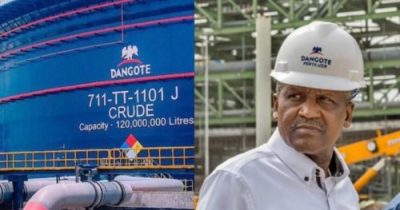
Owners of local refineries in Nigeria, including the Dangote Petroleum Refinery, say they can help the country stop the importation of refined petroleum products in 18 months if the Federal Government works with their plans.
The refiners, who spoke under the aegis of the Crude Oil Refiners Association of Nigeria (CORAN), said there are other refineries at different stages of completion to join the 650,000-capacity Dangote Petroleum Refinery.
In an interview, CORAN Publicity Secretary, Eche Idoko, told The PUNCH that the Dangote refinery and others in the country can satisfy the fuel needs of the nation.
Idoko’s comment is coming at a time when the Chief Executive of the Nigerian Midstream and Downstream Regulatory Authority, Farouk Ahmed, said the country would not stop fuel importation to break the Dangote monopoly and ensure energy security.
The CORAN official argued that there was no way the government would tackle rising inflation if it did not address the high cost of fuel, especially by working with the local refiners.
“You can’t tackle inflation if you don’t address the pump price of petroleum products. You cannot say you have a plan to step down inflation and you are not involving the key sectors like the refineries; you have to involve us, let’s work together.
“And CORAN is saying that, in 18 months, if the Nigerian government will work with our programmes and plans, in 18 months, we can stop the importation of petroleum products completely. There are refineries in different stages of completion. In 18 months, we can produce what Nigeria will consume,” he stated.
Idoko said Nigeria has enough crude oil to feed Dangote and other refineries but noted that crude theft has been the major challenge to the upstream oil sector.
“We have the crude oil to feed these refineries and more fields are being licensed by the day. So, there will be crude to feed the refineries. Our production figure is dropping because of the crude that is being stolen daily.
“When we have local refineries, crude theft will be reduced. People steal crude through the pipelines and most of the refineries are located close to some of these fields. What this does is that the crude oil producers will no longer need to pump their crude through the pipelines to the terminal for export.
“The local refineries will just truck from the fields or get a short pipeline or barge from their fields to these places. We are losing heavily because unscrupulous elements are stealing crude from the long pipelines,” Idoko stated.
The CORAN official said the international oil companies are supposed to sell crude oil to local refineries at a price lower than the international price.
He asked the Federal Government to ensure that crude oil is sold in naira and not dollars, saying this would reduce the cost of fuel production and the pressure on the local currency.
He mentioned that ending the importation of fuel would strengthen the naira against the dollar, asking that the IOCs should start selling fuel directly to local refiners instead of referring them to their trading agents in Europe.
The Nigerian Midstream and Downstream Petroleum Regulatory Authority (NMDPRA) boss had earlier warned that Nigeria could not rely heavily on the Dangote refinery for its fuel supply.
According to him, the refinery had requested the regulator to stop giving import licenses to other marketers to be the only fuel supplier in Nigeria.
“We cannot rely heavily on one refinery to feed the nation, because Dangote is requesting that we should suspend or stop importation of all petroleum products, especially AGO and direct all marketers to the refinery, that is not good for the nation in terms of energy security. And that is not good for the market, because of monopoly,” Ahmed stressed.
However, the President of Dangote Group, Aliko Dangote, denied the allegation, wondering how he could be a monopoly when the Nigerian National Petroleum Company Limited (NNPCL) is renovating government-owned refineries with $4bn.
Many Nigerians have been calling on the Federal Government to support local refineries and stop the importation of fuel. They expressed hope that this would crash the pump price of petrol and diesel.
Dangote, who has been lamenting over the alleged refusal of the international oil companies to supply crude to his refineries, recently said he would begin the supply of petrol between August 10 and 12.
However, an official of the Dangote Group told our correspondent anonymously that the refinery might export its petrol if the current crude crisis persists.
Meanwhile, shareholders have condemned the Chief Executive of the Nigerian Midstream and Downstream Petroleum Regulatory Authority, Farouk Ahmed, for saying the Dangote refinery was producing diesel with higher sulphur content than imported ones.
The group, under the aegis of Pragmatic Shareholders Association of Nigeria, in a statement signed by their National Coordinator, Mrs Bisi Bakare, expressed dismay over the allegations from the regulator regarding the quality of diesel produced by Dangote.
Bakare commended Dangote for his visionary step in establishing one of the world’s largest refineries. She highlighted Dangote’s commitment to national development, stressing his patriotism and resolute character through substantial investments like the refinery.
“Dangote has ensured that the bulk of his business investments are local, contributing significantly to economic development through tax payments, extensive job creation, and consistent returns for shareholders,” she added.
The group condemned what it termed “unwarranted efforts to demarket the refinery” by regulatory bodies.
It cautioned that such actions could deter both local and international investors and undermine the government’s efforts to stabilise fuel prices and ensure availability.
“We must rally around Dangote refinery to provide crucial support such as crude oil allocation, cooperation from international oil companies, and regulatory agency collaboration,” she noted.
Bakare said the refinery has the potential to save Nigeria over 30 per cent in foreign exchange currently spent on offshore refining, which could significantly alleviate the country’s foreign exchange challenges.
“As shareholders, we remain steadfast in our support of Alhaji Aliko Dangote’s vision to bolster the nation’s economy and create more opportunities for our citizens,” she submitted.
Last week, the Management of Dangote Group insisted that the IOCs were still frustrating crude supply to the 650,000-capacity refinery.
In a statement, the group alleged that the IOCs insisted on selling crude oil to its refinery through their foreign agents, saying the local price of crude will continue to increase because the trading arms offer cargoes at $2 to $4 per barrel, above NUPRC official price.
The group also alleged that the foreign oil producers seem to be prioritising Asian countries in selling the crude they produce in Nigeria.
The Vice President, Oil & Gas, Dangote Industries Limited, Mr DVG Edwin, said: “If the Domestic Crude Supply Obligation guidelines are diligently implemented, this will ensure that we deal directly with the companies producing the crude oil in Nigeria as stipulated by the Petroleum Industry Act.”
Edwin insisted that IOCs operating in Nigeria have consistently frustrated the company’s requests for locally-produced crude as feedstock for its refining process.
He highlighted that when cargoes are offered to the oil company by the trading arms, it is sometimes at a $2 to $4 (per barrel) premium above the official price set by the Nigerian Upstream Petroleum Regulatory Commission.
“As an example, we paid $96.23 per barrel for a cargo of Bonga crude grade in April (excluding transport). The price consisted of a $90.15 dated Brent price plus a $5.08 NNPC premium plus a $1 trader premium. In the same month, we were able to buy WTI at a dated Brent price of $90.15 + $0.93 trader premium including transport. When the Nigerian National Petroleum Company Limited subsequently lowered its premium based on market feedback that it was too high, some traders then started asking us for a premium of up to $4m over and above the NSP for a cargo of Bonny Light.
“Data on platforms like Platts and Argus shows that the price offered to us is way higher than the market prices tracked by these platforms. We recently had to escalate this to NUPRC,” Edwin said, urging the commission to take a second look at the issue of pricing.
Edwin was reacting to a statement by the Chief Executive of the NUPRC, Gbenga Komolafe, who in an interview on national television said, “It is ‘erroneous’ for one to say that the International Oil Companies are refusing to make crude oil available to domestic refiners, as the Petroleum Industry Act has a stipulation that calls for a willing-buyer, willing-seller relationship.”
While noting that the commission has been very supportive of the Dangote refinery as it has intervened several times to help secure crude supply, Edwin, however, insisted that the NUPRC boss might have been misquoted by some people hence his statement that IOCs did not refuse to sell to us.