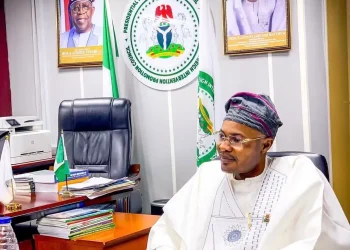


Naira is seriously undervalued, Central Bank of Nigeria (CBN) Governor, Olayemi Cardoso said yesterday.
According to him, the apex bank is putting all that is necessary into place to reverse the trend and make naira attain its real value.
He said: “We believe that the naira is currently undervalued and coupled with coordinated measures on the fiscal side, we will expedite genuine price discovery in the near time.”
Cardoso spoke at the unveiling of the Nigerian Economic Summit Group (NESG) 2024 Macroeconomic Outlook Report in Lagos yesterday.
Analysing the fuel situation, the CBN governor explained that pump prices of Premium Motor Spirit (PMS) will stabilise or drop this year when public and private-owned refineries begin operation.
The drop, he said, will have far-reaching implications on the various sectors of the economy.
He also highlighted measures by the CBN to strengthen the Naira and crash the inflation rate from 28.92 to 21.4 per cent.
The unification of exchange rates and floating of the naira by President Bola Ahmed Tinubu at the inception of his administration are part of the bold moves to reform the economy.
However, this has led to a big devaluation in naira exchange to the dollar.
“The expected stabilisation or reduction in fuel costs is poised to have far-reaching implications across various sectors, contributing significantly to overall economic efficiency and resilience”, Cardoso said.
The report highlighted some economic outcomes of achieving a stable and appropriate pricing of the exchange rate.
While Dangote Refinery, a private initiative has begun production of diesel and aviation fuel, the Port Harcourt Refinery owned by the Federal Government is expected to begin production soon.
Cardoso acknowledged the challenges facing the economy and its resistance to solutions but assured Nigerians that the nation is now at a turning point due to the bold reforms undertaken by the Bola Tinubu administration.
He said that the CBN, Ministry of Finance and the Nigerian National Petroleum Company Limited(NNPCL) have collaborated to ensure that all FX inflows are returned to the apex bank.
The return of FX inflows to the CBN, according to him, has helped to boost reserves accretion and firm up the naira which as of yesterday exchanged for N1,370 to a dollar at the parallel market.
He said: “The expected stability in the foreign exchange market for 2024 can be attributed to the reduction in petroleum product imports and the recent implementation of a market-determined exchange rate policy by the CBN.
“This reform is designed to streamline and unify multiple exchange rates, fostering transparency and reducing arbitrage opportunities.
“The resulting consistent and stable exchange rate will not only boost investor confidence but also attract foreign investment, elevating Nigeria’s appeal to global investors.
“We are implementing a comprehensive strategy to improve liquidity in our FX markets in the short, medium, and long term and our focus is on addressing fundamental issues that have hindered the effective operation of our markets over the years.
“We are already witnessing positive outcomes, and these will undoubtedly become more apparent in the near future. The dedicated and relentless efforts being made are certain to bring about significant and positive changes for our economy.
“Recent reports from international rating agencies such as Fitch and Moody’s, and commendations from multilateral banks like the World Bank reflect this, with upgrades to Nigeria’s ratings from stable to positive. These reports acknowledge the possible reversal of the deterioration in the country’s fiscal and external position due to the authorities’ reform efforts.
“While noting the painful adjustments, they all identify a direction of travel that will unlock the much-needed growth and development for our economy in the medium to long term.”
Cardoso also assured Nigerians that the rising costs of food and volatility in the forex market would soon be addressed.
He noted the global economy is currently grappling with persistent challenges, including inflation and subdued growth prospects.
Despite Gross Domestic Product (GDP) growth outperforming expectations in 2023, it is projected to moderate in 2024 due to tightened financial conditions, sluggish trade expansion, and reduced business and consumer confidence. The International Monetary Fund (IMF) anticipates a mild slowdown in global economic growth to 2.9 per cent in 2024, down from the 3.0 per cent growth observed in 2023, with Asia driving the majority of the projected global growth in 2024, similar to the previous year.
The CBN boss said the projections for the nation’s economy paint an optimistic trajectory as the Federal Government of Nigeria anticipates real GDP growth of 3.76 per cent in 2024, slightly surpassing the estimated 3.75 per cent for 2023.
The optimism, according to him, is underpinned by the implementation of key government reforms set to shape the economic landscape.
Foremost among the factors contributing to this positive outlook is the expectation of improved crude oil prices and production, highlighting the crucial role the oil industry is expected to play in driving economic growth.
Cardoso said the positive outlook for Industry, Services, Agriculture, Mining, Electricity, Gas and Water Supply sub-sectors reflects the potential effect of market-based reforms through private investment and SMEs-led growth.
His words: “Government reforms in the mining and energy sub-sectors are expected to serve as a catalyst for growth and development. While the potential for growth exists in 2024, each sector may encounter unique challenges and opportunities.
“The outlook for decreasing inflation in 2024 will have a profound impact on businesses, providing a more predictable cost environment and potentially leading to lowered policy rates, stimulating investment, fueling growth, and creating job opportunities.”
Cardoso noted that the NESG’s Macroeconomic Outlook Report for 2024 emphasises the necessity of economic transformation under the central theme, “Economic Transformation Roadmap: Medium-Term Policy Priorities.”
“This theme underscores the requirement for a clearly outlined roadmap comprising distinct yet interconnected phases and essential policy recommendations. This resonates with me as we have just last week, launched a new five-year Strategy for the CBN for the period 2024-2028 that provides a clear roadmap for achieving our mandates,” he said.
The 2024 Macroeconomic Outlook Report was summarised by NESG’s Chief Economist Olusegun Omisakin.
The report advised that stabilising the exchange rate through a functional and transparent foreign exchange market entails enhancing market liquidity through regular auctions, reducing administrative restrictions, and ensuring efficient allocation of FX reserves.
“Adopting a managed float system, regulating speculative activities, and encouraging foreign investments would bolster market confidence.
“Besides, access to FX needs to be realigned to facilitate international trade and transactions – as such, local access needs to be to the limit of the Naira equivalent. Reinforcing monetary policies for inflation control and export diversification would promote currency stability,” the report advised.
The NESG report explained that when exchange rates are stable, everyone is better off. Price stability supports economic growth and employment. It allows people to make more reliable plans for borrowing, saving, and expanding businesses.
“Decreased volatility of the exchange rate helps to support stability in inflation, which mainly affects low-income households because they have fewer resources to protect themselves.
“In the situation of price stability, it helps to maintain social cohesion and stability. History has shown that episodes of high inflation tend to be associated with social unrest,” it added.
According to the report, increased capital inflows will fortify the nation’s external reserves, establishing a robust defence against external shocks.
“This can only happen with the stability of the exchange rate. Capital inflows, comprising foreign investment, loans and remittances, elevate the reserve levels, bolstering Nigeria’s financial stability and economic resilience,” it said.
The report advised that in addition to nominal enhancements in revenue, it is imperative for the country’s revenue-to-GDP ratio to reach a minimum threshold of 15 per cent to substantiate the processes of economic growth and stabilisation.
The report partly reads: “The country must significantly decrease its current public debt service-to-revenue ratio, aiming for a reduction to less than 22 per cent from the current high of 80.2 per cent as of 2022.
“This reduction is crucial to create fiscal space, enabling the government to reallocate funds toward economic development and stability initiatives.
“A moderate fiscal deficit can be a useful tool for financing essential investments and stimulating economic activity.
“Hence, the optimal level of fiscal deficit that supports economic growth and stability in Nigeria requires a careful balance.
“A fiscal deficit of less than three per cent as stipulated in the FRA 2007 is considered appropriate for the economy.”