
Featured
Oluyemi Oluleke Osinbajo Profile: Biography Of VP Osinbajo

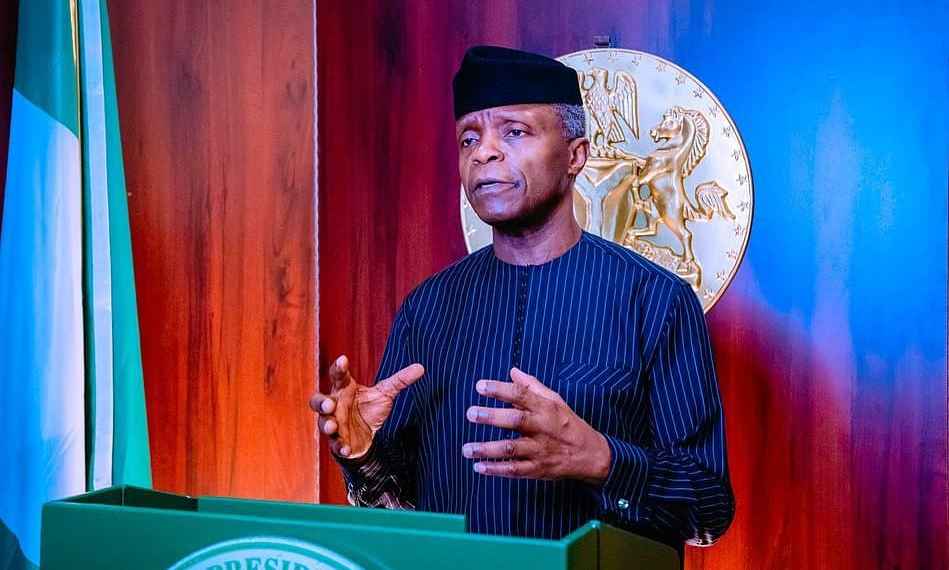
Oluyemi Osinbajo Profile, Biography of VP Osinbajo, VP Osinbajo date of birth, VP Osinbajo political career and other information about Nigeria’s Vice President.
JomogNews Nigeria reports that Oluyemi Osinbajo, SAN, GCON is the Vice President of the Federal Republic of Nigeria.
VP Osinbajo was born on March 8 1957 at Creek Hospital, Lagos, Yemi is a professor of law and a Senior Advocate of Nigeria. He is married to Oludolapo Osinbajo (nee Soyode), granddaughter of the late sage and statesman, Chief Obafemi Awolowo. They are blessed with three children.

VP-attends-Tony-Elumelu-Foundation-Forum
Yemi’s early years in primary school were spent at Corona School Lagos. Between 1969- 1975, he attended Igbobi College, Yaba where he was the winner of the State Merit Award (1971); the School Prize for English Oratory (1972); Adeoba Prize for English Oratory (1972-1975); Elias Prize for Best Performance in History (WASC, 1973); School Prize for Literature (HSC, 1975); and African Statesman Intercollegiate Best Speaker’s Prize (1974).
Thereafter, he studied for his undergraduate degree at the University of Lagos between 1975-1978 when he obtained a Second Class Upper Degree in Law. Here, he also won the Graham-Douglas Prize for Commercial Law.
In 1979, he completed the mandatory one-year professional training at the Nigerian Law School whereon he was admitted to practice as a Barrister and Solicitor of Nigeria’s Supreme Court.
In 1980, he attended the London School of Economics & Political Science, where he obtained a Master of Laws degree.
An accomplished scholar, teacher, lawyer and administrator, Yemi is one of the nation’s leading experts on the Law of Evidence, National and Regional Corporate Commercial Laws and Public Law.
From 1979 –1980, Osinbajo participated in the one-year youth service programme as a Legal Officer with Bendel Development and Planning Authority (BDPA)
In 1981, the University of Lagos, Nigeria, engaged Osinbajo as a Lecturer. From 1988–1992, he was appointed as an Adviser (Legal Advice and Litigation), to the then Attorney-General of the Federation and Minister of Justice, Prince Bola Ajibola, KBE.
In 1994, he became a Professor of Law following which he was appointed Head of Department of Public Law, University of Lagos
Between 1999 and 2007, Osinbajo was Member of Cabinet of the Lagos State Government where he served as Attorney-General and Commissioner for Justice.
From 2007 – 2013, Osinbajo was once again employed as a Professor of Law, Department of Public Law, Faculty of Law, University of Lagos.
In 2007, Osinbajo became Senior Partner at SimmonsCooper Partners, Nigeria (a commercial law practice).
Staff Member, United Nations Operations in Somalia, Justice Division, UNOSOM II
Member, United Nations Secretary General’s Committee of Experts on Conduct and Discipline of UN, Peacekeeping Personnel around the globe, Member, 2006. Partner in Law Firm of Osinbajo, Kukoyi & Adokpaye.
Membership Associations
Yemi is a member of the International Bar Association and the British Institute of International and Comparative Law and has served on the Nigerian Body of Benchers and the Council for Legal Education of Nigeria.
He was also an independent director of CitiBank Nigeria and an ethics adviser to the board of the Africa Development Bank (ADB). He has authored several books.
Reform and Charity Work
While in public office as Attorney General, Lagos, Yemi is credited with undertaking far-reaching significant judicial reform in Lagos State, addressing critical areas as judges’ recruitment, remuneration, training and discipline.
In addition, he addressed access to justice for the poor by establishing appropriate institutions in the Office of the Public Defender (OPD) and the Citizens Mediation Centre (CMC).
Yemi founded the Orderly Society Trust (OST) involved in an Excel literacy programme that aims to provide children in public primary schools with the same level of training in English as is available to their counterparts in private schools .
Yemi also co-founded Justice Research Institute (Gte), a justice sector think tank as well as the Convention On Business Integrity.
Other Charitable Initiatives
As a spiritual leader, Osinbajo has organized various initiatives that work towards social justice. He organizes the Liberty Schools Project that provides free primary school education with free school lunches to poor children.
This Project has three sites in poor communities in Obanikoro, Ikota and Makoko, all in Lagos.
Other initiatives include free health care facilities, free legal services, social rehabilitation, skills acquisition for the very poor, a regular soup kitchen service, and free shelter for young people without accommodation.
He is an ordained Pastor of the Redeemed Christian Church of God and an Emeritus Ambassador for the Environment in Lagos.
Political Career
After the formation of the All Progressives Congress (APC), Prof. Yemi Osinbajo was tasked with other notable Nigerians in the party with the development of a manifesto for the new political party.
This culminated in the presentation of the “Roadmap to a New Nigeria”, a document published by APC as its manifesto in 2013.
The highlights of the Roadmap included a free meal school plan, and a conditional cash transfer to millions of the poorest Nigerians if they enrol their children in school and immunise them.
On 17 December 2014, the presidential candidate of the All Progressives Congress, retired General Muhammadu Buhari, announced Osinbajo as his running mate and vice-presidential candidate for the 2015 general elections.
On the 31st of March 2015, the Independent National Electoral Commission (INEC) confirmed the Buhari/Osinbajo ticket having won the Presidential election, thus Osinbajo became the Vice President-elect of Nigeria. They were both sworn in on the 29th of May 2015 for the first term.
In February 2019, the Buhari/ Osinbajo ticket won the Presidential Elections for a second term in office starting May 29, 2019.


Featured
The Quest For Royalty: Apunren-Ijebu’s Journey To Crown Its Own Oba – Adenaike Oluwaseun Adebanjo

In the heart of Ijebuland in Ogun State, Nigeria, the intertwined histories of the Apunren and Isonyin communities have long been marked by shared aspirations and simmering tensions.
The Apunren, a collective of sixteen vibrant communities, perculiarly surrounded by fifteen other communities, and the Isonyin community have coexisted with a complex dynamic, one that has recently come to a head over the contentious issue of royal leadership.
As Apunren prepares to crown its own Oba, Chief Jimson Owode Oyelaja from Okelapenni Apunren, on May 22, 2025, the journey to this historic moment reveals a tale of resilience, betrayal, and unyielding determination.
A Shared Dream, A Shattered Trust
The story begins with a shared ambition: the desire for a king to unify and elevate both communities. Isonyin, leveraging its educational advantage, convinced Apunren to join forces in petitioning for an Oba. Apunren, with its larger population across sixteen communities, provided the numerical strength needed to justify the establishment of a royal stool. Together, they envisioned a leadership that would represent both communities.
However, on the day of the coronation, a bitter truth emerged. The crown was placed not on a unifying figure but on the Saderinren of Isonyin, a title exclusive to the Isonyin community. For the people of Apunren, this was a profound betrayal. The coronation, meant to symbolize unity, instead sowed division.
Disappointed and angered, many from Apunren left the ceremony feeling sidelined and excluded. The realization that the kingship was not a shared honor, but an Isonyin monopoly sparked a resolve among Apunren’s leaders and youths to chart their own path.
The Struggle For An Oba
The aftermath of the coronation saw the rise of influential figures from Apunren who refused to accept the status quo. Chief M.A. Adenaike from Eriwu Apunren, the late J.O. Olorunkoya and Ade Olorunkoya Senior from Okefudubi Apunren, and the late J.O. Oduntan from Odolewunren Apunren became the vanguard of a movement to secure an independent kingship for Apunren.
More individuals including Adeoluwa Ọpẹ. Adenaike – the Secretary-General of the Apunren Community from Eriwu Apunren, Abiodun Oyelaja from Okelapenni Apunren and Lt. Col Olufemi Oduyemi from Odole Apunren joined the elders to fight for the rights of Apunren land.
Their rallying cry was clear: Apunren as an ancient and independent community would have its own Oba, no matter the obstacles.
This resolve was tested repeatedly. Over the years, successive Saderinren of Isonyin allegedly employed various tactics to undermine Apunren’s aspirations.
From enticing Apunren baálés with promises of favor to using intimidation to maintain dominance, Isonyin’s leadership sought to preserve its exclusive claim to royalty.
The current Saderinren, in particular, Oba Cossy Salami, is said to have deployed every means at his disposal to frustrate Apunren’s efforts, viewing the establishment of an Apunren Oba as a direct challenge to his authority though Apunren-Ijebu is historically an independent Community.
Despite these challenges, Apunren’s efforts have been marked by resilience and strategic patience.
Community leaders have rallied their people, fostering unity and mobilizing resources to navigate the complex socio-political landscape.
The support of Apunren’s youths, who see the establishment of their own Oba as a matter of pride and legacy, has been instrumental in keeping the dream alive.
The Path To Resolution
The turning point in Apunren’s quest came through the intervention of the Awujale, HRH Oba Sikiru Kayode Adetona, whose wisdom and authority have been pivotal in resolving the longstanding dispute.
Recognizing the mischief and undue interference from Isonyin, the Awujale stepped in to ensure that Apunren’s rightful aspirations were not thwarted.
He formed a factfinding committee including two prominent obas in Ijebuland – the Dagburewe of Idowa and the Orimolusi of Ijebu Igbo, to look into the Apunren and Isonyin struggle.
Following extensive investigations, meetings, and presentations, the committee established the independence of Apunren and concluded that the Apunren people’s request for an Oba is thoroughly justified.
The Awujale’ decisive action has paved the way for Apunren to finally achieve its goal.
On May 22, 2025, Apunren at a traditional coronation will crown its own Oba, Chief Jimson Owode Oyelaja from Okelapenni Apunren-Ijebu, marking a historic milestone.
This event is not merely a ceremonial occasion but a powerful statement of Apunren’s sovereignty and its refusal to be subsumed under Isonyin’s shadow.
All well-meaning sons and daughters of Apunren are invited to join in the celebration, as the community stands on the cusp of a new era.
As Apunren prepares to celebrate this landmark achievement, there is an opportunity for reflection and reconciliation.
The tensions between Apunren and Isonyin need not define their future. Both communities, bound by geography and history, can find ways to coexist as dignified equals, each with its own royal leadership.
The establishment of an Apunren Oba should be seen not as a threat but as a step toward mutual respect and cooperation.
For now, the people of Apunren look forward to May 22, 2025, with pride and anticipation.
Their journey, marked by courage and perseverance, serves as an inspiration to individuals and communities everywhere fighting for their rightful place in history.
As the drums beat and the crown is placed, Apunren will not only crown a king but also affirm its unyielding spirit. Apunren means the tenacious people.
The Apunren community extends its heartfelt gratitude to the Awujale, HRH Oba Sikiru Kayode Adetona, for his unwavering support and for seeing through the challenges faced by Apunren.
His intervention has been a beacon of hope and justice, ensuring that the will of the people prevails.
Dubai is renowned for its glitz and glamour, with holidaymakers flocking to enjoy its five-star hotels, swanky restaurants and infinity pools. But there’s a darker side – ultra-strict laws.
This was something that 18-year-old Londoner, Marcus Fakana, discovered when he was jailed for one year for having a consensual sexual relationship with a 17-year-old fellow tourist.
Photography
The UK Government explains on its UAE travel advice page that it’s illegal to take photos of some government buildings and military installations as well as to photograph people without their permission in the UAE.
Simon Hood, Executive Director at shipping company John Mason International, tells MailOnline: “Over there, snapping a quick photo of someone without their permission is a serious no-go and can land you in trouble – even if it’s just in the background. It’s not just about courtesy – it’s the law.”
Virtual private networks (VPNs)
Simon explains: “There’s a big issue with VPNs. In the UK, plenty of people use them to access restricted sites or simply for security, but in Dubai, using a VPN to bypass blocks is illegal.
‘Many travellers forget they’ve got these running on their devices and inadvertently find themselves breaking the law.”
All the strict rules tourists must follow or risk
Social media
The UK Government explains: “It is illegal to post material, including videos and photographs, online that is critical of the government, companies or individuals, or which relates to incidents in the UAE.”
Think you could get away with it? Think again. An Irish man, for example, is facing ‘several years’ in a Dubai jail for sending a ninja emoji to an acquaintance who is alleged to have stolen his belongings.
Simon added: “Sharing anything that could be seen as defamatory, offensive, or invasive – like posting photos of strangers or sharing videos of an accident – is not only frowned upon, but can also lead to hefty fines or worse.”
Poppy seeds
Poppy seeds, even in bakery products, are on the UAE’s list of ‘controlled substances’, warns the US Government. That’s because they can be contaminated with opiates.
Some medications – including codeine
“Medication can be tricky,” explains Simon, adding: “Common UK medications, like codeine, are controlled substances. If you’re carrying them without a prescription or proper documentation, you could find yourself in hot water.”
S3xual relationships
While a consensual relationship outside marriage, including extra-marital relationships, between a man and woman over the age of 18 is generally legal in Dubai, the UK Government warns that there are exceptions. In an extramarital relationship, if the other person’s spouse or parent files a complaint, both people involved in the relationship can get a prison sentence of six months or more.
If a person aged 18 has a relationship with someone 17 or under, they will be prosecuted for a sexual relationship with a minor. If both people are under 18, they will be prosecuted but punishment is unlikely to involve a prison sentence.
Same-sex sexual activity is illegal in the UAE and same-sex marriages are not recognised.
Showing affection in public
Showing affection in public, such as kissing, is frowned upon. Tourists could be arrested for doing so, warns the UK Government.
Banned items
Simon explained: “Items like drones, e-cigarettes, or hoverboards often need special permits. And some things you wouldn’t think twice about at home – like books with themes of magic or witchcraft (Harry Potter comes to mind) – can attract extra scrutiny at customs.
“I remember one case where a client insisted on packing their own shipment and used UK red-top newspapers to wrap everything. Customs flagged the shipment because of the provocative images and headlines on the paper, which delayed everything by weeks and led to extra costs.”
Swearing
The UK Government explains: “It is illegal to swear and make rude gestures, including online, as they are considered obscene acts. You could be jailed or deported.”
Alcohol
It is illegal to drink or be under the influence of alcohol in a public place in the UAE, warns the UK Government.
Tourists can buy and drink alcohol at licensed hotels, restaurants and bars but a licence is required to consume alcohol in a private residence.
Illegal drugs
The UK Government warns that there is ‘zero tolerance’ for drug-related offences in the UAE.
Possession of a small amount of illegal drugs can lead to a three-month prison sentence, while a drug trafficking offence could lead to the death penalty.
Driving etiquette
“Offensive gestures and bad language directed at other drivers can lead to fines, a jail sentence and possibly deportation,” warns the UK Government.
Cross-dressing
The UK Government explains that cross-dressing is illegal in the UAE. It adds that “women should cover shoulders and knees, and underwear should not be visible” – and swimwear should only be worn on beaches or at swimming pools.
Ramadan rules
World Nomads Insurance explains: “During the holy month of Ramadan, eating, drinking and smoking is forbidden between sunrise and sunset, and non-Muslims are expected to follow this principle in public as well.”
Simon adds: “Even away from this time of year, it is illegal to eat and drink on public transport.”
Source: Daily Mail of UK

The Taxpayer Identification Number (TIN) is now a crucial component for individuals and businesses looking to operate seamlessly in Nigeria, JomogNews Nigeria reports.
This Nigeria news platform understands that TIN serves as a unique identifier that streamlines tax payments and ensures compliance with Nigeria’s tax regulations. It is issued by the Federal Inland Revenue Service (FIRS).
Whether you are a small business owner, entrepreneur, or company, securing a TIN is mandatory for tasks like opening a business bank account, applying for government loans, or obtaining an import/export license
A new bill introduced in Nigeria aims to mandate the provision of a Tax Identification Number (TIN) as a precondition for individuals and businesses to open new bank accounts or continue operating existing ones.
The proposed legislation, titled “A Bill for an Act to Provide for the Assessment, Collection of, and Accounting for Revenue Accruing to the Federation, Federal, States, and Local Governments,” was made available by the National Assembly and highlights the role of tax authorities in tightening oversight in financial sectors.
Under the new bill, individuals engaged in banking, insurance, stockbroking, or other financial services will need to present a TIN to access these services. The goal is to ensure that all financial activities are accounted for within the tax system, helping to improve revenue collection.
Required documents for TIN application
When applying for a TIN, whether as an individual or a business, having the correct documentation is crucial. Here is a list of documents required:
For individuals: A valid ID (such as a driver’s license, national ID card, or passport), a utility bill, and a completed TIN application form.
For registered businesses: A business name registration certificate, a utility bill, and a completed TIN application form.
For incorporated companies: Memorandum & Articles of Association (MEMART), certificate of incorporation, particulars of directors, and share capital statement.
Applying for a TIN in Nigeria is a free process. No payments are required, and applicants must ensure that their contact details, including phone numbers and addresses, are accurate.
Additionally, it is important to note that while obtaining a TIN does not necessarily make individuals liable for taxes, it is essential for proper tax accounting and accessing government incentives.
TIN application for individuals
For individuals, the process of obtaining a TIN is now more streamlined than ever. Thanks to online platforms, it is easy to apply for a TIN using a Bank Verification Number (BVN) or National Identification Number (NIN). Here is a breakdown of the steps involved:
Individuals can apply for a TIN online by linking their BVN or NIN. To begin, visit the Joint Tax Board (JTB) website and fill out the online form.
Ensure that all mandatory fields marked with an asterisk (*) are completed correctly.
You’ll need to upload a valid form of identification, such as a driver’s license, international passport, or national ID card, alongside a recent utility bill.
After completing the form and uploading the necessary documents, submit the application.
Upon successful review, you will be notified when your TIN is issued. This typically takes a few business days.
Individuals who already have a BVN or NIN can also verify if they’ve automatically been assigned a TIN by visiting the JTB verification portal.
TIN application for businesses
For companies, partnerships, and other registered non-individual entities, the TIN application process is also conducted online.
The steps are slightly different from those for individuals:
Visit the website and fill in the required fields with your company’s business information, including the company name, registration number, and address.
For businesses, the key documents needed include a business registration certificate, memorandum & articles of association, particulars of directors, and a recent utility bill.
Once the form is complete and documents are uploaded, the Federal Inland Revenue Service (FIRS) will review your application.
While the process typically takes around 10 business days, it can take longer in certain circumstances, up to two months.
Verifying your TIN
Once you’ve completed the application process, to validate your TIN on the FIRS Trade Portal, enter your TIN and email address, then enter the security word and click “Validate.”
If successful, a confirmation message will appear and an email with registration instructions will be sent to your email address. After completing the registration process, a second email will confirm successful validation.
This ensures that your tax identification is properly documented and can be used for all necessary transactions.
Why obtain a TIN?
A TIN is essential for a wide range of business-related activities in Nigeria. Without one, it’s nearly impossible to conduct formal business operations in the country. Here’s why securing a TIN is so important:
A TIN is required to open a business bank account, an essential step in managing your company’s financial transactions.
You must have a TIN when applying for government loans, making it vital for businesses seeking financial support from the state.
It is essential for obtaining trade licenses, such as those for import and export operations.
Tax clearance certificates, tax waivers, and other incentives also require a valid TIN.
As Nigeria seeks to enhance tax compliance, securing a TIN ensures that businesses and individuals can take advantage of government services, incentives, and benefits.

I Delivered $15m Agency Cash To Ex-NIMASA DG Akpobolokemi, EFCC Witness Tells Court

CBN Bars Chronic Loan Defaulters from Accessing New Banking Services

Makinde Only In PDP Because He’s Not Seeking Re-election – Otitoju

Corruption Probe: Court Grants ICPC Access To Data On El-Rufai’s Seized Gadgets

Beyond My Wildest Dreams: Disu Opens Up During Handover From Egbetokun

Terror Surge: Tinubu Demands Results from Security Chiefs

2027 Shakeup: 12 Lawmakers Defect To APC, ADC

World War III Fears: Zelensky Reveals Warning To Trump

Tensions Rise As Makoko Communities Vow To Resist Relocation Order

Union Bank Of Nigeria Marks International Women’s Month 2026 With Inclusion-First “Give to Gain” Campaign
-
 News2 days ago
World War III Fears: Zelensky Reveals Warning To Trump
-
 News1 day ago
2027 Shakeup: 12 Lawmakers Defect To APC, ADC
-
 News2 days ago
Tensions Rise As Makoko Communities Vow To Resist Relocation Order
-
 News1 day ago
Terror Surge: Tinubu Demands Results from Security Chiefs
-
 News15 hours ago
Corruption Probe: Court Grants ICPC Access To Data On El-Rufai’s Seized Gadgets
-
 News19 hours ago
Beyond My Wildest Dreams: Disu Opens Up During Handover From Egbetokun
-
 News11 hours ago
Makinde Only In PDP Because He’s Not Seeking Re-election – Otitoju
-
 News10 hours ago
CBN Bars Chronic Loan Defaulters from Accessing New Banking Services