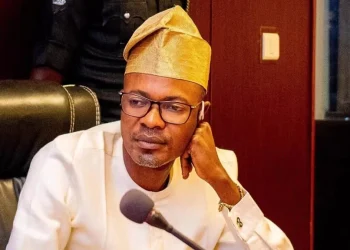


Onaolapo Ademola, a Nigerian man who happens to be one of the 12 associates of Yoruba Nation agitator, Sunday Adeyemo, aka Sunday Igboho, who were recently released on bail from the custody of the Department of State Services, has spoken up.
In this interview with KAYODE OYERO, Ademola narrates how the secret police raided the Ibadan residence of Igboho in a Gestapo style in the midnight of July 1, 2021, killing two associates and arresting him and other Igboho’s aides
Please tell us about yourself.
I am Prince Onaolapo Ademola by name. I am 32 years old. I’m a solar inverter expert. I deal in land and real estate and also have an online television.
What is your relationship with Sunday Igboho?
I am his ‘son’ and a follower. I am the director of his foundation, Sunday Adeyemo Foundation, for the past two to three years now. I also happened to be one of his media aides before we started the journey of Yoruba Nation.
How many years have you known Sunday Igboho and have been working with him?
I have known him for over 10 years.
Can you narrate what happened in the midnight of July 1, 2021 at Igboho’s residence in the Soka area of Ibadan?
It is an unforgettable day in the history of the Yoruba people because when everyone else was greeted, ‘Happy new month!’, we were greeted in a way we never expected; we were greeted as if we were in a battlefield. We woke up to find ourselves in that mess; it was a misuse of power by the present government of the Federal Republic of Nigeria. I’ve been minding my speech about the event of that day because a lot of us are still suffering from psychological trauma because what happened that day alone can take one’s life.
How did it all happen?
My house was not far from Chief Sunday Igboho’s house and being a father to me, I have access to him and he has to me. He did call to see me anytime to run errands for him. I was in my personal house around 12am but I had a message to pass across to him which I could not deliver by phone. I moved from my house to his residence at exactly 12am and met with him. We discussed till around 1am and were outside with some of our people till around 1:30am.
In his house, I have a chalet he allocated to me as one of his associates. At exactly 1:30am, he moved into his building, others retreated into their own apartments and I also moved into my own. But at exactly 1:35am, I started hearing gunshots and I wondered what was happening. My chalet is directly facing the main gate and I opened the window to peep to see what was happening outside. To my greatest shock, I couldn’t see anybody but I heard sporadic gunshots. Whenever I heard, ‘Fire!’, they would shoot at the building.
As a Muslim, I started reciting different verses of the Quran believing it might be the end of my life. While still peeping through the window, I could see two DSS personnel inside the house – they came through the fence because they could not force their way in through the main gate from outside. So, some of them jumped the fence and came in to open the gate for the others. When they opened the gate, I saw that they were dressed in black and were putting on helmets. They were dressed like they were on a battle ground, facing Boko Haram. I heard them calling themselves, ‘Come in two-two!’ I immediately woke the boy that was with me and told him that we needed to start preparing for our burial because there was no way to escape.
They were more than 100 personnel inside the building comprising the DSS and soldiers. They shot sporadically everywhere. When they got to any chalet or any of the rooms, they fired directly. I started praying and I’m thankful that God saved my life.
The shooting continued for three hours. When they got to my chalet, I opened the door for them. They marched on my head on the floor. I had collected around N300,000 from Chief (Sunday Igboho), which I wanted to use to buy something the following morning. One of the soldiers picked up the money. They demanded my gun and I told them, ‘Do I look like someone who can shoot? Do I look like someone who can operate a gun?’ They marched my head still and I was handcuffed. They then took me to the gate to lie down there with others.
At the gate, to my greatest shock, I saw one of my very good brothers, Saheed Oladams (Adogan), the Chief Executive Officer of Oladams Motors in Osogbo, in a pool of blood. Likewise Alfa. We were still together around 12:30am but the two of them were already gunned down.
After we had been handcuffed, and laid on the floor, they (security operatives) started destroying the vehicles in the compound, threatening to burn down the house and saying all sorts of things. They also made a roll call of the people in the house. That was what happened. But to the glory of God, here we are today.
The DSS spokesman, Peter Afunanya, said Igboho men engaged the operatives in a gun duel before you guys were overpowered after two of Igboho’s aides were gunned down. Who among you were firing at the DSS men?
Nothing of such (happened); nobody retaliated, nobody exchanged gunshots with them. You know the Nigerian military, if anybody had retaliated by exchanging gunshots, you know what would have happened. Those they were killed didn’t exchange gunshots with them (security agents). Alfa was an innocent man. He was killed in the waiting room of Chief Sunday Igboho while he was praying. He was a cleric and he could not see; he was blind. On getting to the waiting room, they (security operatives) just fired straight and gunned him down. Also, Adogan did not, in any way, exchange gunshots with them. He was shot in the bathroom where he was hiding.
What about the narrative that the security agents used a mortar to smash Adogan’s head when he refused to die after being shot?
Nothing of such (happened); he was shot in the bathroom.
As an eyewitness to the event of that midnight, exactly how many people died?
Two people died – Alfa and Adogan.
Where are their remains?
When we were being taken to the DSS office in Abuja from Ibadan, we got to Ekiti together with the two corpses. At the DSS office in Ekiti, we noticed that they took the corpses of Adogan and Alfa away in a Hilux vehicle. So, I believe their remains are with the DSS.
How many of you were arrested?
They arrested 22 people; 12 males and 10 females. When we got to Ekiti at the entrance of the DSS office, they freed nine of the ladies, after asking everyone, ‘Who is Lady K?’ So, they only took Lady K with the men to Abuja. Out of the 12 men, one of us was a police officer, an escort of Adogan. The officer was not paraded in Abuja. Instead, 12 of us, including Lady K, were paraded.
Has the officer been released?
Yes, he was released before us.
There were reports that the DSS picked up some cats found in Igboho’s house, CCTV brain box, among other things. What are the things the DSS took from Igboho’s house that night?
They took gold, money, our phones which are still with them. They went away with the CCTV, and one of the cats after killing about four or five cats. They went away with a big MP3; they went away with a lot of things. They went away with the cat, believing Chief Sunday Igboho turned to the cat.
The DSS also claimed in a statement that they recovered some guns and ammunition from Igboho’s house that night. How true is this?
They (the DSS) are in a better position to explain where they got that from. But there was a police officer in the house and he had a gun, maybe they took the gun of the police officer.
Was Igboho at home during the raid?
Yes, he was at home. The DSS saw him; they can’t deny that because that night, they came with three herbalists. After shooting at so many corners of the house, all of a sudden they couldn’t see him again, so they believed he was hiding, not knowing he was in the building. Chief Igboho is not an ordinary man; he is the Akoni Oodua of Yorubaland and a real son of Oduduwa.
When the DSS could not find him, they brought in their herbalists and they started chanting incantations wanting him to come back. The herbalists later told the DSS that Baba (Igboho) had turned to a cat. That was when they started killing the cats. I believe they know he has metaphysical powers, that was why they came in with herbalists to get him at all costs but God was not ready to put his life in the hands of the DSS.
How did you recognise the ‘herbalists’; were they donning amulets and charms?
They wore ordinary clothes, not traditional attire but when the DSS could not find Chief Sunday Igboho, they called them in and the herbalists started chanting incantations.
What is the number of security operatives that came for the raid?
The DSS operatives were more than 20 and most of them were from Oyo while the soldiers were more than 200. I could count about 87 vehicles when they were taking us away. They came with ambulances too, believing they were going to a war zone.
How did you know most of the DSS operatives were from Oyo State?
After they took us from the house, the number of DSS operatives that followed us to Abuja was reduced drastically.
Were the police also involved in the raid?
No, only the Nigerian Army and the DSS came that day.
If there were these many security operatives during that raid, as you have said, how was Sunday Igboho able to escape, while you, his aides, could not?
I am not fortified with anything but I believe in the Almighty God. Chief Sunday Igboho is a human being like everyone but he is a special creature. No one can face what he faced that night and escape. There was a lady in one of their vehicles that was saying, ‘Get him dead or alive!’
From Ibadan, you were whisked to Abuja the same day you were arrested. Can you briefly narrate your ordeal while with the secret police?
I was there for 62 days. It was part of the sacrifice, no going back. It was dehumanising to be in custody without seeing the sun or the moon for months, being maltreated, given food that a dog could not eat, sleeping on bare floor for 62 days, eating in the same place where I defecated, the same place where I urinated, the same place where I observed my prayers. We were given N20 Cowbell (milk) and a loaf of bread of less than N50 to eat per day. There was no access to lawyers, no access to family members. It was hell. It was a terrible experience which I do not wish for even my enemy.
In the DSS custody, what were the offences the secret police said you committed?
Offence? Even if I had committed an offence, is coming in the dead of the night to kill us the solution? I did not commit any offence.
When you were interrogated in the DSS custody, what were the questions they asked you?
They asked me personal questions and my purpose of being in Igboho’s house. They also asked for my bank accounts, Facebook name, my village address, they asked me a lot of questions. They asked me to tell them how long I had known Chief Sunday Igboho and I told them. I cannot disown him, no matter the situation.
Were you kept in an underground cell in DSS custody?
The first place we were kept for the first two days in the DSS custody was an underground cell where if anything happened, we couldn’t know. From there we graduated to another cell where we had access to Fulani, Hausa detainees who don’t understand English language. Some of them were suspected bandits and Boko Haram members. There were others who were not Hausa but suspected IPOB members.
How many detainees were kept in a single cell with you?
Three. It’s a small cell with useless settings for three people, one had to sleep by bending.
Were you kept with your associates or strangers?
We, the Igboho 12, were scattered into various cells. I was detained with Kanuri and Hausa suspects. We didn’t understand our individual languages. All that bound us together was Muslim solat. We couldn’t communicate. It was hell. It got to a time that those of us arrested in Chief Igboho’s house couldn’t sleep at night, we prayed all through; the Muslims observed Tahjud, midnight prayers, while the Christians held vigils.
How did the Igboho 12 pray together when you were in separate cells?
We prayed by raising our voices, both Christians and Muslims. We shouted to communicate when it was time for prayers. Of course, we recognised our different voices.
In all of this, do you have any regrets at all?
I suffered for my fatherland and I want my people to be liberated. This is a tyrannical government that has no respect for the rule of law.
Have you undergone any medical treatment after your release?
I would have died if I hadn’t undergone any medical treatment after my release. You can never be in DSS custody and come back without seeking medical attention.
How do you feel that you have been released on bail?
There is nothing like freedom. Even if you don’t have money but can move around, you should be grateful to God for that. So, I am grateful to God that I have been released.
Some three weeks after your arrest, your boss, Igboho, was also apprehended at an airport in neighbouring Cotonou in Benin Republic on July 19, 2021 and has since been behind bars. How do you feel about this development?
It is a sad development for us, his followers, that Chief Igboho, a man of honour and a philanthropist par excellence, was arrested but there is nothing we could do about it.
You claimed Igboho is not an ordinary man, which was why he was able to escape the DSS raid in Ibadan but he was subsequently apprehended in Cotonou. What do you think went wrong?
God understands everything.
Do you still believe in Igboho despite all that has happened?
I’m 100 per cent with him.
Do you still believe in Yoruba Nation agitation?
No going back, the struggle continues.