
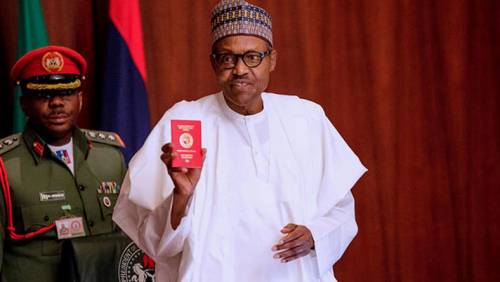
This report exposes the rot, racketeering, ethnic nepotism, complete failure of due diligence, and how an indicted cocaine trafficker has come to control the supply of passports to Nigerian citizens.
The investigation, which was done by Nigerian journalist, David Hundeyin and reported by West Africa Weekly, delves into how the rot in the system led to an embarrassing scarcity of passports for Nigerians at home and abroad.
“We acknowledge and apologise for the challenges faced in the past few weeks regarding passport booklets availability. I am glad to inform you that booklets are now available and are being distributed to all our passport issuing centres.”
With these words on March 31, former Comptroller-General of the Nigeria Immigration Service (NIS) Babandede verbally signed a cheque that the NIS would subsequently fail to cash. Through the course of his tenure as CG, Nigerians had become used to chronic passport booklet shortage and the associated black market arbitrage, but the shortage had become acute by 2021. He needed to make a statement to reaffirm his competence.
Speaking at the commissioning of the Maitama Passport Express Centre – itself a master class in formalised black market arbitrage – Babandede made that statement, and then some. A special team would be dispatched to “facilitate enrollment and production” of passports across Nigeria and its foreign missions. New passport offices to service air passengers would be sited at the airports in Lagos, Kano and Abuja. The new “premium passport processing centre” in Abuja would cut the length of passport issuance and renewal from several weeks to just 72 hours.
Ultimately, Babandede’s statement turned out to be just that – a statement.
From when he made these pronouncements until his retirement earlier this month, passport booklets continued to be a scarce and expensive commodity in Nigeria. Several factors were blamed for the baffling inability of Africa’s most populous country to provide passports for its citizens. Chronic corruption at the NIS; disputes between the NIS and a private contractor responsible for printing booklets; scarcity of forex to pay for security printing materials; even an alleged unofficial government policy to stem brain drain by making passports hard to access – all these have variously been blamed for this state of affairs.
As is so often the case in Nigeria, no theory or explanation should be dismissed out of hand, which is why when I set out to find out what is really behind the perennial shortage of these little green booklets, I was prepared for anything. Or at least I thought I was. What would emerge as I sank my teeth into this however, was not a story about supply chain disruptions or government inefficiencies. It was nothing like I had ever seen before, which is saying something.
Think Transformers meets Black Mirror meets Karishika, with protagonists who are part Elon Musk, part Lawrence Anini and part Bakin Zuwo. There is a murder in New York; a million dollar cocaine deal in Bogotá. Court cases in New Jersey; a legitimate high tech manufacturing operation in Kuala Lumpur; art exhibitions in Lagos; high society marriages; prominent placement in lifestyle and celebrity magazines, and the most comically brazen lawbreaking hidden in plain sight. If this story were a movie, it would be the conceptual offspring of Michael Bay and Ugezu J. Ugezu, which is to say, low on plot and purpose, but high on sheer crash-bang value.
There are 3 main characters in this story. Their existence and relevance was determined after speaking to 5 different sources within the NIS ecosystem. These 3, more than any other people, have had the most influence on passport issuance and the wider state of the Immigration Service. Unsurprisingly, the first name on the list is immediate past CG Muhammad Babandede.
None of my sources have any especially nice words to say about him, but neither do they have any bitter personal complaints either. The impression that comes through about Babandede is that of a fundamentally limited man who is neither virtuous nor especially malevolent. As one of the sources puts it frankly:
“He tried to make some moves such as the passport express centres, but it didn’t work out because he was just there to make money before he retired. He didn’t really care about fixing any systemic issues like staff motivation or the ISTL contract. All that one was not his business.”
The sources inform me that under Babandede’s tenure, complete opacity was institutionalised, with Immigration officers now not even knowing how much to expect on their payslip at the end of the month. Apparently during his tenure, NIS staff were migrated to the Integrated Payroll and Personnel information system (IPPIS), and with that went any sort of transparency regarding staff pay scales, deductions and entitlements. As a source colourfully puts it during one of our long conversations:
“It has now got to the point that you don’t know what will come in at the end of the month, and whatever it is that comes in – you just have to take it like that. The deductions vary every month so we don’t know how much we will take home. So tell me as a man with people depending on you, how else will you survive if not through ‘egunje’ (bribes)?”
While the sources mention different things that Babandede could have done to protect NIS staff welfare and morale, they all have one consistent criticism of him – his alleged ethnocentric posting policy. During his tenure they say, desirable NIS postings such as NIS offices in Lagos, were given exclusively to northerners, while the southerners working there were all posted out. The Ikoyi immigration office I am told, is now staffed almost exclusively by northerners – a state of affairs that would be impossible if the roles were reversed.
Under Babandede and even in these early days of his successor Idris Jere, the sources say, many northerners in the NIS, encouraged by the prebendalist disposition of their superiors, are keen to let everyone know that it is “their turn” and they are in power. Following Idris Jere’s appointment a source claims, the next most senior Deputy Comptroller – a southerner from Lagos – who might have been next in line to succeed Jere, was promptly transferred to Sokoto. At press time, I have been unable to independently verify this.
The other name that every source mentions is a certain “Liman” at the Ikoyi Passport Office. None of the sources bothers to hide how they feel about this fellow. This man and his extreme racketeering they say, is one of the major reasons behind Nigeria’s passport shortage. A bit of research brings up his name as Abdullahi I. Liman, a Deputy Comptroller in charge of the Ikoyi Passport Command of the NIS.
Every single source has a terrible story to tell about Abdullahi Liman. Liman they say, is responsible for the northernisation of the Ikoyi Passport Command. Even worse one source tells me, under Liman’s tenure, the atmosphere at the Command has taken on explicitly polarised ethnic and religious overtones. Take this anecdote from one of the sources for example:
“You can imagine that you are in the middle of doing a capture, then all of a sudden your colleague who is also capturing will just stand up and leave his station with a crowd of people there – because he says he is going to pray. You now end up doing his work for him, can you imagine that? This did not happen before Liman came in.”
Liman they say, is in the habit of pointedly using Hausa to converse with his subordinates at work, which automatically puts every southerner working under his command at a real career disadvantage. Speaking English – or in fact any other language but Hausa – at work is now a career demerit at the Ikoyi Passport Command under Liman’s watch.
A few days after I speak to this source, this story by the Foundation for Investigative Journalism was published, detailing persecution of a southern NIS officer at the Ikoyi Command in the exact ways described by my sources. Notice the reporter’s description of his interaction with Liman.
Up to this point, I have relied on testimony from sources I consider trustworthy, but even their knowledge of affairs at the NIS has its limits. While people like Abdullahi Liman are running rackets within the NIS to restrict access to passport booklets in large population centres like Lagos so as to create a lucrative black market, the sources are also clear that they believe that the NIS simply does not have enough passport booklets. To truly understand why the NIS appears to have not just a distribution problem, but also a supply problem with passport booklets, I had to figure out whose interests were served by the status quo.
First, a brief primer on how Nigeria’s passport system works.
Starting in 2003, Nigeria adopted the e-passport standard to defeat counterfeiting, resulting in a contract awarded to IRIS Smart Technologies Limited (ISTL) which commenced in 2007. The scope of the contract was to implement the Nigeria Harmonised ECOWAS Electronic (SMART) Passport Autogate Systems as well as to supply e-passport booklets, wafers, laminates and maintenance services from 2006 and 2015. ISTL is affiliated with Malaysia’s Iris Corp, which carries out the actual security printing services including supply of e-passport booklets.
The services that ISTL renders to the NIS include creating and maintaining the electronic database containing the passport details of Nigerian citizens, as well as maintaining the communication infrastructure that keeps a constant uplink between passport registration offices and the ISTL data centre. In case the reader has not seen the problem with this, allow me to spell it out clearly:
A private company working for a profit incentive has full and unrestricted access to the sensitive data of all Nigerian passport holders, but more importantly, it alone has access to this data. In other words, ISTL has more access to passport holders’ data than the NIS itself. ISTL does not actually produce passport booklets, but sub-contracts production to the Malaysian firm Iris Corp. Essentially, this company that most people have never heard of, controls a valuable sovereign database exclusively, and all it has to do is maintain a few dozen closed VSAT links from passport registration centres. Essentially, tech support.
This in fact caused a row between the NIS and the company in 2017 when the 10-year contract came up for renewal. Speaking to Daily Trust in 2017, some NIS insiders claimed the following: That the initial contract was a threat to national security because it vests control of the Country Signing Certification Authority (CSCA) – an official government seal – in ISTL, instead of the Nigerian government, which on paper is a risk factor for fraud;
That its implementation did not follow due process;
That the database and other infrastructure was paid for by the Nigerian government, but ISTL holds on to government property and uses tactics such as refusing to train NIS officers in the management of the system as a way to strong-arm the government into renewing its contract;
That NIS officers cannot conduct basic maintenance and repairs on the ISTL systems, meaning that the Nigerian government cannot withdraw from the ISTL contract without incurring catastrophic costs, which violates public procurement regulations;
That the contract had questionable exclusion clauses that gave undue advantage to ISTL at the expense of the Nigerian taxpayer.
The Malaysian company subcontracted by ISTL to print the booklets meanwhile, has found itself facing corruption probes by Malaysian authorities over its activities in other African e-passport jurisdictions such as Guinea. So putting this picture together, we have a tech support company that has somehow wrangled its way into a $138 million 10-year government contract (which was eventually renewed in 2019). Its main activity is maintaining equipment and an electronic database, and it sub-contracts passport booklet printing to a company halfway around the world whose executives have been arrested on corruption charges.
For the purpose of balance, it must be pointed out that the $138 million figure is not paid by the government, but rather comes from the company’s revenue generation activities within the scope of the e-passport project. It is also important to point out that the criticisms of the ISTL contract were possibly made in bad faith by individuals who merely wanted to replace ISTL with their own companies. Indeed, the senior NIS official quoted by the Daily Trust in 2017 remarked, “[The controversy] is between contractors who want the contract. The NIS’ concern is simply the supply of the booklets.”
It is also important to mention that the cost of sub-contracting Iris Corp to print the booklets is paid is USD, while ISTL’s revenue comes in naira, with the CBN refusing to provide forex for the company. This I am reliably informed, is the material reason behind the chronic booklet shortages since 2017 – the cost of printing passport booklets has more than doubled in dollar terms since 2015. Hence, ISTL simply cannot afford to print as many booklets as before.
With that being said, we now know that there is an incredibly lucky or powerful entity behind ISTL. Who is this person? This is where the story really takes a few turns, so hold on to your hats.
High Society Gentleman or Ex-Cocaine Trafficker?
On its website, ISTL describes itself as a “major subsidiary of the flagship company, Image Technologies Limited (Imagetech).” A quick CAC database check on Imagetech brings up the elusive character behind the curtain.
For a Lagos socialite, Olayinka Fisher is a man who somehow keeps a decidedly low profile. For one thing, while researching this story, establishing what exactly his name is turns out to be quite the task. In some places, he is “Yinka Fisher.” In some other places, he is “Olayinka Fisher.” In still other places, he is “Olayinka Fischer” or “Sonayon Fisher.” Only in a few places that he would rather the world did not know about, does his full and correctly spelled government name appear: “Olayinka Sonayon Fisher.” So who is this guy and what is there to him?
Quite a bit, as it turns out.
The story starts in Mr. Fisher’s previous iteration as a high flying Nigerian diplomat in in mid-to-late 1970s. At the time, when he was still known to the world as Olayinka Sonayon Fisher, he was the Second Secretary of the Nigerian Mission to the United Nations.
Researching the many variants of his name online, references to his diplomatic career can be seen right up until about 1980 when he seems to vanish off the face of the historical earth. In 1989, he resurfaces on CAC documents in Nigeria as the majority shareholder in a new company called Imagetech. Presumably at this point, the high-achieving diplomat has decided to pivot into a career in tech entrepreneurship. Nigeria being what it is, nobody ever really bothers to ask why, and by 2003 he is signing the contract above for ISTL under President Olusegun Obasanjo.
The good times are rolling. Following the end of his marriage to River State scion Doris Amachree, he weds Dr. Pius Okigbo’s daughter Anne. He becomes an avid art collector and patron of the arts. He hosts art exhibitions with the Spanish Embassy in Lagos, which are co-curated by both of his sons who share his love of the visual arts. To all intents and purposes, he is the SI unit of the classy and respectable old money Lagosian. There’s just one problem:
According to U.S. court records, Mr. Fisher allegedly used to be part of an intercontinental cocaine smuggling ring.
I obtain the following documents from the United States District Court for the District of New Jersey. They detail court proceedings from a 1983 case involving a violent drug dealer wanted for a murder in the Bronx, New York, a successful American businessman who dabbled into the illegal drug business with him, and a Nigerian diplomat who used his diplomatic immunity to traffic shipments of cocaine into the U.S. on their behalf.
The diplomat’s name? A certain Olayinka Sonayon Fisher.
According to Tracy Wong, the indicted American businessman, he paid Fisher the sum of $50,000 for a single shipment. The indictment further states that this arrangement lasted for at least 2 years with multiple Cocaine trafficking trips made worth several million dollars. Exactly how much Fisher made from this arrangement in total is a question only he can answer, but it certainly raises a few interesting questions.
Perhaps the most telling part of this story is that following the release of this NYT article and his subsequent exit from the diplomatic corps, Fisher appears to have intentionally dropped all mention of “Sonayon” from his name. In fact, it took the extraordinary step of making a few calls to my hometown Badagry, where the name “Sonayon” also originates from, to confirm his identity. The fact that this has somehow slipped under the radar for decades despite his custody of one of the most sensitive databases in Nigeria is a sign of a catastrophic failure of state intelligence and due diligence.
Making this point further, I speak to a lawyer, Solomon Igberaese to give his professional opinion of this issue. He points out that according to the Public Procurement Act 2007, someone with Fisher’s background should have been disqualified from the public procurement process. In his words:
“Falsification of fact can be interpreted to also include drug trafficking. Carrying out drug trafficking under any other guise will constitute falsification of fact. That he concealed packages inside diplomatic pouches certainly qualifies as falsification of fact. Again the section said falsification of facts relating to any matter.”
So there we have it – possibly the most mind-bending story in Nigeria’s rich history of dodgy public procurement and contracting. For added measure, the third person in the drug ring, a career drug dealer called Joseph Anthony Margarite was also wanted in connection with a murder at the time of his involvement with Wong and Fisher.
The full and unredacted set of court records relating to this case is available here.
If you enjoyed this story and you want to see more in-depth investigative work like this, kindly support independent journalism by purchasing a subscription using the button below.