
Connect with us

News

Lagos Explosion: BBC Africa Eye Evidence Contradicts Official Explanation

Published

on

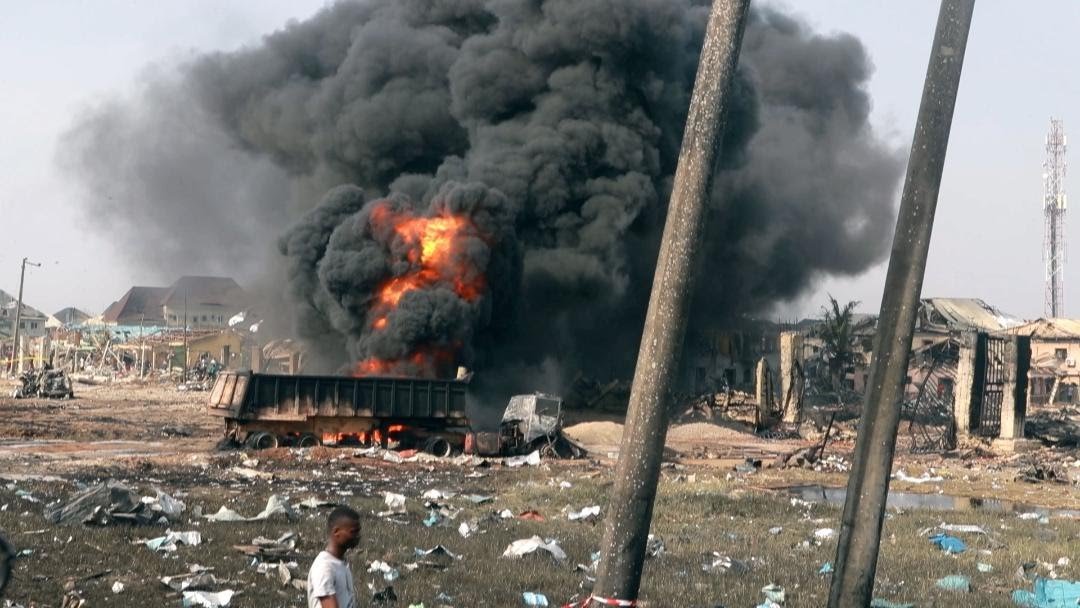
BBC Africa Eye has contradicted official explanation for the cause of an explosion which killed 23 people and destroyed a girls boarding school in Lagos.

The Nigerian National Petroleum Corporation (NNPC), the country’s state-owned oil firm, claimed the explosion occurred as a result of a truck that hit gas cylinders near one of its petroleum pipelines.

But new evidence indicates this official explanation for the cause of the blast, that decimated over 100,000 square metres of Lagos, is incorrect.

The blast occurred in Soba, a residential neighbourhood of Lagos on March 15, 2020 at 8:56am.

New video evidence, filmed at the explosion site, five minutes before the blast, shows a catastrophic leak of vaporised liquid at the exact location where the NNPC high-pressure petroleum pipeline runs beneath the ground through that area.

The BBC found there was no gas processing plant at the explosion’s epicentre.

Moreover, analysis of gas cylinders found at the site after the blast indicated they could not have been at the centre of the explosion when it happened.

Three specialist engineers – experts in LPG gas safety, in petroleum pipeline safety, and in explosions analysis – who have examined video footage all confirm the huge leak of vaporised liquid could not have come from gas cylinders.

Eyewitnesses the BBC heard from corroborate this.

None of them mentioned gas cylinders or saw a collision.

But four of them independently said the leak was coming out of the ground beside the heavily laden truck.

The evidence the BBC has uncovered indicated the heavily laden truck stopped on an eroded, unsurfaced road that had been softened by rainwater.

This could have pressured the pipeline to breaking point, releasing a cloud of vaporised flammable petroleum product that ignited.

But petroleum pipeline safety expert, Dr. Ambisisi Ambituuni, told the BBC the System 2B pipeline network has “been in existence for way over the lifespan of the pipeline”.

Ambituuni asked: “How is it so difficult for the operator to maintain the safety of those pipelines?”

After watching the film, Ebun Olu Adegboruwa, human rights activist and senior Lawyer, said: “Incidences of fire disasters have become commonplace for Lagosians.

“It just more or less reiterates the need for the government to be responsive and to hold accountable those who are working in the sector in terms of maintaining global best practice in their operation.”

The NNPC were contacted and denied the pipeline was inadequately protected, reaffirmed their explanation for the explosion’s cause, and said there was no leakage prior to the explosion.

They also said: “NNPC pipelines comply with safety and regulatory guidelines” and that they “worked closely with the Lagos State Government in providing a N2billion relief fund for the victims of the explosion.”

Advertisement

News

Oyo 2027: Adelabu Quits As Power Minister To Focus On Guber Race

Published

on

By

The Minister of Power, Adebayo Adelabu has formally resigned from his position in the Federal Government to pursue his governorship ambition in Oyo State.

In a resignation letter dated April 22, 2026, and addressed to the President, Adelabu stated that his resignation will take effect on April 30, 2026, to enable him to focus on his governorship ambition in Oyo State.

The letter, routed through the Office of the Secretary to the Government of the Federation, stated that he was stepping down with “a deep sense of honour and profound gratitude.”

He wrote, “I write with a deep sense of honour and profound gratitude to formally tender my resignation as the Honourable Minister of Power of the Federal Republic of Nigeria. This resignation is to take effect on 30th April 2026, in order to allow sufficient time for a smooth and orderly handover of responsibilities.”

Adelabu thanked the President for the opportunity to serve, describing his appointment as a privilege.

He said, “Your Excellency, I remain sincerely grateful for the privilege and confidence you reposed in me by appointing me to serve our great nation in this capacity.

“It has been a rare honour to contribute to national development under your leadership and to play a role in advancing reforms in the power sector—one of the most critical foundations of Nigeria’s industrial growth and economic transformation.”

The former minister said his resignation was to enable him focus fully on his governorship ambition in Oyo State, citing provisions of the amended electoral law.

He added, “My decision to step down is informed by my intention to focus fully on my gubernatorial ambition in Oyo State. This aspiration, which dates back to 2016 during my service as Deputy Governor of the Central Bank of Nigeria, ultimately led to my voluntary resignation from the Central Bank in 2018 in order to pursue the same goal.”

“In line with the provisions of the Amended Electoral Act 2026, which preclude political office holders from contesting elections, I consider it both appropriate and necessary to resign at this time.”

Adelabu’s exit marks a major political development ahead of the next electoral cycle, particularly in Oyo State, where he is expected to contest the governorship election.

Continue Reading

News

Wale Edun, Musa Dangiwa Resigned Voluntarily, Not Sacked – Presidency

Published

on

By

The Presidency has clarified that Wale Edun (former Finance Minister) and Ahmed Musa Dangiwa (former Housing Minister) voluntarily resigned from their positions and were not sacked by President Tinubu.

In a statement released this evening April 22, presidential media aide, Bayo Onanuga, said that contrary to public opinions, Wale Edun resigned on health grounds while Dangiwa also tendered his resignation and thanked the President for the opportunity given him to serve in the Federal Executive Council.

Onanuga stated that Edun, who clocked 70 on Monday and has battled recent ill health, fittingly submitted his resignation letter on his birthday, thanking the President for the opportunity to serve Nigeria.

“It has been a pleasure and privilege to serve your administration and the Renewed Hope Agenda, Under your leadership, Nigeria has emerged stronger, more resilient and more internationally respected. I wish you and the administration every success in the future” he wrote

Onanuga stated that on Tuesday, before the Office of the Secretary of the Government of the Federation announced his departure from the Cabinet, Edun paid a valedictory visit to the President at the Villa and held an hour-long discussion with the president and then left to focus on his private businesses.

The presidential aide stated that President Tinubu has expressed deep appreciation to Edun and Dangiwa for their dedicated service and significant contributions to the administration’s economic reform programme and wished them continued success in their future endeavours.

‘’In the same vein, the President has urged the new Minister of Finance, Taiwo Oyedele, to consolidate ongoing reforms and advance the administration’s fiscal and economic objectives with renewed focus, discipline, and innovation.

President Tinubu will shortly send the ministerial nominee for housing, Muttaqha Rabe Darma, also from Katsina, like Dangiwa, to the Senate for confirmation” the statement concluded

Continue Reading

News

Unity Bank, Experts Advocate Green Investment, Climate Innovation To Drive Economic Resilience

Published

on

By

Nigeria’s retail lender, Unity Bank Plc, alongside leading climate innovation experts, has called for increased investment in the green economy and the adoption of frontier technologies as critical pathways to driving economic resilience and reducing the impact of climate change on vulnerable populations across Africa.

The call was made during a thought-provoking webinar hosted by the Bank to commemorate this year’s Earth Day, themed “The True Cost of Climate Change and Who Pays?”. Climate experts and stakeholders convened to examine the human, economic, and institutional costs of climate change, while spotlighting practical solutions to address its growing impact.

In his opening remarks, Unity Bank’s Head of Strategy and Innovation, Ibukun Coker, emphasised the urgency of addressing climate risks from both a societal and business perspective.

He said: “Climate change is no longer a distant or abstract challenge. It is an existential threat with direct consequences for individuals, businesses, and economies. At Unity Bank, we recognise the role institutions must play in incorporating sustainability in project financing, supporting businesses and promoting solutions that build resilience in communities where we operate.”

The webinar featured Chinwe Udo-Davis, Founder and CEO of Instollar, and Oluwatosin Ajide, Programme Manager at the Nigeria Climate Innovation Centre, both of whom provided insights into the drivers of climate change and the pathways to mitigation and adaptation.

Speaking during the session, Udo-Davis highlighted the disproportionate burden which climate change places on underserved communities and the need for inclusive solutions.

“The true cost of climate change is not evenly distributed. Communities with the least resources are often the most affected, whether through energy poverty, environmental degradation, or limited access to sustainable alternatives. Addressing this imbalance requires intentional investment in clean energy solutions that are both accessible and scalable.”

Ajide underscored the importance of coordinated, system-wide approaches in tackling climate challenges, particularly through innovation and policy alignment.

“Climate change is fundamentally a structural problem, and its solution requires a paradigm shift: from innovation and policy to financing and implementation. Stakeholders must work collaboratively to drive solutions that are sustainable and inclusive.”

The session also explored emerging opportunities in climate technology, renewable energy, and ecosystem financing, reinforcing the role of innovation and cross-sector collaboration in building long-term resilience.

By hosting the webinar, Unity Bank continues to demonstrate its commitment to advancing sustainability-focused dialogue and supporting initiatives that promote responsible growth and environmental stewardship.

The initiative underscores the Bank’s broader strategic focus on environmental sustainability as well as its commitment to financial inclusion.

Continue Reading

Trending