
News
Aishat Buhari confirms husband doesn’t rule Nigeria.
When I publicly voiced my concerns in 2018 that Muhammadu Buhari was too cognitively and physically ill to have the capacity to govern Nigeria and that the country was being ruled on his behalf by an unorganised and unelected gaggle of corrupt cronies and family members, some people didn’t believe me.
But his wife’s unprecedentedly stinging public censure of presidential spokesman, Garba Shehu and Mamman Daura, Buhari’s nephew, on December 11, 2019 provides evidentiary grounding for what most of us have always known and said: that Buhari is too weighed down by dementia and physical infirmity to even control his immediate family, let alone rule a country of nearly 200 million people.
In my January 19, 2019 column titled “Buhari’s Physical and Mental Health is now a National Emergency,” I noted the following:
“On November 23, 2018, for instance, I tweeted that a doctor who has met Buhari during a personal, non-medical visit told me he was troubled that Buhari appeared to evince tell-tale symptoms of dementia (of which Alzheimer’s disease is a type), which is often characterised by repetitiveness, unawareness, mental deterioration, impaired memory, diminished quality of thought, slurred speech, and finally complete helplessness.”
“A friend whose dad has dementia and who has also met Buhari in the recent past had earlier told me Buhari reminded her of her dad whom she forced to retire, adding, sadly, that Buhari’s dementia is way worse than her dad’s is. She was, and still is, concerned that Nigeria has no president. She’s right, and the evidence stares us every day. Buhari barely has any awareness of his existence, much less the requirements of being president…
“People around the president are intimately familiar with his considerably diminished sentience and his notoriously declining short-term memory.
As a consequence, he is being taken advantage of by several people close to him. Aso Rock insiders say Buhari doesn’t remember anything, so no one even obeys his instructions–if he gives any at all. The last person to see him gets him to do whatever they want. Someone from the Presidential Villa told me it’s precisely because of this fact that governors frequent the Villa several times in a week; they are in a race to be the last people to see the president before he takes decisions and signs off on them.
“If you think with Buhari as president Nigeria has a president, you should sue your brain for non-support; you’re NOT thinking! We have a national emergency on our hands. Buhari appears infirm both in mind and in body. Without a doubt, other people are ruling on his behalf, and his own wife hinted at that when she said her husband’s presidency had been hijacked by a three-man cabal.”
Aisha also told TVC’s, “Journalists’ Hangout” that she doesn’t have private conversations with her husband. “There is no pillow in the villa,” she said. “No, because we are always busy listening to one story or another. I think the people he puts in the cabinet, they should just sit up and do the needful. That is why it is not good to have godfatherism.”
A lot of people were flustered by the revelation that she has no access to her husband. But I am not.
I actually hinted at that in my October 22, 2016 column titled “Aisha Buhari and the Evil Aso Rock Cabal.”
Here’s what I wrote:
“This [her BBC Hausa interview chastising her husband’s government] can only mean that although Aisha is formally married to President Buhari, she is actually isolated from him. This is consistent with what I’ve heard from inside sources about the relationship between the first couple. Buhari is held hostage by an evil, sneaky, corrupt, vulturous, and conniving cabal that ensures that his wife doesn’t see him even in the ‘kitchen,’ the ‘living room,’ or ‘the other room.’
“The BBC interview was Aisha’s vigorous ventilation of pent-up anguish against a cold, calculating, and corrupt cabal that has made Buhari a stranger to his own wife.”
And I had written about Aisha’s December 11 revelation that Garba Shehu and other Aso Rock media aides have no access to Buhari and take directives from Mamman Daura and other unelected Buhari cronies and family members.
In my August 26, 2017 column titled “Garba Shehu, Presidential Villa Rodents and Bad PR,” I wrote the following, which Aisha just confirmed:
“First, it’s obvious that both Adesina and Shehu don’t have a robust, direct access to the president. Directives don’t seem to always come directly from the president to his media aides. It’s usually, it would appear, from the president to a tortuous labyrinth of surrogates before it gets to the media team. Most of the times, it’s actually influential people connected—or thought to be connected—to the president who dictate what the presidential media team says to the public.
“I recall an incident in late 2015 that left me in no doubt that the president’s media team members don’t enjoy the respect usually accorded to presidential spokespeople. I was having an argument with someone close to the Buhari presidency over something, and he suddenly said, ‘I will tell the president’s media team to issue a statement to clarify this.’ A few hours later, a statement was issued expressing the exact sentiments of my interlocutor who isn’t even officially a part of the government. That blew me away.
“So, basically, the presidential spokespeople are mere errand boys of Buhari’s shadowy surrogates and a motley crowd of official, semi-official, and unofficial power brokers who pull the levers of power in the presidency.
“No public relations person, however smart he might be, can function optimally in the kind of politically toxic and factious environment that the Buhari presidency exemplifies.”
I warned Nigerians in the run-up to the 2019 election that if they voted APC, they were voting Mamman Daura and Abba Kyari, not Buhari who is barely aware of his own existence. People who thought I was merely being mischievous are now coming to terms with what I said.
For selfish reasons, Aisha won’t reveal the true state of her husband’s health, but she’s opportunistically railing against someone who is taking orders from people who hold the real power. As they say, nature abhors a vacuum. If Buhari can’t exercise power, others will exercise it on his behalf and in his name.
If Nigeria weren’t the dysfunctional theatre of the absurd that it is, the revelations from Aisha Buhari would be regarded as a national emergency.
The National Assembly would have constituted an independent team of medical experts to examine the state of Buhari’s physical and mental state.
Prof Farooq Kperogi


News
DSS Releases Ogun Pastor, Associates Following Public Outcry Over Arrest
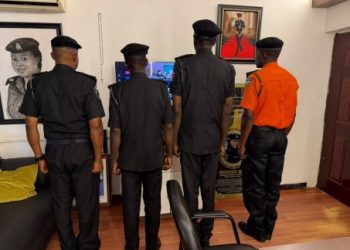
Operatives of the Department of State Services (DSS) have released Ogun State-based pastor Kayode Olawoye and two of his associates, Johnson Idowu and Korede Oluwadare, following intense public outcry.
Olawoye became an internet sensation following his exposé on the poor state of some roads in Ogun State, which he had repeatedly drawn to the attention of the state government.
A family source close to Olawoye confirmed his release in a telephone conversation with PUNCH Metro on Tuesday.
In an earlier interview with our correspondent, Olawoye’s family had raised concerns over his detention after he was allegedly invited by the DSS.
Speaking with PUNCH correspondent earlier on Tuesday, Olawoye’s wife, Shola Olawoye, said her husband received a phone call from the DSS on Sunday evening, asking him to report to its Ogun State office by 2 p.m. on Monday, January 19, 2026.
According to her, the officials described the invitation as a “friendly interrogation visit,” assuring him that it was nothing serious.
She said Olawoye arrived at the DSS office at about 1:30 p.m. on Monday but was held without family members having access to him, adding that several efforts made to reach him proved abortive.
She also noted that two other associates, Benjamin Olaleye and Joshua, who accompanied him to the DSS office, were also detained.
“I have not been able to speak with him since he entered the office. I don’t know his condition—whether he has eaten or even taken water. The people who went with him also had their phones seized, and we have not heard from any of them,” she said.
Shola said that while she was at the DSS office to inquire about her husband’s welfare, she was told to leave and return later, with assurances that he would be released after questioning.
She added that she waited until late Monday night and into Tuesday morning without receiving any update on his status, adding that the detention may be linked to his continued advocacy for the improvement of road infrastructure across the state.
She continued, “This is a man who is fighting for grassroots governance. He is not a criminal. He is not fighting or abusing the governor. He is not anti-politics, anti-peace, or protesting. He is simply saying, ‘Our governor should fulfil his campaign promises.’ That is all he is doing, and I don’t understand when being civil became a crime in my state.
“I do not know when being civil and asking for your rights turned into a criminal offence. He has been detained as if he were a criminal. Bandits are on TikTok and everywhere, yet the DSS has not detained any of them.
But they have detained my husband since yesterday. It has been almost 24 hours now, and I have not heard anything from him. I need the help of the whole of Nigeria.”
Another family member, who did not want to be named, explained that Olawoye had been invited on two occasions in the past and had always honoured the invitations.
The family source said this was the third time Olawoye had been invited by the DSS, adding that during previous visits, he was questioned about his public commentary on the condition of roads in Ogun State.
The source alleged that DSS officials had repeatedly asked whether he was sponsored to publicise poor road infrastructure in the state, an allegation Olawoye denied, maintaining that he had no sponsor.
“The first time he was invited, I was with him at the meeting. They asked who was sponsoring him to showcase the bad roads that Governor Dapo is not fixing. He replied that nobody was sponsoring him and that he was instructed by God to speak out about the bad roads so that the governor would fix them.
“The second time, they asked him the same question again—that he should name the people sponsoring him. He told them nobody was sponsoring him,” the family member said.
The news of his detention, however, sparked public outcry, with social media users condemning the action.
Reacting to the detention, Amnesty International Nigeria, condemned Olawoye’s detention in a statement on Tuesday.
The human rights advocacy group described the detention as unlawful and abuse of human rights.
The statement read, “The Nigerian authorities must end the incessant intimidation and harassment of Pastor Kayode Olawoye — a cleric widely known for advocating for better road infrastructure in Ogun State.
“Subjecting such a peaceful advocate for good governance to bizarre intimidation by the Department Of State Services is unlawful. The advocacy of Pastor Kayode is justified given the shocking and deplorable state of roads in Ogun — his state. Criticizing Gov. Dapo Abiodun is not crime.
“The authorities have an obligation to uphold and protect fundamental human rights. Instead of investing in desperate attempts to punish activists, the government should be listening to them and doing more to addressing people’s concerns.”
In an update on Tuesday night, the family source told our correspondent that Olawoye and the two associates who were with him had been released.
The source said, “Mr Olawoye and the two associates have been released. They were freed on Tuesday night after more than 24 hours in detention.”
Meanwhile, when contacted on Tuesday, the State Director of the DSS in Ogun State, Peter Afunanya, did not respond to messages sent to his line, nor did he pick calls placed to him as of the time of filing this report.
The governor’s Special Adviser on Information and Strategy, Kayode Akinmade, asked our correspondent to call back when contacted on Tuesday.
He was, however, not reachable as of the time of filing this report.
News
Unity Bank Unveils Enhanced Unifi Mobile App To Deepen Digital Banking Experience
Nigeria’s retail lender, Unity Bank Plc, has launched an upgraded version of its mobile banking platform, Unifi, as part of ongoing efforts to improve customer experience on the Bank’s digital Banking platform and reinforce its proposition in ebusiness.
The latest update, Unifi version 2.3, introduces a suite of improved features designed to enhance usability, security, and convenience for customers. Key upgrades include enhanced security protocols, expanded quick-action functionalities, improved bill payment options, and an updated Nigeria Quick Response (NQR) feature to support faster and more secure QR code transactions.
A key aspect of the rollout builds on the Bank’s continued investment in digital and security infrastructure, aimed at safeguarding customer data, ensuring secure payments and enabling safe, real-time transactions across channels.
Speaking on the upgrade, Adenike Abimbola, Divisional Head, Retail, SME, Digital Banking & Fintech Partnerships at Unity Bank, said the improvements are built on the back of continuous interrogation of the platform to be more responsive to customer feedbacks which are being received overtime in our interactions and engagements.
“Digital banking has become an integral part of everyday life, particularly for retail customers who expect speed, dependability, convenience, and security as standard. With the latest upgrade to Unifi, we are responding directly to these expectations by enhancing functionality, strengthening security, and simplifying key payment and transaction journeys. Our goal is to ensure that customers can carry out their banking activities seamlessly, confidently, and without friction, anytime and anywhere.”
She added that the Bank remains committed to continuous improvement of its digital channels in line with evolving customer needs and emerging industry trends.
“As mobile banking increasingly defines how people interact with financial services, Unifi is central to our strategy of delivering intuitive, reliable, and inclusive digital solutions. We will continue to invest in technology partnerships and platform enhancements that support financial inclusion, drive adoption, and improve overall customer experience.”
Originally introduced as part of Unity Bank’s strategic push to expand its retail footprint, particularly among young and digitally savvy customers, Unifi has grown into a core engine of the Bank’s retail banking expansion. The platform plays a critical role in driving customer acquisition, deepening engagement, and reinforcing Unity Bank’s broader digital transformation agenda.
The Unifi mobile app is available for download on Android and iOS devices, offering customers access to a wide range of services, including transfers, bill payments, airtime purchases, and QR-enabled transactions.
News
Recapitalisation Explained — Where Access, FCMB And Others Fit
Nigeria’s banking sector is being reshaped by one of the most ambitious recapitalisation programmes in its history.
If you bank, invest, or do business in Nigeria, understanding how this works and where each bank stands matters.
In 2024, the Central Bank of Nigeria raised minimum capital requirements and introduced three banking “tiers”: regional, national, and international.
Banks have until March 31, 2026, to comply.
Here’s what that means:
International banks need ₦500bn in paid-up capital
National banks need ₦200bn
Regional banks need ₦50bn
Paid-up capital is key. Retained earnings don’t count.
Several banks, including Access Bank, Zenith Bank, GTBank, UBA, Fidelity Bank, and First Bank of Nigeria, have already met the ₦500bn threshold and secured international licences.
Others, such as Stanbic IBTC, Citibank Nigeria, and Wema Bank, have secured national licences and appear focused on domestic operations.
First City Monument Bank, a subsidiary of FCMB Group Plc, sits between these groups. In 2024, it raised ₦147.5bn in a public offer, pushing its banking subsidiary above ₦200bn in paid-up capital and securing its national licence. That means FCMB’s core banking operations are not at risk under the new rules.
The bank is now raising additional capital to reach the ₦500bn mark required for an international licence.
This includes further share sales and shareholder-approved funding options. Regulatory review is ongoing.
Why does this matter to customers? A bank’s licence affects what it can do.
International banks can finance cross-border trade and large projects. National banks focus on domestic lending. Both are viable models.
For FCMB customers, the national licence already ensures continuity.
The international licence would expand services beyond Nigeria into the rest of Africa and the world.
The recapitalisation is also driving mergers, downgrades, and niche strategies across the sector, making Nigeria’s banking system more structured and transparent.
By 2026, the system will be stronger, not because every bank has become international, but because each has chosen a sustainable path.