Business
Heritage Bank, PWC, Deloitte canvass use of tech to rescind effects of Covid-19, tackle fraud
Heritage Bank Plc, Nigeria’s Most Innovative Banking Service provider has called on internal auditors of banks to adopt the various digital technologies to prevent fraud and annul the adverse impact of Covid-19 on the financial ecosystem.
Speaking at the just concluded 47th Quarterly Meeting of the Association of Chief Audit Executives of Banks in Nigeria (ACAEBIN), the MD/CEO of Heritage Bank, Ifie Sekibo disclosed that for improved banking operations and safer financial system for stakeholders, internal auditors must be dynamic and quick to adopt various digital measures.
Raising the alarming impact of fraudulent activities in the banking sector, Sekibo quoted PricewaterhouseCoopers’ (PWC’s) Global Economic Crime and Fraud Survey 2020, revealing that that the total cost of cybercrimes is worth an eye-watering $42 billion, which was cash taken straight off companies’ bottom line, whilst 13% of those who had experienced fraud said they had lost $50 million-plus.
Sekibo, who spoke on the theme, “Elevating Internal Audit’s Role in the Face of Emerging Risks and Opportunities” organised virtually and hosted by the Heritage Bank, urged, “While it was sufficient for yesterday’s auditor to understand regular and routine banking practices such as credit, treasury, etc in his traditional assurance role, for him to be relevant in harnessing the opportunities in today’s business world, he must become versed in cybersecurity, artificial intelligence, data analytics, fraud management, regulatory pronouncements, forensics etc and having equipped himself, present balanced, objective audit reports to Executive Management while striking the right balance between the assurance and consulting responsibilities.”
In her keynote address, titled, “Elevating Internal Audit Role In The Face Of Emerging Risks and Opportunities,” Ibukun Beecroft, Partner Risk Advisory at Deloitte, noted that the banking industry in Nigeria today has adopted various digital measures to keep the business running and delivering services to the customers but there was need for Internal Audit (IA) positioned to provide the required assurance and consulting services in the face of the changes and attendant risk, particularly increased cyber-risks.
Quoting 2018 Financial Stability Report by the Central Bank of Nigeria, she stated that Banks recorded 25,029 confirmed cases of fraud and this resulted in a loss of N2.21 billion. More than 90% of fraud cases in 2018 were perpetrated via technologically driven channels.
“As Internal Auditors, the knowledge of technology would enable us identify gaps in our core banking applications and other applications and provide relevant recommendations to eliminating loopholes that may serve as an avenue for potential fraud.
She, however, advised auditors on the need to focus on advanced technologies and risk management operations as reflected around the Three Lines of Defense (3LOD) churned out by the Institute of Internal Auditors, which create opportunities for IA and its future role.
Beecroft warned that the ever-changing landscape and evolving risks in the banking industry could render the current internal audit plan obsolete.
According to her, internal auditors should reprioritise the audit plan as soon as possible to provide assurance over the most consequential risks while being cognisant of the impact on operations.
“To take advantage of these changes and disruptions, auditors need to rethink their role by adapting to and embracing change, enabling the IA function to become more agile, nimble, and forward-looking, thus driving change through the 3LOD,” Beecroft stated.
Yetunde Oladeji, Director Internal Audit Services at PricewaterhouseCoopers Limited (PWC), who spoke on the theme, “Elevating IA’s role to meet today’s emerging risks,” advised that the banking sector should be dynamic, prioritse digitization and flexibible workforce strategies as these would determine its ability to adapt to rapidly changing circumstances to survive and thrive.
Business
Union Bank’s Union Cares Initiative Celebrates Academic Excellence at Pacelli School for the Visually Impaired Graduation
Union Bank of Nigeria proudly participated in the graduation ceremony of the Pacelli School for the Visually and Partially Sighted on 23 July 2025, honouring the resilience and academic achievements of visually impaired students.
The event, held on the school premises, highlighted the importance of inclusivity and determination in education.
As a 108-year-old institution committed to social responsibility, Union Bank’s involvement reflects its enduring support for Persons With Disabilities (PWD) and its dedication to fostering equitable access to education.
The Bank’s Chief Brand and Marketing Officer, Olufunmilola Aluko, expressed her admiration for the graduating students:
“Union Bank proudly stands as a champion of inclusiveness and equitable representation. Through our UnionCares corporate social responsibility initiative, we are committed to supporting vulnerable and underrepresented communities.
We celebrate the incredible achievements of these students and reaffirm our dedication to empowering them to reach their full potential.”
UnionCares is Union Bank’s CSR Arm focused on creating sustainable social impact in key areas, including:
• Support for Vulnerable Groups: Empowering persons with disabilities and other marginalised communities through inclusive initiatives.
• Education and Skill Development: Facilitating access to education and practical skills that promote self-reliance and opportunity.
• Community Well-Being: Enhancing the overall quality of life of communities through health, education, and social welfare projects.
Union Bank remains honoured to collaborate with institutions dedicated to uplifting less-recognised members of society. The Bank remains dedicated to championing initiatives that inspire positive change, and foster a more inclusive, enlightened community across Nigeria.
Business
Fidelity Bank ED, Kevin Ugwuoke Takes Over As President Of Risk Managers Association
Kevin Ugwuoke, Executive Director and Chief Risk Officer of Fidelity Bank Plc, has formally assumed office as President of the Chartered Risk Management Institute of Nigeria (CRMI).
His leadership promises a reform-focused era anchored on policy advocacy, ethical standards, and digital innovation to deepen risk governance across sectors in the country.
Speaking during the presidential handover ceremony in Lagos over the weekend, Ugwuoke — who also doubles as acting President of the Federation of African Risk Management Associations (FARMA) — described his election as “a call to action.”
He pledged to reposition CRMI as a thought leader and institutional partner in shaping the future of risk management in Nigeria’s national development.
“Our mission is more than just certification; it’s about strengthening the culture of risk governance across sectors. We will collaborate with regulators, raise awareness, and provide practical tools to help organizations embed risk discipline at all levels.”
Ugwuoke outlined a five-pronged strategy to guide his administration: strengthening professional education and certification; deepening policy and regulatory engagement; accelerating digital transformation; integrating ESG and climate risk into corporate strategies; and mentoring the next generation of risk practitioners.
He explained that CRMI will align its initiatives with key policy institutions — including the Nigerian Economic Summit Group, the National Assembly, and sub-national governments — to help embed robust risk frameworks into economic development plans.
“We must integrate risk thinking into how we plan, govern, and invest. We will advocate for more inclusive regulations to empower small and medium enterprises, improve macroeconomic stability, and foster institutional resilience.”
Ugwuoke also announced plans to revise the Institute’s curriculum, introduce specialized certifications to reflect emerging risks, and implement a new National Risk Observatory to provide real-time risk data to both the public and private sectors.
“Digital innovation will be central to how CRMI operates going forward. We are automating our backend, delivering more virtual training, and employing technology to scale our impact across the country and beyond.”
In his remarks, the outgoing President of CRMI, Ezekiel Oseni, challenged the new leadership to consolidate on the achievements made under his tenure — from securing chartered status and strengthening partnerships to gaining greater international recognition — and take the Institute to the next level.
Also speaking on the occasion, Chukwuma Nweke, deputy managing director of United Bank for Africa (UBA), delivering a goodwill message on behalf of Group Managing Director, Oliver Alawuba, described Ugwuoke as a worthy successor. “As Professor Oseni hands over the baton to Kevin Ugwuoke — a well-respected leader in the risk management ecosystem — we are assured CRMI is poised for greater achievements under his watch.”
Nweke stressed that growing economic uncertainties — from inflation and exchange rate volatility to growing debt — underscore the need for a more strategic view of risk. “Risk must be recognized not as a compliance obligation or a cost center but as a key enabler of resiliency and growth. Institutions that embed risk into their strategies will absorb shocks more effectively, unlock value, and inspire investor confidence.”
As part of the day’s ceremonies, 11 distinguished practitioners were conferred with the Fellow of Chartered Risk Manager (FCRMI) award, while 21 new members were formally inducted as Chartered Risk Managers (CRM).
Furthermore, a new Governing Council was inaugurated to oversee the affairs of the Institute for the 2025–2027 term, marking a decisive step forward in institutional renewal and policy direction.

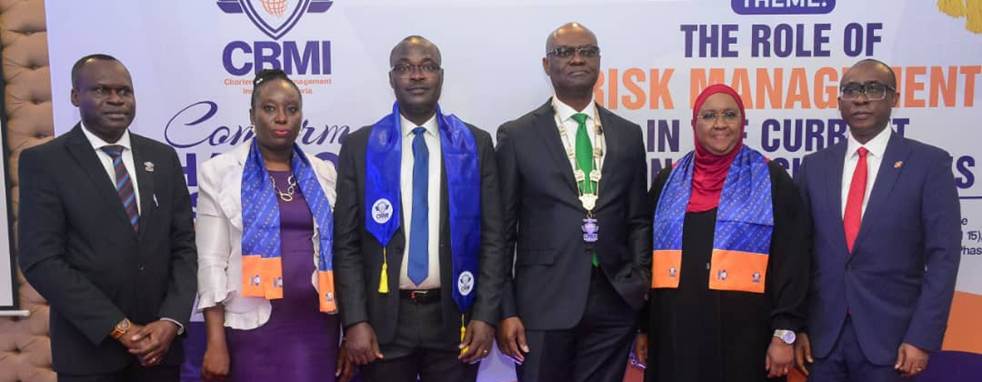
L-R: Registrar/Chief Executive, Chartered Risk Management Institute of Nigeria (CRMI), Victor Olannye; Divisional Head, Risk Management Securities and Exchange Commission (SEC), Grace Abioye; Immediate Past President, CRMI, Ezekiel Oseni; President, CRMI and Executive Director/Chief Risk Officer, Fidelity Bank Plc, Kevin Ugwuoke; Director, Enterprise Risk Management, Nigeria Deposit Insurance Corporation (NDIC), Amal Haruna; and Rep. Keynote speaker, Deputy Group Management Director, United Bank of Africa (UBA), Chukwuma Nweke; at the CRMI Conferment Handover/Sent-Forth ceremony, held in Lagos recently.
Business
ZENITH BANK ENHANCES STAFF PAY BY OVER 20% AND PROMOTES ABOVE 4,000
One of Africa’s leading financial institutions, Zenith Bank has reaffirmed its dedication to employee welfare by announcing the promotion of over 4,000 staff members and implementing salary increases ranging from 20% to 30% across various employee grades.
This bold initiative, under the leadership of Managing Director/CEO Dame Adaora Umeoji, its aimed at boosting staff morale and productivity.
With over 8,000 employees, this significant investment in human capital reflects Zenith Bank’s belief that its workforce is its most valuable asset. The salary adjustments, effective January 1, 2025, aim to reward performance, alleviate financial pressures, and ensure enhanced customer service delivery. Promotions for top management are also expected as part of the bank’s ongoing commitment to excellence and growth.
Dr. Umeoji emphasized the importance of maintaining a motivated workforce, stating that the bank’s dedication to its employees will translate into superior service experiences for customers. She highlighted the organization’s commitment to setting industry benchmarks through innovative solutions and exceptional service delivery.
Zenith Bank’s continued leadership in the Nigerian financial sector is underscored by numerous awards, including Best Bank in Nigeria 2024 by Global Finance and recognition as the Biggest Bank in Nigeria by Tier-1 Capital in 2024 by The Banker. These accolades complement its reputation for innovation, sustainability, and corporate governance.
By prioritizing employee welfare during challenging times, Zenith Bank not only strengthens its internal operations but also sets a standard for other financial institutions in the region, reinforcing its position as a leader in Africa’s banking landscape.
As a major player in Nigeria’s financial landscape, under its managing director/chief executive officer, Adaora Umeoji, the bank has embraced a holistic approach to growth that integrates environmental, social and governance (ESG) principles with its core business objectives.
At the heart of Zenith Bank’s strategy is a focus on buoying economic inclusion, supporting small and medium-sized enterprises (SMEs) and driving technological innovation to enhance customer experiences. The bank’s proactive investments in renewable energy, sports, digital transformation and impactful community initiatives exemplify its dedication to creating long-term value for its stakeholders while addressing global sustainability challenges.
Zenith Bank’s continued success is driven by a combination of strong financial performance and an unwavering commitment to its stakeholders.
Zenith Bank’s growth trajectory is underpinned by a robust expansion strategy. With operations in several countries, including the UK, UAE, China, and most recently, France, the bank continues to expand its geographical footprint.
As usual, the bank’s efforts in 2024 did not unnoticed as the lender clinched several local and international awards in recognition of its outstanding performance.
In 2024, the bank won the Best Bank in Nigeria at the annual Global Finance award in Washington, DC, NY.
The bank also emerged the Biggest Bank in Nigeria by Tier-1 Capital, 2024 by The Banker; Best Commercial Bank, Nigeria 2024 – World Finance; Best Corporate Governance, Nigeria 2024 – World Finance; Most Sustainable Bank, Nigeria 2024 – International Banker; Bank of the Year, 2024 – Business Day; Retail Bank of the Year, 2024 – Business Day; Bank of the Year 2024- The Banker.
It also clinched the Most Responsible Organization in Africa 2024 – SERAS; Best in Gender Equality & Women Empowerment 2024 – SERAS and Best in Transparency & Reporting 2024 – SERAS
-
News2 days agoImpeachment Proceedings Against Fubara, Deputy Still Active – Rivers Assembly
-
News2 days agoYour Second Coming Was A Chance To Avoid These Political Mistakes – Fayose To Fubara
-
News1 day agoHow Rivers Women Spread Wrappers For Wike’s Motorcade During Port Harcourt Visit
-
News12 hours agoBoko Haram Demands $300,000 Ransom For Abducted Borno Ex-LG Chair, Another Victim