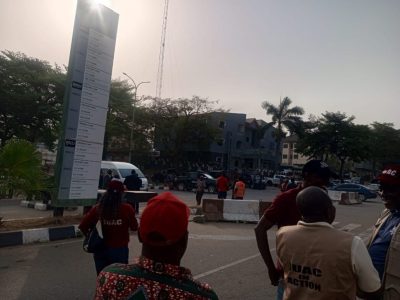


The National Industrial Court in Abuja has issued an interim order restraining the Nigeria Labour Congress (NLC) and the Trade Union Congress (TUC) from proceeding with a mass protest scheduled for Tuesday, February 3.
The order was granted on Monday by Justice Emmanuel Subilim, following an ex parte application filed by Nyesom Wike, minister of the Federal Capital Territory (FCT), and the Federal Capital Territory Administration (FCTA).
The suit lists the NLC, TUC, and senior union officials — including Benson Upah, Nuhu Toro and Stephen Knabayi — as defendants, alongside the inspector-general of police, the FCT commissioner of police, the Department of State Services (DSS) and the Nigeria Security and Civil Defence Corps (NSCDC).
In the application, Wike and the FCTA asked the court to restrain the unions from organising any protest or industrial action against the FCTA, citing concerns over public safety, disruption of services and the potential breakdown of law and order in the capital.
According to the filing, the claimants argued that the planned protest would obstruct traffic, violate the rights of residents and visitors, and cripple government operations in Abuja. They also accused the unions of preparing to defy an existing court order by mobilising workers for demonstrations.
The court was urged to intervene to preserve industrial peace and ensure the continued delivery of essential services pending the hearing of the substantive motion.
Ogwu Onoja, counsel to the FCT minister, told the court that the planned protest violated an earlier directive of the court restraining industrial action.
Despite the pending litigation, the NLC and TUC had, on Sunday, called on members to prepare for a “solidarity rally” to the office of the Federal Capital Development Authority (FCDA) in support of the Joint Union Action Committee (JUAC).
Background to the dispute
The dispute follows an indefinite strike launched by FCTA workers on January 19 over unresolved labour and welfare issues. The action shut down activities across FCTA and FCDA departments and agencies, prompting the minister to seek legal redress.
On January 27, the national industrial court ordered workers to suspend the strike, ruling that while the matter constituted a trade dispute, the right to industrial action was not absolute once a case had been brought before the court.
The judge held that any ongoing strike must cease pending the determination of the suit. Following the ruling, the office of the head of civil service in the FCTA directed workers to resume duty immediately.
The NLC, however, rejected the directive and asked its members to continue the strike, setting the stage for the latest court intervention.