
Connect with us

News

I Have Delivered On Yahaya Bello Prosecution Promise — EFCC Chairman Olukoyede

Published

on

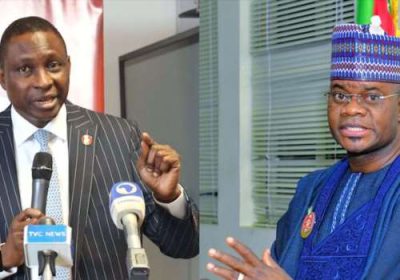
EFCC Chairman, Ola Olukoyede has declared that he has fulfilled his 2024 promise to oversee the prosecution of former Kogi State Governor Yahaya Bello.

Addressing public questions regarding his previous vow to resign if Bello was not prosecuted, Olukoyede stated during an interview on Sunday Politics aired by Channels Television that his mandate to investigate and bring the matter to court has been achieved.

“A sitting governor, because he knew he was about to leave office, moved money directly from government to a bureau de change and used it to pay his child’s school fees in advance $720,000,” Olukoyede said.

He described the alleged action as disturbing, particularly in view of the economic condition of Kogi State.

“In a poor state like Kogi, you want me to close my eyes to that under the excuse that I am being used? Being used by who at this stage of my life?” he asked.

Olukoyede also recalled a public statement he made in April 2024, when he vowed to resign if Bello was not prosecuted.

“If I do not personally oversee the completion of the investigation regarding Yahaya Bello, I will tender my resignation as the chairman of the EFCC,” he had said.

Addressing public concerns over the pace of the case, the EFCC chairman said the commission had fulfilled its responsibility and that the matter is now before the courts.

“Have I not fulfilled that promise? Is Yahaya Bello not being prosecuted? The case is in court,” he said.

He stressed that the EFCC’s role is to investigate and prosecute, not to determine guilt or secure convictions.

“I have three cases against Yahaya Bello. Am I the judge who will decide conviction? I have done my work and fulfilled my mandate,” Olukoyede added.

Bello is currently facing multiple charges before different courts. He is standing trial on a 16-count charge involving alleged property fraud amounting to N110 billion, alongside Umar Oricha and Abdulsalami Hudu.

In a separate case before the Federal High Court, the former governor is also facing a 19-count charge bordering on alleged fraud and money laundering involving N80.2 billion.

The EFCC had earlier declared Bello wanted in April 2024 over alleged financial crimes estimated at about N80 billion, a development that sparked widespread political debate.

News

Opposition Leaders Reject Alleged Plan To Make Tinubu Sole 2027 Candidate

Published

on

By

Opposition leaders in Nigeria have issued a communique vowing to resist any attempts by the ruling All Progressives Congress (APC) to make President Bola Tinubu the sole candidate for the 2027 general elections.

This statement followed a National Summit of opposition parties held in Ibadan, Oyo State, where several key political figures including Atiku Abubakar (PDP), Peter Obi (LP), and Rabiu Kwankwaso (NNPP) gathered to discuss a united front.

The opposition political figures made this declaration via a communique issued at the end of a meeting christened “National Summit of Opposition Political Party Leaders”.

The meeting was hosted by governor Seyi Makinde of Oyo State in Ibadan on Saturday.

It was attended by former Vice President, Alhaji Atiku Abubakar, former Senate President, David Mark, former Minister of Information, Professor Jerry Gana, Aisha Yesufu, Professor Pat Utomi and a former Minister of Sports, Solomon Dalung.

Others are former governor of Osun State, Rauf Aregbesola, former governor of Sokoto State, Aminu Tambuwal, former governor of Kano, Rabiu Kwankwanso, former governor of Kwara State, Abdulfatai Ahmed, former governor of Rivers State, Rotimi Amechi, former governor of Niger State, Babangida Aliyu among others.

The leaders of the opposition political parties in the communique vowed to resist all machinations by the ruling All Progressives Congress to foist a one-party State on Nigeria.

They vowed to resist all attempts to make Tinubu the sole presidential candidate in the 2027 general elections.

The opposition political figures also disclosed that the Chairman of Independent National Electoral Commission INEC, Professor Joash Amupitan should not be allowed to conduct the forthcoming general elections in 2027.

The communique partly read, “That we shall resist all machinations by the APC to foist a one-party State on Nigeria and fight for the survival of multi-party democracy in our country.

“That despite the onslaughts and maneuverings of the ruling party, the APC to impose President Bola Tinubu as the sole Presidential candidate in 2027; we shall field candidates and contest the 2027 Presidential and other elections.

“That we shall work towards fielding one Presidential Candidate for the 2027 elections, which shall be agreed and supported by all participating opposition parties to rescue our nation and her long suffering masses”.

Continue Reading

News

Nigerian Army Recovers Remains Of Personnel Murdered During Wedding Trip

Published

on

By

The Nigerian Army said troops from the 82 Division has recovered the suspected remains of a soldier couple, Master Warrant Officer Linus Musa Audu and Private Gloria Mathew, who were murdered in May 2022.

In a statement shared on its official X handle, the Army said the troops acted on credible intelligence to carry out the operations on 24 April 2026 along the Ubaha Orsu axis of Orsu Local Government Area.

The operation was part of a strategic clearance and search mission aimed at dismantling the IPOB/ESN hideout in the region and locating the remains of two Nigerian Army personnel, Master Warrant Officer Linus Musa Audu and Private Gloria Mathew, who were brutally abducted and murdered by terrorists in May 2022 while on their way to their traditional wedding.

Upon receiving credible intelligence, the army reported that its troops advanced towards a suspected IPOB/ESN hideout, where they encountered heavy fire from armed criminals.

The statement said the troops engaged the terrorists decisively, successfully repelling multiple ambushes and forcing the criminals to retreat in chaos.

“The encounter further revealed the desperation and criminal nature of the group, which continues to target innocent citizens and security personnel alike,” the statement said.

After successfully clearing the camp, the Nigerian Army said the troops conducted a comprehensive search of the area, leading to the discovery of shallow graves believed to contain the remains of the slain personnel.

“The graves were carefully excavated, and the suspected remains were recovered,” the statement said.

The Nigerian Army confirmed that the recovered remains have been secured for detailed forensic analysis, including DNA testing, to definitively establish their identities.

“Efforts are also ongoing to liaise with the families of the fallen personnel to ensure proper identification and facilitate befitting burial arrangements in honour of their sacrifice.

“This operation not only underscores the Nigerian Army’s unwavering commitment to ensuring justice for fallen heroes but also highlights the continued degradation of IPOB/ESN criminal networks and infrastructure across the South East.

“The discovery of shallow graves within their camp further exposes the group’s heinous atrocities and disregard for human life.”

The Nigerian Army reassured the general public that ongoing operations will continue until all criminal elements are neutralised and lasting peace is restored across the region.

“We appreciate the law-abiding citizens for the information and urge you remain vigilant and continue to support security agencies with timely and credible information,” it added.

Continue Reading

News

South Africa and Xenophobia: A Crisis of Unity and Memory – By Dr George Ogunjimi

Published

on

By

Xenophobia in South Africa has become a deeply troubling issue, raising questions about unity, historical memory, and the values that once defined the African struggle for liberation.

While concerns about illegal immigration and documentation are valid, they cannot justify the violence, hostility, and loss of life that have increasingly targeted foreign nationals, particularly fellow Africans.


The recurring outbreaks of violence—such as the 2008 South African xenophobic riots—highlight a pattern that continues to resurface. Incidents like the recent killing of a Nigerian taxi driver, widely shared in disturbing videos, serve as painful reminders of how severe and personal this crisis has become. These acts not only harm individuals and communities but also damage the broader vision of African solidarity.


Historically, many African nations, including Nigeria, stood firmly against Apartheid, offering financial, political, and moral support to movements like the African National Congress. This shared struggle fostered a sense of continental unity—an idea that now seems under strain.


Figures like Julius Malema have spoken about African unity and condemned xenophobic violence, though the broader political and social landscape remains complex. The persistence of these attacks suggests deeper underlying issues, including economic inequality, unemployment, and social frustration.


Ultimately, xenophobia in South Africa is not just a national issue—it is an African one. It challenges the continent to reflect on its shared history, its responsibilities to one another, and the urgent need to rebuild a sense of unity and mutual respect.


George Ogunjimi Esq

Juris Republic

jurisrepubliclegal@gmail.com

24/04/2026.

Continue Reading

Trending