
Connect with us

News

INSECURITY: SANWO-OLU, SOUTH-WEST STAKEHOLDERS PUSH FOR INDIGENOUS SOLUTIONS, TECHNOLOGY, STATE POLICING

Published

on

•Senate holds Zonal Security Meeting in Lagos, seeks collaboration to address insecurity


The Governor of Lagos State and Mr Babajide Sanwo-Olu, and stakeholders across security agencies, government, civil society, and traditional institutions on Friday renewed calls for the adoption of indigenous security solutions, advanced technology, and state policing as part of efforts to address Nigeria’s escalating security challenges.


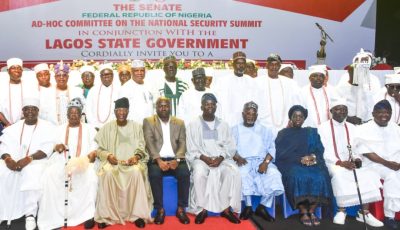
The stakeholders spoke unanimously on the need to tackle insecurity across the country during the South-West Zonal Security Summit, organised by the Senate Ad-hoc Committee on National Security, in collaboration with the Lagos State Government, held in Ikeja, on Friday.


The summit, attended by Governor Sanwo-Olu, who was represented by the Executive Secretary of the Lagos State Security Trust Fund, Dr Ayodele Ogunsan; South-West states representatives; members of the Senate led by Senator Adetokunbo Abiru; serving and former public office holders; heads of security agencies; members of civil society organisations; and traditional, religious and political leaders, provided a platform for stakeholders in the South-West to discuss practical approaches to improving national security.


Speaking at the event, Governor Sanwo-Olu reaffirmed his administration’s commitment to strengthening security systems in Lagos State. He also called for a regional security framework, noting that security is essential not only for peace but also for economic stability.


He said: “As governors of this region, we must reaffirm our commitment to a regional security framework, which includes transforming Amotekun into a more unified, well-equipped, technology-driven command that can facilitate cross-state intelligence sharing and joint operations. Our traditional institutions – our Obas and community leaders – must remain central to this framework, as no one knows the heartbeat of local communities better than they do.


“Security is not just about keeping the peace; it is about ensuring our economic survival. When insecurity disrupts markets, farmlands, transportation, and investment, our GDP takes a hit, livelihoods crumble, and growth stalls. A region that cannot promise safety cannot promise prosperity either. That is why our strategy needs to be proactive, driven by intelligence, and deeply embedded in community involvement.


“We need to strengthen our early-warning systems, enhance surveillance capabilities, and maintain open lines of communication with youth groups, farmers, transport unions, and local vigilante networks, all while renewing our partnership with civil society.”


Governor Sanwo-Olu pledged the full cooperation of the Lagos State Government with the Senate Ad-Hoc Committee, saying his administration is willing to collaborate closely with neighbouring states, royal leaders, and all security agencies to secure the present and protect the future of the South-West.


In his opening remark, Senator Adetokunbo Abiru, who is the Chairman of the South-West geopolitical zone interactive hearings of the 10th Senate’s ad-hoc committee on the National Security Summit, noted that the summit was part of a nationwide exercise taking place simultaneously across the six geopolitical zones.


He also stressed the need for stronger collaboration among all stakeholders to tackle insecurity effectively. “While the South-West has not experienced the full brunt of terrorism as in some other regions, the rise in banditry, kidnapping, and violent crimes across our states is deeply troubling.


“Our villages and farmlands have come under increasing threat; farmer-herder clashes have been on the increase, our highways have seen more daring incidents, and the disturbing spread of armed groups such as the reported Lakurawa incursion into parts of Kwara and Kogi underscores the urgent need for proactive measures. If decisive action is not taken, the danger could spill fully into the South-West geo- political zone.


“We must not allow the South-West to become a sanctuary for criminality or a battleground for those who seek to destabilise our nation. We must use every resource – human, material and technological – to defend our communities.


“No effort is too small in the quest to secure the South West Zone and our nation. Security is a collective responsibility. We must build trust, stay vigilant, and report suspicious activities promptly to our community leaders and security agencies,” he said.


Senator Abiru also urged the media to see the fight against insecurity as a national duty, noting that “We must promote narratives that strengthen unity, inspire confidence, and avoid framing our national challenges along ethnic or religious lines. Let us strive to paint a positive and reassuring picture of our country.”


Also speaking, Senator Ibrahim Jimoh, representing Ondo South and sponsor of the bill establishing the National Security Summit, stated that terrorism and insurgency require non-conventional approaches involving both military and civilian efforts.


Senator Gbenga Daniel, representing Ogun East, also called for collaborative efforts by all stakeholders to address insecurity in Nigeria.


During his presentation, Lagos State Commissioner of Police, Moshood Jimoh, noted that Governor Sanwo-Olu’s provision of logistics and other essential assistance has significantly boosted police and safety agencies in the state.


He emphasised the need to sustain the current momentum, noting that security challenges are often local and require local solutions.


Speaking on behalf of traditional rulers, the Alara of Ilara in Epe, Lagos, Oba Olufolarin Ogunsanwo, advocated community policing, the use of modern technology, a joint task force comprising all security agencies, expanded police recruitment, increased funding, better equipment and more employment opportunities to limit youth restiveness and associated threats.


He said that President Bola Tinubu’s administration had intensified collaboration with international partners but noted that weak structures at the grassroots continued to derail progress.


On his part, the Aare Onakankanfo of Yorubaland, Iba Gani Adams, maintained that state policing remains a key solution to tackling insecurity nationwide.


Also speaking, representatives of civil society organisations, women, youths, and Christian and Islamic leaders also called for improved welfare packages for security operatives to motivate them to diligently discharge their duties without fear or favour.


News

I Delivered $15m Agency Cash To Ex-NIMASA DG Akpobolokemi, EFCC Witness Tells Court

Published

on

By

A prosecution witness, Captain Ezekiel Bala-Agaba, testified in a Lagos Federal High Court on Thursday, that he personally delivered $15 million in cash to former NIMASA DG, Patrick Akpobolokemi.

The witness, Bala-Agaba, a former Executive Director of Maritime Safety, Shipping Development and Marine Operations at NIMASA, made the disclosure while testifying before Justice Ayokunle Faji of the Federal High Court in Lagos.

Captain Agaba, who appeared as the 15th prosecution witness, told the court that funds meant for pipeline surveillance were withdrawn from NIMASA’s accounts, converted into dollars, and handed over to Dr Akpobolokemi.

According to him, the money was taken to a Bureau de Change, which converted it into $15 million before the cash was delivered to the NIMASA office on Burma Road, Apapa, Lagos.

He said he subsequently took the money to the office of the then Director-General.

“The money was sent to a Bureau de Change, which later brought the dollar equivalent to our office at Burma Road, Apapa, Lagos. I asked my Personal Assistant, Ekene Nwakuche, to carry the bag and follow me to the Director-General’s office,” he told the court.

The witness explained that he collected the bag from his aide before entering the office.

“When we got to the door of the Director-General’s office, I collected the bag from him and asked him to wait outside. I then personally delivered the sum of $15 million to the Director-General.”

The witness was initially a defendant in the case but later opted to testify for the prosecution.

While being led in evidence by prosecuting counsel, Suleiman Suleiman, he explained the chain of command within NIMASA and how financial approvals were processed in the agency.

According to him, the Director-General is the overall head of the agency and issues instructions to directors, who then implement policies in line with the NIMASA Act.

He told the court that he chaired the agency’s Intelligence Committee, which was responsible for certain security-related operations.

“As chairman of the committee, I oversaw its activities and reported directly to the Director-General, Dr. Patrick Akpobolokemi,” he said.

During the proceedings, the witness was also shown a document containing a letter from Access Bank to the Economic and Financial Crimes Commission (EFCC) detailing transactions in NIMASA’s accounts between 2013 and 2015.

When asked how much money he took to the former Director-General, Agaba replied: “$15 million.”

After listening to the testimony, Justice Faji adjourned the matter until April 22 and 23 for cross-examination of the witness.

The EFCC had in December 2015 arraigned Dr. Akpobolokemi and seven others before the court on a 30-count charge bordering on conspiracy, fraudulent conversion of funds and money laundering.

Those charged alongside the former NIMASA boss include, Warredi Enisuoh, Governor Juan, Ugo Frederick, Timi Alari, as well as Alkenzo Limited and Penniel Engineering Services Limited.

They pleaded not guilty to the offences.

The anti-graft agency alleged that the defendants conspired to divert funds running into over N1.15 billion under the guise of providing security intelligence in Nigeria’s maritime domain.

According to the EFCC, the NIMASA Intelligence Committee allegedly received N1,153,000,000 between December 2013 and July 2015.

Investigations further revealed that several companies contracted to execute the intelligence operations were either unregistered or lacked the capacity to perform the services, while some were allegedly linked to the defendants.

The prosecution also alleged that the defendants nominated or owned many of the companies used to execute the contracts.

One of the charges stated that the defendants conspired to commit offences punishable under the Money Laundering (Prohibition) Act, 2012.


Continue Reading

News

CBN Bars Chronic Loan Defaulters from Accessing New Banking Services

Published

on

By

The Central Bank of Nigeria (CBN) has issued a directive to all financial institutions to immediately restrict certain banking services for large-ticket borrowers with non-performing loans (NPLs).

This move is aimed at strengthening credit discipline and protecting the stability of the Nigerian financial system following a rise in the industry’s NPL ratio to approximately 7%, exceeding the regulatory 5% threshold.

This order is specifically targeted at large-ticket obligors.

The CBN issued the directive in a circular to banks on Monday.

The latest instruction comes almost a week after the CBN asked financial institutions to stress test.

It is uncertain if the two directives are connected or what may have triggered the loan-related instruction, but the apex bank said it furthers its mandate to protect Nigeria’s financial system.

“In furtherance of its mandate to promote a sound financial system, protect depositors, and enhance prudential compliance within the banking sector, the Central Bank of Nigeria (CBN) hereby directs all banks to restrict non-performing large ticket obligors, whose activities pose systemic risk to the financial system, from accessing specified banking services,” the circular reads in part.

“Any large-ticket obligor with a non-performing facility recorded in the CRMS and/or any licensed private credit bureau shall not be granted additional credit facilities. For the purpose of this restriction, credit facilities include loans and other forms of direct credit.

“In addition, such obligors shall not be granted banking facilities or contingent liabilities such as bankers’ confirmations, letters of credit, performance bonds, or advance payment guarantees.”


Continue Reading

News

Makinde Only In PDP Because He’s Not Seeking Re-election – Otitoju

Published

on

By

Babajide Kolade-Otitoju, the Director of News at TVC News, recently stated that Oyo State Governor Seyi Makinde would likely have defected from the People’s Democratic Party (PDP) if he was still serving his first term.

Otitoju stated this on Friday on TVC’s ‘Breakfast Show’.

He described the National Convention of the Peoples Democratic Party, PDP, in Ibadan last November as a mere waste of time.

“People must show good judgment at a critical phase. What was the point of having that convention? Two courts told you not to go ahead but you went ahead.

“I may not be a fan of former Senate President Bukola Saraki but if he says something that makes sense, I will be the first to admit it. He made sense when he said let’s go for caretaker. What’s the point of not listening to him?

“Later you will be shouting that the ruling party is behind your crisis, meanwhile you are the architect of your own misfortunes. You created this problem.

“If Makinde were in his first term, he would have fled like the dancing governor because his second term would have been in danger,” Otitoju said.

Continue Reading

Trending