
News
DSS Witness Details How ISWAP Unit Planned And Executed Owo Church Massacre


A DSS lead investigator testified at the Federal High Court in Abuja regarding the funding, arming, and mobilization of terrorists for the June 5, 2022, attack on St. Francis Xavier Catholic Church in Owo.
The witness detailed the roles of the defendants and stated that over 40 people died and more than 100 individuals sustained various injuries.
The prosecution also tendered what it described as a comprehensive investigation report on the incident, in court on Tuesday, which the court admitted in evidence in the absence of objection from the defence.
The witness, who was identified simply as SSI and featured as the ninth prosecution witness (PW9) testified at the resumed hearing in the trial of five men accused of complicity in the attack.
The five men are: Idris Abdulmalik Omeiza (25 years), Al Qasim Idris 20 years), Jamiu Abdulmalik (26 years), Abdulhaleem Idris (25 years) and Momoh Otuho Abubakar (47 years). They are being prosecuted by the DSS.
Led in evidence by prosecuting lawyer, Ayodeji Adedipe (SAN), the witness said he is the Deputy Director in charge of Counter Terrorism Investigation and led the investigation team.
He said his team was mandated to unravel the perpetrators, the cause of the incident, their sponsors and any other findings that may arise .
SSI said: “With that, we proceeded to gather intelligence and also exploited technical resources, which eventually led us to the arrest of five persons in the month of August 2022.
“The arrest occurred both in Kogi and Ondo states and the persons we arrested were Al-Qasim Idris (2nd defendant) and his brother Abdulhalid Idris (4th defendant), then Omaiza Abdulmalik (1st), then his brother, Jamiu Abdulmalik (3rd),” he said, and gave the name of the fifth defendant as Momoh Otuho Abubakar.
The witness added: “Our investigation found out that the persons we arrested were members of Islamic State West African Province (ISWAP), a proscribed terrorist group, who belong to a cell that operated around Okene/Adavi Local Government Area of Kogi State, as well as Omielafa and Omielege in Ose Local Government Area of Ondo State under the coordination of one Odoba.
“Odoba usually hibernate around Ogaminana in Adavi LGA of Kogi State,” he said.
Giving details of how the attack was planned, the witness said: “On the 30th of May, 2022, Odoba called a meeting of some of the group’s members, who are members of his ISWAP cell. They go with alliance, Al-Shabab.
“So on the 30 of May, 2022, they met at the Government Secondary School, Ogaminana where Al-Qasim Idris was present in the meeting and Odoba passed the instruction for them to prepare to attack the Catholic Church Owo.
“And, his instruction was clear that they should attack on Sunday and ensure that they kill the priest. So when Al-Qasim returned to Omilafia, he gathered some of the cell members, including Abdulhalid (4th defendant), his brother, Jamiu (3rd defendant) and all the four were in the meeting, except the 5th defendant.
“There was equally one Kabir, who is a cousin to Al-Qasim and Addulmalik. The meeting was held after the jumaat prayer at the mosque where the Idris bothers’ father is the Chief Iman.
“He (Al-Qasim) told them (those at the meeting) to be prepared for the attack as instructed by Odoba. He only told them they will be getting two other persons to reinforce the team
“The names of these individuals (the other two) are Mohammed and Abdullahi. On Saturday, the next day, being the 4th of June, 2022, Abdulhaleem Idris (4th) travelled to Adavi, where he hired a Volkswagen Golf 3 car.
“He proceeded to lead Odoba, who supported them with five AK47, 10.magazines, rounds of ammunition and improvised explosive devices (IED) for the planned attack,” he said.
The PW9 said by evening of the same day, they all gathered in Abdulhaleem’s house in Omilafia, where Al-Quasim allegedly, reviewed with the others, the attack plan and subsequently engaged in some dry practice.
When asked to explain what he meant by dry practice, the witness said it is the practice done with weapon, without live rounds, to reorient oneself on the safety precaution of the weapons
He added that at the end of the dry practice, they all spent the night in Al-Quasim’s room, adding that on the night of June 4, Al Qasim took a motorbike belonging to his father, which he rode most of the time, to deliver items to Mohammed and Abdullahi, to facilitate their movement for surveillance on the church and also during the attack.
Giving a graphic detail of how the attack was carried out, the witness said: “The next morning, 5th of June, the first to 4th defendants and Kabir, now at large, were driven in the Golf car, with the weapons concealed in sacks, to the church about 8 to 8:30 am.
“They met Abdullahi and Mohammed. The got to the church, removed the sacks and pulled out their weapons. Two of them sat with a woman roasting corn.
“They bought some corns. A young man hawking stuff was observing them. One of them (the attackers) went and whispered to the hawker. When he was about leaving after being whispered to, he was shot dead instantly.
“This triggered chaos in front of the church. In the midst of that, they accosted a man coming from the Deeper Life Bible Church in a Nissan Sunny car. They snatched his car and drove into the church premises.
“Under Al Qasim’s directive, they proceeded in the directions he had told them to take. Abdulhaleem was carrying the bag containing the improvised explosives.
“They shot sporadically in the church’s sanctuary, outside and all over, including worshippers trying to escape.
“Abdulhaleem, who had the bag containing IEDs, detonated at least three explosives. Other attackers engaged the worshippers with gunshots.
“40 people, including women and children, died at the Federal Medical Centre (FMC). 23 were wounded and rushed to the hospital.,” he said.
The witness added that apart from the 40 church members, who were killed, a non-member was the first to be killed by the attackers in front of the church, adding that some of the 40 deceased were taken to the hospital dead.
The prosecution subsequently tendered a medical report, signed by one Dr Ayodeji O.O, in respect of which the witness said: “We have made effort to see how the doctor could come but was not possible.”
The prosecution equally tendered 30 photographs taken from the incident’s scene by investigators, which the court admitted as Exhibit M – M30.
SSI told the court that at the end of the investigation, his team made a comprehensive investigation report.
On whether the fifth defendant played no role, since he spoke extensively about the first four defendants, the witness said it was an oversight that he did not speak about the fifth defendant.
He then proceeded to give details of the role the fifth defendant allegedly played in the whole incident.
The witness said: “Investigation revealed that the 5th defendant worked in tandem with the 1st to 4th defendants .He was operating a Point of Sales (POS) units in five deferent locations.
“About two to three weeks prior to the attack, his account was credited at two different instances with 800k. He used the POS machine to distribute the money to the individuals, who aree members of the Al-Shabab Unit of ISWAP, and the defendants were beneficiaries of this money, with no evidence of business transactions between them.”
PW9 added that technical evidence established that the fifth defendant was in communication with them (the other four), within the period of the attack.
He confirmed that autopsy examination was conducted on some of the dead bodies and a report was generated. The prosecution tendered the report which was admitted in evidence without objection from the defence.
The court also admitted in evidence, the comprehensive investigation report on the attack, which the prosecution tendered through the witness.
The defence lawyer, Abdullahi Mohammad said he would not object to the tendering of the report, but would require time to study it, because it was served on his team few days ago.
He sought an adjornment to enable him study the investigation report before he could cross examine the witness.
In the absence of objection from the prosecuting lawyer, the court adjourned further proceedings till Wednesday, February 18 at 11am.








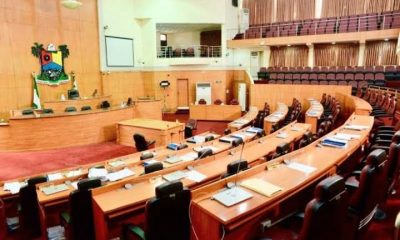


Nigeria’s digital banking revolution is raising the stakes for consumer trust. The question is whether the industry is rising to meet them.
Nigeria’s relationship with digital banking has changed almost beyond recognition in a decade. Where cash once dominated every transaction, from the roadside market to the corporate boardroom, mobile apps, instant transfers and USSD codes have reshaped how tens of millions of Nigerians interact with their money every single day.
The figures speak for themselves: point-of-sale transactions surged to a record N18 trillion in 2024, a 69 per cent increase from the year before, and the number of POS terminals in operation more than doubled to 5.5 million. Mobile banking is now the most widely used digital financial service in the country, with four in five users having accessed it within any given 90-day window.
This is, by any honest measure, an extraordinary story of financial inclusion and technological adoption. But it is an incomplete story if told without its other half.
Behind the growth curves and transaction volumes, a quieter and more troubling story has been unfolding. According to the 2024 Nigeria Consumer Protection Survey published by Innovations for Poverty Action, nearly one in four digital financial services users reported experiencing unexpected fees, charges or fraud attempts in the past year. Of those who encountered a problem, only half sought any form of formal redress. That silence is not apathy. It is the sound of eroded confidence: customers who have concluded that raising a complaint is unlikely to produce results.
The fraud data from the Nigeria Inter-Bank Settlement System tells the same story from a different angle. Actual losses to digital payment fraud rose to N52.26 billion in 2024, a figure inflated significantly by a single N31.1 billion incident involving one institution but still representing a 196 per cent increase in fraud losses over five years, even as the number of individual cases declined.
The decline in case counts is not reassurance enough. It suggests that while fraudsters are making fewer attempts, they are making each one count considerably more.
By channel, e-commerce and internet banking remain the most exposed, followed by point-of-sale, mobile and web platforms.
The most common technique is social engineering, which requires no sophisticated technology at all. It requires only a convincing conversation and a customer who does not know what to guard against. Insider abuse, where bank staff are complicit in fraud, is identified by NIBSS as the single greatest structural threat to the sector.
That is a sobering finding, and one that no institution should read past quickly.
What this data collectively points to is a gap that the industry must confront honestly. Nigeria’s digital banking infrastructure has expanded at speed. The consumer protection architecture that should travel alongside it has not always kept pace.
Convenience and safety are not natural enemies, but they require deliberate and sustained design to coexist. Left to grow at different speeds, they create precisely the conditions that fraudsters, rogue actors and complacent institutions exploit.
The encouraging news is that the gap is closing. Nigeria exited the Financial Action Task Force’s grey list in 2025, a signal that the country’s financial system has materially strengthened its safeguards. The CBN’s 2024 rollout of risk-based cybersecurity frameworks for deposit money banks formalised the standard of care that institutions are required to demonstrate.
Regulatory enforcement actions in 2024, including reported industry penalties totalling over N15 billion, have underscored that consumer protection is a compliance obligation with real and immediate consequence. The industry is being held to a higher standard, and that is the right direction.
Within institutions themselves, the most effective safeguards are often the ones customers never see. The strongest security infrastructure operates silently in the background: monitoring account behaviour in real time, identifying anomalies before they become losses and intervening before a suspicious transaction completes rather than after.
This is not glamorous work, but it is the work that matters most. A customer who never has to report a fraud incident has been protected more effectively than one who was offered a sympathetic apology after the damage was done.
Union Bank’s experience illustrates what this balance looks like in practice.
According to the bank’s full-year 2025 customer experience data, its digital channels recorded strong customer satisfaction scores across all platforms: UnionMobile achieved a customer satisfaction score of 87 per cent and a net promoter score of 77, while the USSD channel (*826#) returned scores of 82 per cent and 70 respectively.
These are not numbers that emerge from convenience alone. They reflect what customers value above all else when they transact digitally: the confidence that the experience will be safe, seamless and complete.
That confidence is built through sustained investment in security infrastructure, proactive monitoring and an institutional culture that treats customer protection as a core value rather than a compliance line item.
It is a culture Union Bank articulates through its ICARE values, where the commitment to being customer and community-focused is not a policy position but a founding organisational principle, reinforced consistently from the moment any member of staff joins the bank.
In March, as institutions across Nigeria marked World Consumer Rights Day, Union Bank reaffirmed to its staff the responsibility that every individual within the organisation carries to uphold the rights and dignity of the customers it serves. It is the kind of internal commitment that rarely makes headlines, but that ultimately determines the quality of every customer interaction that does.
Trust is the only currency in banking that cannot be manufactured on demand. It is built over time, through consistent behaviour, through systems that protect customers before they know they need protecting, and through institutions willing to be accountable when they fall short. Nigeria’s digital banking revolution has done extraordinary things for financial access and economic participation. Its next chapter must be defined by what it does for financial safety. The two are not in competition. In the long run, they are, in every meaningful sense, the same thing.
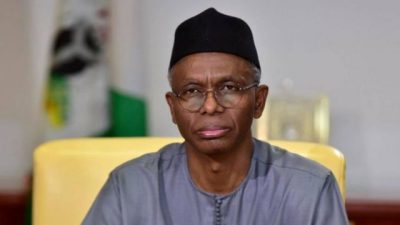
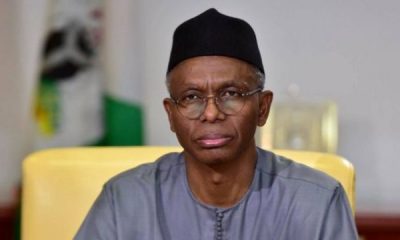
Former Kaduna State Governor Nasir El-Rufai has returned to the Federal High Court in Kaduna to resume his trial over alleged financial improprieties following the burial of his mother, Hajiya Umma El-Rufai.
El-Rufai was seen entering the court premises under tight but orderly security presence, with officials closely monitoring movements around the facility as proceedings resumed.
The former governor’s return in the court comes after subsequent temporary release by the Independent Corrupt Practices and Other Related Offences Commission, ICPC.
JomogNews reported how he was allowed to attend the funeral rites of his late mother, Hajiya Umma El-Rufai, who died in Cairo, Egypt.
The release was alleged to have been approved on compassionate grounds following the family’s bereavement, although the ICPC has yet to officially disclose the specific conditions attached to the bail.
As of the time of filing this report, it remains unclear whether the former governor will retain his temporary bail status or be required to return to ICPC custody pending further court decisions.
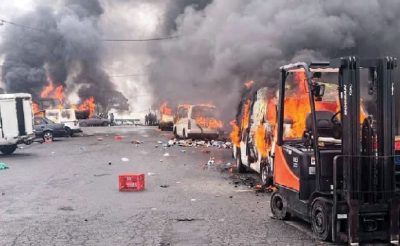
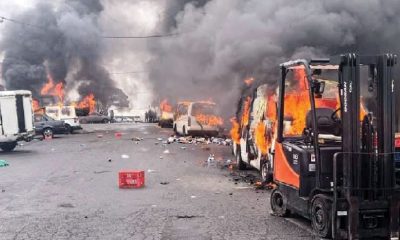
Violent protests broke out in the Eastern Cape province of South Africa following the controversial coronation of a Nigerian national, Solomon Ogbonna Eziko, as a traditional Igbo king, with demonstrators torching vehicles and looting shops owned by foreign nationals.
The protests, led by members of ActionSA alongside traditional leaders and residents on Monday, were initially staged in opposition to what organisers described as a violation of the province’s sovereignty, constitutional order, and recognised traditional leadership structures.
However, tensions escalated rapidly in KuGompo City, where the protests turned violent, forcing police to intervene and disperse crowds, according to SABC News.
Video evidence shared on X showed protesters setting several vehicles and buildings allegedly belonging to foreigners on fire, while security forces intensified efforts to restore order.
“Protesters have torched vehicles and buildings allegedly belonging to foreign nationals in protest against the installation of a Nigerian king in the Eastern Cape,” Newsroom Afrika reported.
Similarly, CDR Africa disclosed that the unrest reflected growing outrage over the coronation, with foreign-owned properties becoming primary targets.
The situation further deteriorated, with eNCA reporting that the violence turned deadly following a stabbing incident allegedly involving Ethiopian shop owners.
At least two people were taken to the hospital for treatment, while several vehicles were destroyed in the chaos.
ActionSA’s Eastern Cape chair, Athol Trollip, reaffirmed the party’s opposition to the coronation in East London, describing it as unlawful and inconsistent with South Africa’s traditional leadership framework.
He said, “With the traditional leadership of the Eastern Cape, all the traditional leaders, and the people of the province, let me state clearly that ActionSA’s policy on illegal immigration is very clear. If you are in this country illegally and commit any offence, you will be sent back home.
“This is a sovereign nation. It is our nation, and we are protected by a constitution. Nowhere in our constitution is there a provision for a Nigerian from the Igbo tribe to be crowned as a king in the Eastern Cape.
“Beyond that, the utterances made at the coronation are what concern us as a party. They claimed to have established a kingship.”
He added that the party stood firmly with recognised traditional authorities, insisting that due process must be followed in matters of cultural and traditional governance.
“We have a painful history of homelands in this province—the former Ciskei and Transkei—where people were displaced, their land expropriated, and opportunities limited. We will not tolerate the establishment of another homeland.
“They went further to say they would encourage their brothers and sisters in Nigeria, in their hundreds of thousands, to come and establish a homeland here. That will not happen. This province is not up for the taking.
“We respect our traditional leaders. There are five recognised kingships acknowledged by the president and the constitution.
“We also take exception to the Nigerian Embassy’s claim that the coronation was merely customary. We want the Nigerian government to speak clearly against it, and we want our government to make an unambiguous statement affirming its recognition of existing traditional leaders and rejecting any Igbo kingship in the Eastern Cape or South Africa,” he added.
Some protesters issued stark warnings, vowing to escalate resistance if authorities fail to address their concerns.
A protester, Inoksi Sigcawu, said residents were prepared to “take up arms” if the matter remained unresolved, while others called for the deportation of Nigerians linked to the coronation.
Sigcawu said, “Our sovereignty is defined by the Constitution and the laws of this country. No one can come from elsewhere and undermine the authority of this nation or this kingdom.
“We are led by King Jongilizwe Sandile, a descendant of King Palo. We are appealing to the government to ensure that anyone involved in this illegal coronation is removed from the country immediately, whether they entered legally or not.
“We also call on authorities to investigate foreign-owned businesses, including spaza shops, to verify documentation.
“If law enforcement fails to act, people may take matters into their own hands. We do not want that, but we will not allow our authority to be undermined.”
He added that tensions must be addressed urgently to prevent further escalation.
The protesters had earlier marched through parts of the province, demanding immediate government intervention and warning that failure to act could trigger further unrest.
Meanwhile, the Nigerians in Diaspora Commission said it had yet to receive any official report regarding alleged attacks on Nigerians abroad, dismissing claims circulating on social media.
Speaking on the issue, NiDCOM spokesperson Abdur-Rahman Balogun said the commission could not act on unverified reports and would rely on official diplomatic channels.
“Well, we will get a report from our embassy there. I cannot comment on your report,” he said.
Balogun noted that neither the victims nor any official body had formally reported the incident to the commission.
“I cannot respond to social media reports. When incidents of this magnitude occur, they are usually reported through official channels and captured by our diplomatic missions,” he added.
He assured us that the commission would liaise with Nigeria’s embassy in South Africa to verify the situation.
However, the Nigerian High Commission in Pretoria issued an advisory on Monday evening, urging Nigerians in South Africa to remain cautious and vigilant.
The advisory urged Nigerians to maintain a low profile, avoid large gatherings, limit unnecessary travel, and be mindful of their social media activities, warning that misinformation could escalate tensions.
It emphasised the importance of unity, caution, and adherence to local laws, noting that while South Africa offers significant opportunities, safety must remain a priority amid rising tensions.
The High Commission stressed that the advisory was not meant to cause panic but to encourage responsible behaviour and prevent avoidable risks during the period of uncertainty.

When 8 million Customers Trust You, Safety Cannot Be an Afterthought

COURT UPDATE: Nasir El-Rufai Resumes Trial After Mother’s Passing

South African Locals Clash With Nigerians Over Disputed Igbo King Coronation

LIRS EXTENDS DEADLINE FOR FILING OF INDIVIDUAL ANNUAL INCOME TAX RETURNS TO APRIL 14, 2026

Polaris Bank Strengthens Legacy of Excellence with Major Renovation of Historic Faculty Building at University of Ibadan

President Tinubu Donates Salaries To Families Of Fallen Heroes, Injured Soldiers

Political Giants Unite: Ribadu, Tambuwal, and Gov. Sani Attend El-Rufai’s Mother’s Burial

NDLEA Seizes Cocaine Hidden In Stockfish Heads Bound For India

Nigeria’s Radiographers Vow To Fight “Profession-Scrapping” Bill

X Payout: Nigerian Creator Receives ₦32M In Accumulated Earnings
-
 News2 days ago
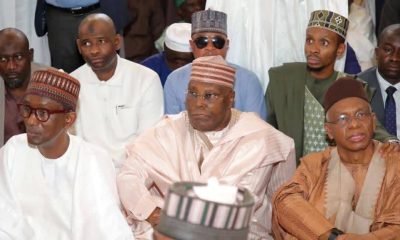
Political Giants Unite: Ribadu, Tambuwal, and Gov. Sani Attend El-Rufai’s Mother’s Burial
-
 News2 days ago
President Tinubu Donates Salaries To Families Of Fallen Heroes, Injured Soldiers
-
 News8 hours ago
LIRS EXTENDS DEADLINE FOR FILING OF INDIVIDUAL ANNUAL INCOME TAX RETURNS TO APRIL 14, 2026
-
 News1 day ago
Polaris Bank Strengthens Legacy of Excellence with Major Renovation of Historic Faculty Building at University of Ibadan
-
 News3 hours ago
COURT UPDATE: Nasir El-Rufai Resumes Trial After Mother’s Passing
-
 News7 hours ago
South African Locals Clash With Nigerians Over Disputed Igbo King Coronation
-
 News2 hours ago
When 8 million Customers Trust You, Safety Cannot Be an Afterthought