
News
Tinubu’s Economic Reforms: Nightmarish Cases from Other Countries – Farooq A. Kperogi
Only people who are alive and healthy use infrastructure. The time to know very little economics and have lots of commonsense is now because the lofty “tomorrow” Tinubu’s IMF economic policies are promising will never come. It never came for countries that implemented similar policies.


The President Bola Ahmed Tinubu administration likes to psychologically anesthetize Nigerians who are grieving from the hurt of its economic policies (petrol price spike, electricity tariff hike, devaluation of the naira, etc.) by saying Nigerians are only undergoing transitory pains in the service of a forthcoming permanent prosperity.
I have repeatedly called this an intentional lie. I have done so from the benefit of my knowledge of the outcomes of such policies in other countries, including in Nigeria from 1986 to 1993 when Ibrahim Badamasi Babangida implemented a Structural Adjustment Program (SAP) as dictated by the World Bank and the IMF, which is similar to Tinubu’s “reforms.”
I have also made recurrent references in the past to countries that have made progress precisely because they defied the economic template Tinubu is implementing now. I highlight the case of Malaysia in the late 1990s to support my point.
But let’s start with SAP in Nigeria. In 1986, self-described military president Ibrahim Badamasi Babangida was persuaded by the IMF and the World Bank to “restructure and diversify” Nigeria’s economy.
The restructuring and diversification led to the removal of subsidies on petrol (all past regimes called petrol price spikes “subsidy removal”), devaluation of the naira (now it’s known by the fancy term “floating of the naira”), deregulation (that is, allowing market forces to regulate the economy while the government takes the back seat), privatization (i.e., selling off of Nigeria’s national patrimony to a few moneybags), etc.
The immediate aftereffect of this IMF-endorsed “restructuring” (Tinubu calls his “reform”) of the economy was a never-before-seen inflationary conflagration, which eroded the purchasing power of the average Nigerian. It produced widespread hardship similar to what Nigerians are going through at this moment.
Petrol price spike and privatization led to job losses and a deepening of the unemployment crisis. Reduction in government spending, particularly on social services, led to declines in healthcare and education quality. Poverty rates also increased as a direct consequence of the removal of subsidies for fuel and basic services.
I distinctly remember all the rhetorical maneuvers that officials of the IBB regime used to fray nerves, and they are awfully similar to what honchos of the Tinubu regime now use: it will get worse before it gets better, there is light at the end of the tunnel, there is no gain without pain, Nigeria simply can’t afford to fund subsidies, our economy would collapse if we don’t restructure the economy, the current system is unsustainable, we’ll all smile and appreciate the wisdom of this temporary sacrifice when the gains start coming, etc.
By 1993 when IBB left power, Nigeria became firmly secured in the economic toilet. Manufacturing collapsed, social unrest rose, and brain drain (which is now called “japa”) started and blossomed, and hopelessness was democratized.
Someone very close to IBB who nonetheless opposed his IMF-backed economic “restructuring” told me he asked one of IBB’s IMF/World Bank-appointed finance ministers a few years ago what happened to the “gains” they promised would replace the “pains” people underwent between 1986 and 1993?
He reported him as saying the gains didn’t materialize because the “restructuring” wasn’t implemented faithfully. Meanwhile, thousands of people died, and millions of people were destabilized because of this “restructuring.” I can bet that Tinubu and his defenders would give the same excuse when they dig Nigeria deeper into the depths of despair at the end of their “reforms.”
In a 1995 report titled “Structural Adjustment and the Spreading Crisis In Latin America,” we see the same scenario repeated throughout the developing countries of South and Central America. Everywhere subsidies were removed, currency devalued, and so-called market forces given a free reign, the result is always the same: devastation, poverty, hopelessness, death of the middle class, etc.
The report instructively noted: “Mexico is one of many cases worldwide where adjustment and the free market have not only failed to alleviate poverty, but have further polarized the country and led to disaster, economic and social. World Bank and IMF officials continued to say — right up to the current crisis — that adjustment’s attack on poverty would take time, but, after more than a dozen years of adjustment in Mexico, things have never been worse than they are today, and there is no light at the end of the tunnel. There must be a point at which these institutions acknowledge that their strategy has failed and needs to be abandoned, and that a new, more democratically determined approach to the country’s development has to be taken.”
But it’s not inevitable that governments in developing countries should follow the IMF/World Bank’s ruinous prescriptions.
Many countries with leaders who have guts and who care for the welfare of their people resist these institutions. And it often turns out that the only countries that are witnessing inclusive growth and development are countries that have chosen to depart from the hell-paved path created by the IMF and the World Bank.
For example, in 1997, when Thailand, Malaysia, Indonesia, and South Korea faced economic headwinds and turned to the IMF and the World Bank for financial bailout, they were offered help with the usual conditionalities attached: budget cuts, subsidy removal, currency devaluation, etc.
Malaysian Prime Minister Mahathir Mohamed rejected the conditions. He said they would choke off economic growth, bankrupt companies, and cause massive unemployment in his country. So, he went counter to the counsel of the IMF. Instead of budget cuts, he increased government spending. Instead of currency devaluation, he defended the ringgit, Malaysia’s currency, by fixing it to the US dollar. Malaysia recovered from the economic crisis faster than its IMF-obedient neighbors.
During “A Meeting of Minds” dialogue organized by Forbes magazine in 2009, the magazine’s chief executive officer and editor-in-chief, Steve Forbes, asked Mahathir how and why he bucked the IMF and did better than countries that slavishly obeyed it.
“Fortunately, I am not a financier,” he said. “I know very little about economics, so I do things which are not quite off props.
When people tell me that the right way to handle a crisis like that is to obey the IMF and the World Bank, I thought otherwise. I actually examined their prescriptions, and I found that those prescriptions would actually make matters worse, so I didn’t see why I should be following them.”
I am glad Mahathir attributed his success in standing up to the IMF to his not being a financier and knowing “very little about economics.” It’s as if he was talking about Nigeria’s gaggle of slavish, brain-dead, self-impressed, IMF-controlled know-things who pass themselves off as “economic experts” and who have popularized the aggravating idiocy that subsidies are bad and must be removed because they are supposedly bad for the economy and don’t benefit the poor.
Now we know the truth. We need more people who “know very little about economics” and a lot about commonsense to make economic decisions for Nigeria.
The questions people with lots of common sense and very little knowledge of “economics” should ask are, what does it profit a national economy if a government increases the cost of production for manufacturing companies through sharp spikes in the cost of petrol and electricity?
What benefits does a country derive from a policy that causes mass pauperization, which ensures that everyday citizens can’t afford the basic things of life, not to talk of discretionary spending? Recession kicks in when people have no money to spend.
How does a country get light at the end of the tunnel when its policies trigger inflation and a once-in-a-generation cost-of-living crisis because it devalued its currency under the instruction of far-flung economic institutions notorious for instigating mass misery in developing countries and that are concerned more for “their loans, not on growth,” as Mahathir once put it?
How can a country surrender its economic sovereignty to a foreign entity and tell its citizens to expect a bumper harvest in an undefined future?
The only benefit of the ongoing “economic reforms,” according to Tinubu and his officials, is that it is bringing in more money for the government. And what does the government do with the money? Fritter it away in frivolities while people starve and die.
Even if the money will be used to build or renew infrastructure—we all know it won’t—if this is achieved at the expense of pauperizing the great majority of our people, it is still worthless.
Only people who are alive and healthy use infrastructure. The time to know very little economics and have lots of commonsense is now because the lofty “tomorrow” Tinubu’s IMF economic policies are promising will never come. It never came for countries that implemented similar policies.





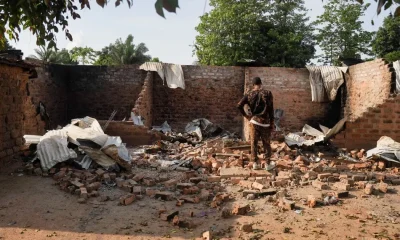

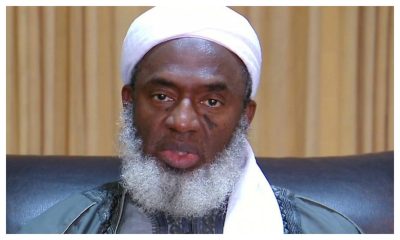
Islamic cleric Sheikh Ahmad Gumi recently defended his past interactions with armed groups, stating he “took the bull by the horns” in 2021 as a necessary step to address Nigeria’s insecurity.
In a post shared on Facebook on Thursday, Gumi said decades of neglect of disadvantaged populations had created deep socio-economic inequalities, leaving many youths vulnerable to manipulation by external forces seeking to destabilise the country.
According to him, the widening gap between the rich and the poor has turned many young people into “ready-made foot soldiers” in cycles of violence that enable the exploitation of Nigeria’s resources.
He also criticised the political class for being largely unresponsive, while noting that the intellectual community is preoccupied with survival struggles.
Reflecting on his past efforts, Gumi said he “took the bull by the horns” in 2021 by attempting to reintegrate violent elements into society rather than allowing them to be further radicalised.
He wrote: “Nigeria for decades has ignored the underprivileged section of its society. There is a significant socio-economic discrepancy, and the society is stratified. This makes our teaming youth ready-made foot soldiers for any foreign interest trying to divide us and rule. To plunder our resources while we are involved in a vicious circle of violence.
”Unfortunately, the political class is unattentive while the intelligentsia is held hostage in the struggle for existence.
“In 2021, I took the bull by the horns in an attempt to bring some of these uncouth elements back to our fold rather than letting them be exploited by the devil.
“I still believe this is the only way out of our predicament. However, it needs the political will and determination to achieve.
“May Allah bring peace back to our nation.”
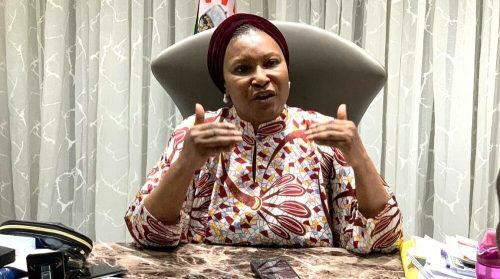
The Federal High Court in Abuja rejected an ex-parte application seeking to bar Senator Ireti Kingibe from participating in the activities of the African Democratic Congress (ADC).
Justice Peter Lifu declined the request from Wuse Ward leaders, ruling that such an order could not be granted without first hearing from the senator.
Instead, the judge ordered the ward leaders said to be loyal to the Minister of the FCT, Nyesom Wike, to put the senator on notice to appear in court to join issues with them on their grievances.
Justice Lifu in a ruling on Thursday held that discretion in such a request for prohibition from party activities and in political matters must be exercised judicially and judiciously.
The judge said justice would be met in the case of the plaintiffs only when the side of the defendant is heard on its merit, along with that of the plaintiffs.
Consequently, the judge ordered that Senator Ireti Kingibe should be served with all court processes by the plaintiffs to enable her become aware of the suit and to prepare her defense.
The judge fixed April 20, 2026, for the plaintiffs and the serving senator to appear before him for hearing of all applications in the matter.
Those who sued the senator in the suit marked FHC/ABJ/ CV/539/2026 are Okezuo Godfrey Anayo and Isaiah Ojonugwa Samuel, on behalf of themselves and ward members as plaintiffs. The senator is the sole defendant.
In their ex-parte application, Kingibe representing the FCT in the Senate was said to have been suspended on March 10, 2026 by her Wuse Ward executives following allegations of anti-party activities and disregard of your cnstitution of the ADC.
In the ex- parte application filed on their behalf by a Senior Advocate of Nigeria, SAN, Kolawole Olowookere, the aggrieved ADC members in Wuse Ward applied for an order of interim injunction restraining Kingibe from parading herself as a member of party, pending the hearing and determination of their motion on notice for interlocutory injunction.
They also asked the judge to restrain the senator from performing any function, attending meetings or performing activities reserved for ADC members or representing the party in any activities.
Besides, the Ward Executive Committee had asked that she be restrained from further interfering with the administration of the ward, ward register and other activities.
The suit was predicated on five grounds among which are that Mrs Kingibe was placed on suspension due to anti-party activities, gross misconduct and confiscation of the ward statutory records.
They argued that the suspension followed due process as enshrined in the ADC constitution and ratified by the two thirds majority of the EXCO members.
They averred that despite the communication of the suspension to Kingibe, she has continued to hold parallel meetings, issue press statements as an ADC member, and using her security details to intimidate the executive committee.
“Her actions constitute flagrant disregard to the internal mechanism of the party,” the plaintiffs stated.
Meanwhile, a lawyer, Abubakar Marshall who claimed to be representing the senator, announced that he had filed a preliminary objection against the suit. He added that it was served on M. S. Garba, who stood for the plaintiffs at Thursday’s proceedings.
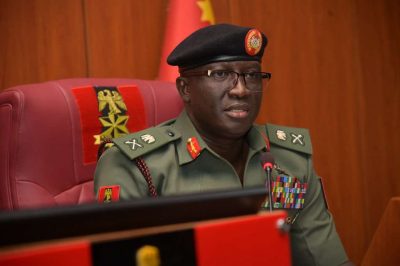
The Chief of Army Staff (COAS), Lieutenant General Waidi Shaibu, visited Jos, Plateau State, on Thursday, April 2, 2026, to lead a high-powered security assessment following recent security breaches.
The visit was aimed at strengthening public confidence and reinforcing ongoing efforts to stabilize affected communities.
Colonel Appolonia Anele, acting Director, Army Public Relations, said in a statement that the visit forms part of ongoing efforts to restore calm and entrench lasting peace across the state.
According to the statement, upon arrival, the COAS was received by the Executive Governor of Plateau State, Caleb Mutfwang, in a clear demonstration of strong civil-military cooperation and a shared commitment to addressing emerging security challenges.
The statement said the COAS received a comprehensive operational briefing from the General Officer Commanding 3 Division and Commander, Joint Task Force Operation ENDURING PEACE, Major General Folusho Oyinlola, who highlighted ongoing operations and proactive measures being implemented in synergy with other security agencies to contain threats, protect lives and property, and stabilise affected communities.
“As part of his engagements, Lieutenant General Shaibu also interacted with community leaders and residents, reassuring them of the unwavering commitment of the Nigerian Army to safeguarding all law-abiding citizens.
He urged residents to remain calm, vigilant and supportive of security agencies by complying with the curfew and cooperating fully with ongoing operations and investigations, while going about their lawful activities.
The chairman of Jos North Local Government Area, Hon. Dachung Bagos, commended the COAS for the timely visit, noting that the presence of the nation’s top military leadership would boost public confidence and reinforce trust in ongoing security efforts.

Gumi Defends Dialogue As Sole Solution To Nigeria’s Insecurity

Court Clears Senator Ireti Kingibe To Remain Active In ADC

COAS Shaibu Hits Jos To Restore Peace, Public Confidence

President Tinubu Appoints New PTDF Executive, Reappoints TCN Head

Simi Welcomes Second Child With Adekunle Gold

United Nigeria Airlines Staff Suspended After Viral Amputee Abuse Video

Pay Your Fare: AIG Cracks Down On Officers Boarding For Free

INEC Removes David Mark, Aregbesola From ADC Leadership Portal

JUST IN: FG Approves Friday 3, Monday 6, as Easter Public Holidays

When 8 million Customers Trust You, Safety Cannot Be an Afterthought
-
 News2 days ago
When 8 million Customers Trust You, Safety Cannot Be an Afterthought
-
 News2 days ago
El-Rufai Back In Detention After Temporary Compassionate Release
-
 News1 day ago
United Nigeria Airlines Staff Suspended After Viral Amputee Abuse Video
-
 News2 days ago
2027: Kwankwaso’s Exit Marks End Of NNPP – Kwankwasiyya Movement
-
 News1 day ago
Pay Your Fare: AIG Cracks Down On Officers Boarding For Free
-
 News1 day ago
JUST IN: FG Approves Friday 3, Monday 6, as Easter Public Holidays
-

 News2 days ago
Lagos CP Withdraws Taskforce From Traffic Duties
-
 News1 day ago
INEC Removes David Mark, Aregbesola From ADC Leadership Portal