News
Agricultural Productivity: Nirsal Plc Empowers Over 2,000 Farmers In 4 States


NIRSAL Plc has completed a midyear training programme for lead farmers and extension agents in the Aquaculture and Cassava value chains across locations in Imo, Sokoto, Kwara, and Oyo States.
The programme, aimed at boosting farmers’ capacities to access and repay commercial loans, had over 2,000 participants, with state government representatives also in attendance.
As it continues to promote the Agro Geo-Cooperative® approach to primary production, NIRSAL primarily targets lead farmers with the experience and skill to share new knowledge with members of their various cooperatives for its training programmes.

In Imo State, where no less than 500 participants assembled in two locations—one urban and one rural, the focus was on efficient models for fish production.
It was the same in Sokoto State, while the Oyo and Kwara outings focused on cassava.
Mr. Uche Agabige, Imo State House Committee Chairman on Agriculture, lauded NIRSAL for including Imo in this round of the capacity building programme, with the belief that it would complement local efforts aimed at boosting agricultural productivity in the state.
Head of Value Chain Capacity Development at NIRSAL Plc, Mr. Ibrahim Suleiman, said that the capacity development programme, which is part of the Technical Assistance offered by NIRSAL to agricultural value chain actors under its Technical Assistance pillar, was happening simultaneously in three other states spanning four Geo-political zones.
According to Mr. Suleiman, lead farmers and extension agents in aquaculture and cassava were similarly gathered at two urban and rural locations in Sokoto, Oyo, and Kwara States, and they are expected to cascade the training to an estimated 6,000 farmers across the states.
The NIRSAL teams received warm reception and commendations in locations, including from the Commissioner for Agriculture and Rural Development and the Akinyele Local Government Chairman in Oyo State, and the Special Adviser to the Kwara State Governor on Farmers’ Interventions, among others.
In addition to the formation of functional cooperatives with proper governance structures, the training programme also discussed readiness for possible protocol breaches and early warning systems.
Participants who spoke after the lectures said that they were delighted at the new insights they gained, pledging to share same with members of their various cooperatives.
NIRSAL Plc is an initiative of the Central Bank of Nigeria (CBN) established to de-risk agriculture and agribusiness financing in Nigeria, with a view to stimulating the flow of finance and investment into the Agricultural Value Chain from multiple sources.
Logic for the Imo training exercise is provided by one of the five pillars of NIRSAL—Technical Assistance, under which value chain fixing initiatives are researched, developed, and promoted.
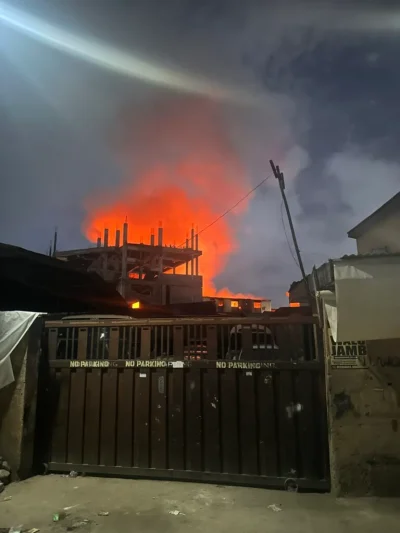
A major fire outbreak occurred at a market in the Yaba area of Lagos State in the early hours of Saturday.
The blaze, which reportedly began between 1:00 AM and 3:00 AM, has destroyed several shops and goods worth millions of naira, leaving numerous traders stranded and counting their losses.
Videos circulating on social media showed thick smoke and flames consuming parts of the market, while traders and residents scrambled to salvage belongings.
An eyewitness, Lugar Feliz, livestreaming on TikTok, noted that firefighters were already at the scene and identified the affected area as the Popo section of Yaba Market. Another user, Olamilekan Iyiola (@Olamilekan0932), described the incident as a “terrible fire outbreak in Yaba right now.”
Some residents expressed frustration over emergency response efforts. Adeoluwa (@Okunlola_Jude) reported that shops behind his property were completely destroyed, with losses estimated in the billions of naira. He added, “Fire service headquarters is just 10 minutes away, yet only one truck was brought to the scene.”
Sullex Print and Branding (@SullexBranding) also highlighted equipment challenges, claiming, “Three fire service trucks responded, but only one had water. The fire is currently at Ajibode Street, Yaba.”
As of Saturday morning, the cause of the fire remained unknown. No official statement has been released by the Lagos State Fire and Rescue Service regarding the extent of damage or potential casualties. Firefighting and containment efforts were ongoing, while residents called for enhanced emergency preparedness to prevent further losses.
News
Union Bank Looted: How former directors gambled with billions and nearly destroyed a national bank

The former directors and owners of Union Bank did not just fail, they engineered a financial disaster. They manipulated reports, hid massive losses, diverted foreign loans and treated depositors’ money like a private wallet.
Investigators uncovered billions of dollars in misconduct. These directors buried over ₦250 billion in losses, piled a $300 million foreign loan onto the bank without protection and then forced Union Bank to carry the burden. They even used the bank’s own funds to buy its shares, an outrageous betrayal of trust.
It didn’t stop there. Over $100 million was pulled out improperly, leaving the bank exposed and struggling. Loans meant for customers were secretly diverted into shady transactions. False reports were sent to lenders. The system was deliberately deceived.
This was not incompetence. It was exploitation.
By 2025, their actions had created nearly ₦400 billion in losses and over ₦147 billion in unpaid charges. The bank was on the edge.
The Central Bank of Nigeria (CBN) stepped in just in time. Without that intervention, Union Bank could have collapsed, dragging others down with it.
Now, the bank is stabilising. But let’s be clear: this recovery is happening in spite of those former directors, not because of them.
They didn’t build value. They destroyed it.
And Nigerians deserve to never forget who was responsible.
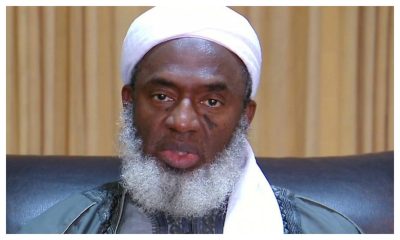
Islamic cleric Sheikh Ahmad Gumi recently defended his past interactions with armed groups, stating he “took the bull by the horns” in 2021 as a necessary step to address Nigeria’s insecurity.
In a post shared on Facebook on Thursday, Gumi said decades of neglect of disadvantaged populations had created deep socio-economic inequalities, leaving many youths vulnerable to manipulation by external forces seeking to destabilise the country.
According to him, the widening gap between the rich and the poor has turned many young people into “ready-made foot soldiers” in cycles of violence that enable the exploitation of Nigeria’s resources.
He also criticised the political class for being largely unresponsive, while noting that the intellectual community is preoccupied with survival struggles.
Reflecting on his past efforts, Gumi said he “took the bull by the horns” in 2021 by attempting to reintegrate violent elements into society rather than allowing them to be further radicalised.
He wrote: “Nigeria for decades has ignored the underprivileged section of its society. There is a significant socio-economic discrepancy, and the society is stratified. This makes our teaming youth ready-made foot soldiers for any foreign interest trying to divide us and rule. To plunder our resources while we are involved in a vicious circle of violence.
”Unfortunately, the political class is unattentive while the intelligentsia is held hostage in the struggle for existence.
“In 2021, I took the bull by the horns in an attempt to bring some of these uncouth elements back to our fold rather than letting them be exploited by the devil.
“I still believe this is the only way out of our predicament. However, it needs the political will and determination to achieve.
“May Allah bring peace back to our nation.”

Fire Outbreak Leaves Hundreds Of Traders Stranded At Yaba Market

Union Bank Looted: How former directors gambled with billions and nearly destroyed a national bank

Gumi Defends Dialogue As Sole Solution To Nigeria’s Insecurity

Court Clears Senator Ireti Kingibe To Remain Active In ADC

COAS Shaibu Hits Jos To Restore Peace, Public Confidence

President Tinubu Appoints New PTDF Executive, Reappoints TCN Head

Simi Welcomes Second Child With Adekunle Gold

United Nigeria Airlines Staff Suspended After Viral Amputee Abuse Video

Pay Your Fare: AIG Cracks Down On Officers Boarding For Free