
News
FAAN Shuts KFC Lagos Airport Outlet For Discriminating Against Physically-Challenged Ex-Gov’s Son


The Federal Airports Authority of Nigeria has shut down a branch of a popular food outlet, KFC, at the Murtala Muhammed Airport, Lagos State.
FAAN stated this on Thursday in a statement signed by its Director, Public Affairs and Consumer Protection, Mrs Obiageli Orah.
The statement, titled, ‘FAAN shuts down KFC outlet at MMIA,’ noted that the food outlet violated the Lagos State law on People with Special Needs, Part C, Section 55 of General Provisions on Discrimination.
The statement added that the directive followed a social media report by a Passenger with Reduced Mobility who alleged discriminatory treatment he received at the airport.
It read, “In line with Lagos State law on People with Special Needs, Part C, section 55 of General Provisions on Discrimination which states that “A person shall not deprive another person of access to any place, vehicle or facility that members of the public are entitled to enter or use on the basis of the disability of that person”, the management of the Federal Airports Authority of Nigeria (FAAN) has closed the KFC facility at the Murtala Muhammed International Airport in Lagos with effect from March 28, 2024.
“This is as a result of a social media report by a Passenger with Reduced Mobility (PRM), alleging discriminatory treatment he received at the Murtala Muhammed International Airport, Lagos.
“The MD/CE of FAAN, Mrs Olubunmi, Kuku intervened swiftly by deploying a management team comprising the Director, Public Affairs and Consumer Protection, Mrs Obiageli Orah; the Regional Manager South West, Mr. Sunday Ayodele; Ag. General Manager Public Affairs, Mrs Ijeoma Nwosu-Igbo and the International Terminal Manager, Mr. Kerri, to investigate the allegation.”
FAAN said, “It is based on the findings of the team that FAAN has shut down the KFC facility at the MMA, where the incident occurred.
“The authority has instructed that the KFC Management should tender an unreserved apology, in writing, to the affected PRM and a policy statement of non-discrimination be written and pasted conspicuously at the door post of their facility at MMIA before it resumes operation.
“FAAN uses this medium to express our unreserved apology to the affected Passenger with Reduced Mobility and assures all airport users that we shall continue to work tirelessly to ensure that the rights of every passenger are not infringed upon.”
The victim of the maltreatment, Adebola Daniel, son of former Ogun State Governor, Gbenga Daniel, recounted his experience at the KFC outlet of the airport in a series of tweets posted on Wednesday via his X handle, @DebolaDaniel.
Daniel, a wheelchair user, described his ordeal as “the worst sort of public humiliation” he ever had.
The Ogun State-born noted that it all started during his planned trip to London from Lagos via a Virgin Atlantic airline.
He stated that in years past, while he was quite familiar with security and immigration processes, being a frequent traveller, he would visit the Oasis lounge of the airport to wait for his flight.
However, because “the lift to the lounge has been out of service,” for the past three years, he decided to find “solace” at the KFC outlet in the airport, alongside his wife and his three brothers, whom they were travelling together.
“Today I chose KFC – what a colossal mistake,” he bemoaned.
His tweets partly read, “Being disabled often rolls over my spirit, leaving behind a trail of shattered dignity and forgotten humanity. Nowhere more so than in Nigeria.
“I have never been the type of person to make a fuss or complain about my disability. My approach has always been ‘laissez-faire.’ Ultimately, it is what it is. It is a part of my identity and like everyone else, I have my days of self-doubt and confusion as to how/if I fit in society.
“To be disabled in Nigeria is to be undesirable, unwelcome and unaccepted. As I’ve said before, it’s a lonely, scary and isolated place.
“Never has this been more true than it has ever been today when I faced the worst sort of public humiliation that I have ever experienced. To think that this happened at an international brand @kfc @kfcnigeria at an international airport – Murtala Muhammed Airport, Lagos – is unthinkable.”
Daniel stated that he “arrived at the airport as normal for my Virgin Atlantic flight to London. I’m a frequent flyer and I’m extremely familiar with all due processes at Murtala Muhammed Airport. Years ago, after all security and immigration formalities had been completed, I would normally go to the Oasis lounge to wait for my flight.
“For the past three years, the lift to the lounge has been out of service so I’ve often found solace in other establishments, sometimes lounges, sometimes restaurants such as @kfc @kfcnigeria.”
Daniel stated that as they were about to sit, a lady who is “apparently the manager” called out loudly, “No wheelchairs allowed.”
He added that upon hearing what she said, one of his brothers, Taiwo, asked what the lady meant, but “she refused to listen to reason and stood her ground that at @kfc @kfcnigeria Murtala Muhammed branch, wheelchairs and wheelchair users of all shapes and sizes were not permitted in the premises and we should leave immediately.
“My siblings and wife became instantly irate and proceeded to debate her position with her, ultimately cumulating in raised voices and strong verbal protests. If there’s one thing I hate more than anything in this life is to create a scene. I detest it. I do not like to draw attention to myself and as such I began pleading with my people that we should just leave.
“My wife took some video footage and my brothers took some pictures. There were at least five other witnesses at the scene, who tried to intervene as things unfolded. Eventually, our party departed to another lounge upset and quite frankly pissed off.”
Daniel stated that he wouldn’t let such an incident slide, adding that as another of his brothers alongside his wife met the lady at another time, she stressed “that the business does not allow wheelchairs into their premises,” while they took an audio record of her statement.
He recalled the lady saying that “she recently just transferred to that branch, it is something that has been drummed into them.
“It harkens back to dark periods in recent history… No wheelchairs allowed… No coloureds allowed…. No blacks allowed…,” saying, “Today, I felt less than human, like a guard dog not allowed into the house. Lonely and isolated.”
Daniel noted that he would “continue to escalate the matter “until I get a reasonable resolution and there’s no stopping me. You cannot treat people this way.
“There are approximately 27 million Nigerians living with some form of disability. That’s over 13% of the country. One in six people on the planet are disabled. You must not treat people this way.
“So my question to @kfc @kfcnigeria is simple. Does this represent your approach to disabled customers or will you be looking into this? Am I not human enough for KFC?”
He added an audio record of the conversation between his wife and the lady.
“Audio clip from my wife. I’m trying to get all the evidence up on here,” he wrote.
In response to the allegation before the outlet’s shutdown by the FAAN, KFC tweeted via its official X handle on Thursday morning, stating, “KFC is unwavering in our stance against bias or discrimination in any form, with inclusivity and respect as non-negotiable pillars of our values.
“However, this recent incident has underscored the pressing need for immediate action. We have embarked on efforts to address the situation and extend apologies and deeply regret the frustration and distress experienced by our guest.”
The food outlet added that it’s “urgently implementing sensitivity training for all our employees. This incident is not reflective of our standards, and we will act swiftly to rectify it.
“We are actively exploring solutions to equip our team members and establishments better to ensure that every guest feels genuinely welcomed and that we deliver empathetic customer service that proactively addresses the diverse needs of each guest.”
On Thursday, the General Manager, Lagos State Office for Disability Affairs, Mrs Adenike Oyetunde-Lawal, stated in a statement that the attention of her office “has been drawn to a viral story about the discrimination against Mr. Debola Daniel, a person with a disability in a wheelchair. This incident happened on 27th of March 2024, at a KFC restaurant located at Murtala Muhammed International Airport, Lagos.”
The LASODA GM noted that “it frowns upon any form of discrimination, particularly against persons with disabilities. Every individual, regardless of their disability, deserves to be treated with dignity and respect.
“The agency is committed to ensuring that the rights of persons with disabilities are protected and upheld in Lagos State. Discriminatory actions, such as those alleged in this incident, are unacceptable and will not be tolerated.
“LASODA, therefore, encouraged anyone who has experienced discrimination based on their disability to report such incidents to lasoda@lagosstate.gov.ng We are committed to working towards a society that is inclusive and accessible to all.”






The Nigerian Medical Association (NMA), Delta State branch, has officially debunked the cancer claims made by relationship influencer Blessing Okoro, popularly known as Blessing CEO.
In a statement on Tuesday, the association revealed that the document is an altered version of an original medical report belonging to a different patient diagnosed with breast cancer.
The statement, jointly signed by NMA Delta State Chairman, Dr. Israel Adaigho, and Secretary, Dr. Usamah Hannah, was sighted by The Nation on Tuesday.
According to the NMA, the viral report was purportedly issued by Xinus Medical Diagnostics and signed by consultant pathologist Dr. O.A. Odigwe.
However, Dr. Odigwe, who is the proprietor of the diagnostic centre, clarified that his facility never issued any report to Blessing Okoro.
The association explained that Xinus Medical Diagnostics is located in Asaba, Delta State not Enugu State as claimed in the circulating document.
The centre was contacted in May 2025 by a doctor from a private hospital in Asaba to conduct a confirmatory histology test for a patient identified as Mbara Deborah, who had a suspected case of breast cancer.
The test confirmed breast cancer, and the original result was issued to the referring doctor on May 9, 2025.
The NMA stated that the document currently being paraded online by the law firm Allen Juris Law is the original report bearing the name Mbara Deborah.
The version linked to Blessing CEO appears to be a doctored copy of this same report.
The statement read in part: “Our attention has been drawn to an online histology report purportedly issued to one Blessing Okoro, aka Blessing CEO, by Xinus Medical Diagnostics allegedly located in Enugu State. The said histology report was also alleged to have been signed by Dr. O.A. Odigwe, a consultant pathologist.
“The proprietor of Xinus Medical Diagnostics, Dr. O.A. Odigwe, who is also a member of the Nigerian Medical Association, Delta State chapter, has reached us and offered the following clarification: that Xinus Medical Diagnostics is located in Asaba, Delta State and did not at any time issue any report to Blessing Okoro.
“The centre was contacted in May 2025 by a doctor from a private hospital in Asaba to do a confirmatory test on a possible case of breast cancer for a patient, Mbara Deborah. The test was done and the result issued to the referring doctor as a case of breast cancer on May 9, 2025.
“A copy of that result is the one currently being circulated online by the law firm, Allen Juris Law, with the name Mbara Deborah as the patient. That result from the law firm is the original version issued to the patient through her hospital.”
The NMA said the clarification became necessary because of the way the altered report was allegedly being used to solicit public sympathy and financial assistance.
It urged the public to be cautious and warned against actions that could tarnish the integrity of medical professionals.
The association also called on relevant security agencies to take appropriate steps to protect unsuspecting members of the public.
“The integrity of our association and its members is very paramount and should not therefore be taken for granted.
“We call on the authorities responsible for maintaining law and order to do the needful and save unsuspecting members of the public from being unduly taken advantage of,” it added.
Recall that Blessing CEO recently solicited financial help from the public for the treatment of what she claimed was stage four cancer.
Following widespread backlash and allegations that her medical report had been edited, she made a U-turn, stating in an interview: “I don’t have stage 4 cancer. That was a miscommunication.”

Justice Binta Fatima Nyako of the Federal High Court in Abuja has sentenced Hamatu Modu, a major food supplier for Boko Haram terrorists, to 40 years imprisonment for his involvement in terrorism activities.
Modu, who confessed in the open court to supplying food items and information to terrorists, was put on trial by the federal government through the Attorney General of the Federation and Minister of Justice.
He was slammed with 4- count charges and instantly pleaded guilty to them.
The Director of the Public Prosecution of the Federation, DPPF, Rotimi Oyedepo, SAN, led the prosecution.
In his judgment, Justice Nyako sentenced him to 10 years on each of the count but due to the plea of the defense counsel, the judge ordered that the 40 years imprisonment should run concurrently, giving the convict opportunity to spend only 10 years.
In another development, Isah Ali, another food supplier also in Borno, was jailed 10 years by Justice Nyako.
His jail term will, however, start three years ago when he was arrested and clamped into detention.
The convict confessed to committing the offence as charged.
Justice Nyako ordered that the convicts be made to undergo rehabilitation and radicalization at the end of their service of the jail terms.
The Federal Ministry of Interior was ordered to determine where the two men will serve their jail terms.
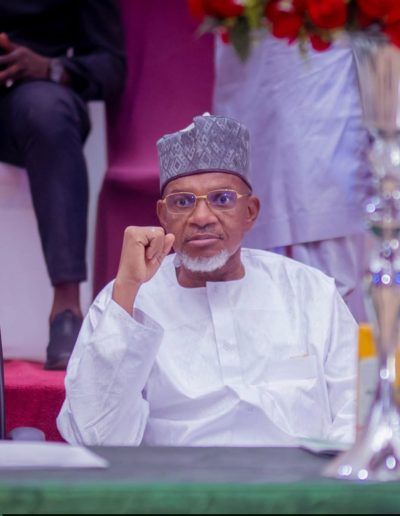
The Speaker of the Kebbi State House of Assembly, Muhammad Usman Ankwai has passed away in the late hours of Monday, 6 April 2026.
Ankwai, who represented Zuru Constituency under the All Progressives Congress (APC), was elected Speaker at the inauguration of the 10th Assembly on June 8, 2023.
Details surrounding the circumstances of his death were not immediately disclosed at the time of filing this report.
His death has, however, triggered an outpouring of condolences from fellow lawmakers, political associates, and residents across Kebbi State, many of whom have described him as a dedicated public servant who contributed to legislative development in the state.
Further announcements regarding burial arrangements are expected to be made by his family soon.

Delta NMA Declares Blessing CEO’s Cancer Report Fraudulent

Abuja Court Jails Boko Haram Food Supplier, Hamatu Modu For 40 Years

Just In: Kebbi Assembly Speaker Muhammad Ankwai Passes Away

Gbenga Daniel Slams Successor As ‘Enfant Terrible’ Who Showed Him Hell

Scores Of Terrorists Neutralised As Military Foils Major Borno Offensive

Easter Tragedy: Herdsmen Strike Benue Again, 9 Dead

President Tinubu Authorizes ₦3.3tn For Power Sector Liquidity, Recovery

Tinubu Commiserates With Former INEC Chair Jega Following Death Of Wife

IGP Disu Summons Lagos Officers To Abuja Over Viral Harassment Video

Fire Outbreak Leaves Hundreds Of Traders Stranded At Yaba Market
-
 News2 days ago
Scores Of Terrorists Neutralised As Military Foils Major Borno Offensive
-
 News9 hours ago
Abuja Court Jails Boko Haram Food Supplier, Hamatu Modu For 40 Years
-
 News6 hours ago
Delta NMA Declares Blessing CEO’s Cancer Report Fraudulent
-
 News17 hours ago
Gbenga Daniel Slams Successor As ‘Enfant Terrible’ Who Showed Him Hell
-
 News13 hours ago
Just In: Kebbi Assembly Speaker Muhammad Ankwai Passes Away