
News
Prove Tinubu’s Certificate Forgery Allegation Beyond Reasonable Doubt, S’Court Tells Atiku

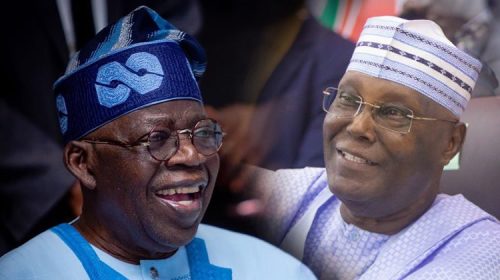
The Chairman of the Supreme Court panel hearing the appeals against the election of President Bola Tinubu, Justice John Okoro, said on Monday that the Peoples Democratic Party standard bearer in the February presidential election, Atiku Abubakar, must prove the allegation of certificate forgery levelled against the ex-Lagos State governor beyond reasonable doubt.
Okoro handed down the admonition during the hearing of the election petition appeals filed by Atiku and Peter Obi of the Labour Party.
He stated this following the submission of Atiku’s lead counsel, Chris Uche, SAN, urging the court to admit the fresh evidence brought by the petitioners.
In his bid to nullify Tinubu’s victory and prove the allegation that he was not qualified to contest the presidential poll, Atiku had prayed to an Illinois Chicago district court to order the Chicago State University to release the President’s academic records.
The former vice-president had accused Tinubu of falsifying the CSU diploma of Bachelor of Science in Business Administration awarded in 1979 that he submitted to the Independent National Electoral Commission.
He demanded a copy of any diploma issued by CSU in 1979, a copy of the diploma the CSU gave to Tinubu in 1979, and copies of diplomas with the same font, seal, signatures, and wording awarded to other students that are similar to what CSU awarded to him in 1979.
Atiku’s application was opposed by Tinubu’s lawyers, citing privacy concerns even as they conceded that only the certificate should be released and not other privileged records.
Academic record
But the United States court ordered the release of the ex-Lagos State governor’s academic records which Atiku filed in support of his election petition appeal at the Supreme Court.
Addressing the apex court on Monday, Uche insisted that the issue of Tinubu’s academic records was a weighty matter and urged the Supreme Court to admit it as fresh evidence.
The senior lawyer said, “The issue involving Tinubu’s certificate is a weighty, grave, and constitutional one, which the Supreme Court should admit. I urge the court to admit the fresh evidence of President Tinubu’s academic records from CSU presented by Atiku.
“The court should take a look at Tinubu’s records and reach a decision devoid of technicality. As a policy court, the court has a duty to look at it and should side-step technicalities. ”
Atiku’s lead counsel also said the issue of 180 days should not tie the hands of the court.
But Justice Okoro, while describing the matter as criminal in nature, said it must be proven beyond reasonable doubt.
He observed that there were two conflicting letters from Chicago State University.
According to him, one of the letters authenticated the President’s certificate and the other discredited it.
He said, “This is a criminal matter that has to be proved beyond reasonable doubt. There are two conflicting letters from the CSU: one authenticating the president’s certificate and another discrediting it.”
Another panel member, Justice Emmanuel Agim observed that the deposition Atiku was seeking to tender as evidence was done in the chambers of Atiku’s lawyer and not in the courtroom.
“I expected the college to write disclaiming the documents in dispute. Does a stenographer have the legal authority to administer oaths? We are dealing with a matter that touches on national interest,’’ he noted.
But Uche argued that the depositions were done in the presence of Tinubu’s US lawyers, adding that there was no dispute about it.
The counsel to the All Progressives Congress, Akin Olujinmi, SAN, told the court that Atiku should not be allowed to bring in documents not presented at the tribunal.
He said, “You cannot smuggle in a document into the Supreme Court without first tendering the same at the trial court. The appeal is misconceived and lacks merit. It should be outright dismissed. ”
In his response to Uche’s arguments, the lawyer to the President, Wole Olanipekun, SAN, similarly urged the court not to admit the fresh documents, adding that INEC was not a party to it.
“The depositions are not admissible in the USA. It is akin to deposition which we have in Nigeria. The deposition was not done in court and INEC was not a party to it. The deposition must be adopted by the individual that deposed to it before it can be admitted as evidence before the court,“ he reasoned.
He also said the 180 days stipulated for the conclusion of election petition cases “is like a rock of Gibraltar, it cannot be moved.’’
INEC’s lawyer, Abubakar Mahmoud, asked the court to interpret section 285 of the constitution and also urged the court to dismiss the appeal.
The court which had Uwani Aji, Mohammed Garba, Ibrahim Saulawa, Adamu Jauro, Abubakar Tijjani, as other panel members, however, reserved judgment in the matter.
The court also reserved judgment in the appeal filed by the presidential candidate of the Labour Party, Peter Obi, against the tribunal’s judgment affirming Tinubu’s election.
Obi and the LP, through their lawyers led by Dr. Livy Uzoukwu, SAN, urged the court to uphold the appeal and set aside the judgment of the Presidential Election Petition Court that dismissed their petition.
The INEC, Tinubu, and the APC had prayed the court to dismiss the appeal for want of merit.
The panel said it would communicate the judgment date to all the parties.
Obi, who came third in the election, had in his 51 grounds of appeal, maintained that the PEPC panel erred in law and thereby reached a wrong conclusion when it dismissed his petition.
He alleged that the panel wrongly evaluated the proof of evidence he adduced before it and occasioned a grave miscarriage of justice when it held that he did not specify polling units where irregularities occurred during the election.
Obi and the LP further faulted the PEPC for dismissing their case on the premise that they did not specify the figures of votes or scores that were allegedly suppressed or inflated in favour of President Tinubu and the APC.
Seven-man panel
The seven-man panel led by Okoro after listening to the submissions of the parties involved in the matter said the judgment date would be communicated to them.
The panel led by Okoro said, “This appeal is reserved for judgment until a date to be communicated to the parties.”
The apex court struck out the appeal by the Allied Peoples Movement seeking to nullify the election of the President.
The party had claimed that the placeholder nominated by the president, Ibrahim Masari, was not replaced within 14 days as stipulated by section 33 of the Electoral Act.
The lead counsel for the party, Chukwuma -Machukwu Ume argued that their appeal was not premised on double nomination which the lower court ruled on, insisting that Vice President Kashim Shettima was illegally nominated.
But Okoro asked him if the APM had anything to gain from the matter.
He said, “What will you gain if you win this appeal? There are other appeals that are asking for something substantial.
There is nothing to gain but to give us work to do. You are not asking us to put your candidate there as president.”
The APM lawyer applied to withdraw his appeal.
The APC, INEC, Ibrahim Massari, and Tinubu’s counsels did not object.
“Having been withdrawn, the appeal is hereby struck out,” Okoro said.






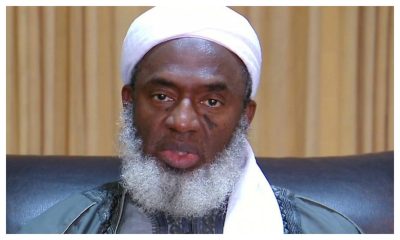
Islamic cleric Sheikh Ahmad Gumi recently defended his past interactions with armed groups, stating he “took the bull by the horns” in 2021 as a necessary step to address Nigeria’s insecurity.
In a post shared on Facebook on Thursday, Gumi said decades of neglect of disadvantaged populations had created deep socio-economic inequalities, leaving many youths vulnerable to manipulation by external forces seeking to destabilise the country.
According to him, the widening gap between the rich and the poor has turned many young people into “ready-made foot soldiers” in cycles of violence that enable the exploitation of Nigeria’s resources.
He also criticised the political class for being largely unresponsive, while noting that the intellectual community is preoccupied with survival struggles.
Reflecting on his past efforts, Gumi said he “took the bull by the horns” in 2021 by attempting to reintegrate violent elements into society rather than allowing them to be further radicalised.
He wrote: “Nigeria for decades has ignored the underprivileged section of its society. There is a significant socio-economic discrepancy, and the society is stratified. This makes our teaming youth ready-made foot soldiers for any foreign interest trying to divide us and rule. To plunder our resources while we are involved in a vicious circle of violence.
”Unfortunately, the political class is unattentive while the intelligentsia is held hostage in the struggle for existence.
“In 2021, I took the bull by the horns in an attempt to bring some of these uncouth elements back to our fold rather than letting them be exploited by the devil.
“I still believe this is the only way out of our predicament. However, it needs the political will and determination to achieve.
“May Allah bring peace back to our nation.”
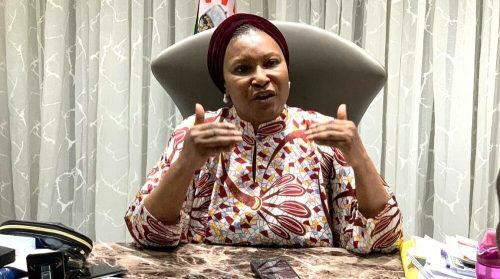
The Federal High Court in Abuja rejected an ex-parte application seeking to bar Senator Ireti Kingibe from participating in the activities of the African Democratic Congress (ADC).
Justice Peter Lifu declined the request from Wuse Ward leaders, ruling that such an order could not be granted without first hearing from the senator.
Instead, the judge ordered the ward leaders said to be loyal to the Minister of the FCT, Nyesom Wike, to put the senator on notice to appear in court to join issues with them on their grievances.
Justice Lifu in a ruling on Thursday held that discretion in such a request for prohibition from party activities and in political matters must be exercised judicially and judiciously.
The judge said justice would be met in the case of the plaintiffs only when the side of the defendant is heard on its merit, along with that of the plaintiffs.
Consequently, the judge ordered that Senator Ireti Kingibe should be served with all court processes by the plaintiffs to enable her become aware of the suit and to prepare her defense.
The judge fixed April 20, 2026, for the plaintiffs and the serving senator to appear before him for hearing of all applications in the matter.
Those who sued the senator in the suit marked FHC/ABJ/ CV/539/2026 are Okezuo Godfrey Anayo and Isaiah Ojonugwa Samuel, on behalf of themselves and ward members as plaintiffs. The senator is the sole defendant.
In their ex-parte application, Kingibe representing the FCT in the Senate was said to have been suspended on March 10, 2026 by her Wuse Ward executives following allegations of anti-party activities and disregard of your cnstitution of the ADC.
In the ex- parte application filed on their behalf by a Senior Advocate of Nigeria, SAN, Kolawole Olowookere, the aggrieved ADC members in Wuse Ward applied for an order of interim injunction restraining Kingibe from parading herself as a member of party, pending the hearing and determination of their motion on notice for interlocutory injunction.
They also asked the judge to restrain the senator from performing any function, attending meetings or performing activities reserved for ADC members or representing the party in any activities.
Besides, the Ward Executive Committee had asked that she be restrained from further interfering with the administration of the ward, ward register and other activities.
The suit was predicated on five grounds among which are that Mrs Kingibe was placed on suspension due to anti-party activities, gross misconduct and confiscation of the ward statutory records.
They argued that the suspension followed due process as enshrined in the ADC constitution and ratified by the two thirds majority of the EXCO members.
They averred that despite the communication of the suspension to Kingibe, she has continued to hold parallel meetings, issue press statements as an ADC member, and using her security details to intimidate the executive committee.
“Her actions constitute flagrant disregard to the internal mechanism of the party,” the plaintiffs stated.
Meanwhile, a lawyer, Abubakar Marshall who claimed to be representing the senator, announced that he had filed a preliminary objection against the suit. He added that it was served on M. S. Garba, who stood for the plaintiffs at Thursday’s proceedings.
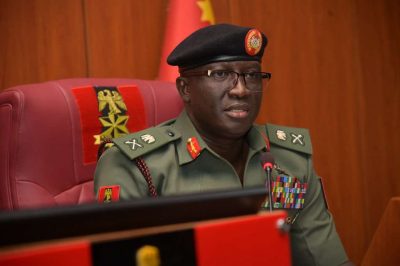
The Chief of Army Staff (COAS), Lieutenant General Waidi Shaibu, visited Jos, Plateau State, on Thursday, April 2, 2026, to lead a high-powered security assessment following recent security breaches.
The visit was aimed at strengthening public confidence and reinforcing ongoing efforts to stabilize affected communities.
Colonel Appolonia Anele, acting Director, Army Public Relations, said in a statement that the visit forms part of ongoing efforts to restore calm and entrench lasting peace across the state.
According to the statement, upon arrival, the COAS was received by the Executive Governor of Plateau State, Caleb Mutfwang, in a clear demonstration of strong civil-military cooperation and a shared commitment to addressing emerging security challenges.
The statement said the COAS received a comprehensive operational briefing from the General Officer Commanding 3 Division and Commander, Joint Task Force Operation ENDURING PEACE, Major General Folusho Oyinlola, who highlighted ongoing operations and proactive measures being implemented in synergy with other security agencies to contain threats, protect lives and property, and stabilise affected communities.
“As part of his engagements, Lieutenant General Shaibu also interacted with community leaders and residents, reassuring them of the unwavering commitment of the Nigerian Army to safeguarding all law-abiding citizens.
He urged residents to remain calm, vigilant and supportive of security agencies by complying with the curfew and cooperating fully with ongoing operations and investigations, while going about their lawful activities.
The chairman of Jos North Local Government Area, Hon. Dachung Bagos, commended the COAS for the timely visit, noting that the presence of the nation’s top military leadership would boost public confidence and reinforce trust in ongoing security efforts.

Gumi Defends Dialogue As Sole Solution To Nigeria’s Insecurity

Court Clears Senator Ireti Kingibe To Remain Active In ADC

COAS Shaibu Hits Jos To Restore Peace, Public Confidence

President Tinubu Appoints New PTDF Executive, Reappoints TCN Head

Simi Welcomes Second Child With Adekunle Gold

United Nigeria Airlines Staff Suspended After Viral Amputee Abuse Video

Pay Your Fare: AIG Cracks Down On Officers Boarding For Free

INEC Removes David Mark, Aregbesola From ADC Leadership Portal

JUST IN: FG Approves Friday 3, Monday 6, as Easter Public Holidays

When 8 million Customers Trust You, Safety Cannot Be an Afterthought
-
 News2 days ago
United Nigeria Airlines Staff Suspended After Viral Amputee Abuse Video
-
 News2 days ago
JUST IN: FG Approves Friday 3, Monday 6, as Easter Public Holidays
-
 News2 days ago
Pay Your Fare: AIG Cracks Down On Officers Boarding For Free
-
 News1 day ago
COAS Shaibu Hits Jos To Restore Peace, Public Confidence
-
 News2 days ago
INEC Removes David Mark, Aregbesola From ADC Leadership Portal
-
 News1 day ago
President Tinubu Appoints New PTDF Executive, Reappoints TCN Head
-
 Entertainment2 days ago
Simi Welcomes Second Child With Adekunle Gold
-
 News1 day ago
Court Clears Senator Ireti Kingibe To Remain Active In ADC