
News
Naira Crisis May Disrupt Polls, INEC Warns Emefiele, NSA


With about 16 days to the general election, there are strong indications that the new naira notes scarcity may disrupt the exercise.
The Chairman of the Independent National Electoral Commission, Mahmood Yakubu, said this during a meeting with the Central Bank Governor, Godwin Emefiele at the CBN headquarters, Abuja, on Tuesday.
He explained that many service providers to INEC had no bank accounts.
He, therefore, solicited the support of the apex bank to address the concern related to the CBN cash withdrawal policy which had caused chaos across the country.
The apex bank had last year pegged weekly cash withdrawal limits set for individuals and corporate organisations to N500,000 and N5 million, respectively.
It also introduced the currency redesign policy which involves the issuance of new N1000, N500 and N200 notes last December.
But explaining his concern to the CBN chief, Yakubu said the service providers needed to be paid fully or partly, adding that there were fears about the withdrawal limits.
He said, “The Nigerian election is a huge and complex one. It requires the engagement of critical services and in line with the provisions of the exchange laws and regulations, service providers are generally paid by means of electronic transfer to their accounts.
‘’However, there are crucial areas such as transportation and human support services that have to be immediately enumerated, either partially or in full because services are rendered.
“In addition, emergency situations may arise requiring immediate cash payments. Some of the critical service providers are unbanked. Over the years we have worked with the Central Bank of Nigeria and commercial banks to pay for such services seamlessly during general elections, as well as off-cycle and by-elections.
‘’Over the years, the commission has migrated all its accounts at national and state levels to CBN and this arrangement has worked without hindrances to our activities.
“In view of the recent policy involving the redesigning of some denominations of our currencies and the limit on cash withdrawals and availability, we consider this meeting important in addressing some of our areas of concern with just 17 days to the 2023 general elections.
‘’We are confident that an aspect of this meeting will reduce the anxiety expressed by some of our service providers. We are determined to make the 2023 general election one of the best elections in Nigeria but we cannot do it alone. That is why the commission is mobilising every critical national institution for the success of the election.”
CBN allays fears
The CBN governor assured that cash would be made available for payment of the service providers and added that the apex bank would not allow itself to be used to frustrate the efforts of the electoral body.
Emefiele promised that the apex bank would do everything possible to support the 2023 election, stressing that it has never failed Nigerians.
He stated, “Now, just aside from the issue of storage of election materials and together with transportation of these election materials from CBN locations to your own specific or designated locations; where do you want these materials to be?
‘’I know that just a few months ago, I visited your office and you raised the issue of how foreign exchange can be procured for you to import your BVAS and other election materials that need to be imported. And I give you my word that foreign exchange will be provided for that purpose.
“I stand here or I sit here to confirm that today, not $1 is owed. All the dollars that are needed to import those items have been provided and those items have been imported.
“So, it is all part of our commitment. Now this issue of payment and logistics for people who are going to be transporting election materials, even to visit wards; the assurance I give to you is that because we regarded the INEC project as a topmost or urgent national assignment, it cannot fail and the central bank would not allow itself either to be used or itself to be seen as an agent that frustrated a positive outcome of that election.’’
Emefiele said the CBN would provide the cash support with the electoral body needed to prosecute the poll.
‘’It is not just about cash and you have done electric electronic payments before and if in this case after making your electronic payments, you require some money to pay transporters, in this case, cash; the assurance I give to you is that we will make it available so it is nothing to worry about,’’ he said.
NSA on security
Meanwhile, the National Security Adviser, Babagana Monguno, has assured Nigerians of a secured voting atmosphere, saying the security personnel were well prepared ahead of the poll.
Speaking while hosting the INEC chairman on Tuesday, the NSA noted, “We had several meetings with the chairman of INEC, the Inter-Agency Consultative Committee on Election Security, which I co-chair. We know what we have done. We are sure of what we have on the ground.
“All of us here who are the managers of security in the electoral process know what we are doing. We are not in any way in doubt but we need to let the entire country know that agents of bad news are peddling all kinds of stories we see on social media. If these are intended to scare people, I want to dispel such illusions.
“Everybody that is concerned in carrying out his legitimate undertaking, casting his or her vote will do so in a secure atmosphere. It’s very important that Nigerians are not pushed to the limit where they will abandon their number one responsibility as citizens. All security agencies are up to the task.’’
On his part, the INEC chairman said the commission was confident that the recent security actions would further reassure voters, its officials, service providers and stakeholders of their safety during the election.
Yakubu appreciated the security assurances from the NSA and other security chiefs.
“We are aware that additional security has been deployed in our facilities nationwide. We also note the increasing tempo of activities in many troubled spots nationwide.
“We are confident that these actions will further reassure voters, our personnel, service providers, and stakeholders of their safety during elections and a free, fair and peaceful process. We look forward to a comprehensive plan for the deployment of security personnel,” he noted.
Buhari, govs’ meeting
Also, a meeting between the President, Major General Muhammadu Buhari (retd.), state governors, Emefiele and other officials, meant to discuss the disastrous new naira policy of the CBN was cancelled on Tuesday.
The development, it was gathered, followed the two separate lawsuits filed by three governors and five political parties, which have stalled Buhari’s intervention.
Senior Special Assistant to the President on Media and Publicity, Garba Shehu, confirmed to The PUNCH on Tuesday that the meeting was “put down” due to the legal battles surrounding the policy.
Governors Nasir El-Rufai of Kaduna, Yahaya Bello (Kogi) and Bello Matawalle (Zamfara) on Monday dragged the Federal Government and the CBN before the Supreme Court, seeking a halt to the full implementation of the naira redesign policy.
The applicants in the suit were the Attorneys-General and Commissioners of Justice of Kaduna, Kogi and Zamfara three states, while the Attorney-General of the Federation and Minister of Justice, Abubakar Malami, SAN, was the sole respondent in the matter.
In furtherance of their support for the currency redesign initiative, four parties obtained an order from the Federal Capital Territory High Court restraining the FG, CBN Governor Godwin Emefiele, CBN and 27 commercial banks from halting the policy or extending the February 10 deadline handed down by the apex bank.
The order was handed down on Monday by Justice Eleojo Enenche following an application by the five applicants.
Also on Monday, 14 political parties threatened to boycott the February 25 election, should the CBN extend the time limit.
Speaking on behalf of the parties at a news conference in Abuja, the spokesperson for the Conference of Nigerian Political Parties Chairmen, Kenneth Udeze, warned that the parties would pull out of the election if the apex bank bows to pressure and suspend the policy.
But explaining why the planned meeting between the governors and the President was shelved, Shehu said, “According to the programme, he was to meet the Nigeria Governors Forum in attendance with the CBN Governor, the IG of Police, EFCC and so on.
“Because of the legal matters in court over the naira redesign, that meeting was put down and a smaller meeting was convened with the Chairmen of the NGF and the Progressives Governors Forum. So, they were called into a private meeting.”
Despite the cancellation, Buhari met privately with the Chairman of the Nigeria Governors’ Forum, Governor Aminu Tambuwal of Sokoto State, Chairman of the Progressives Governors’ Forum, Governor Abubakar Bagudu of Kebbi State; the CBN governor, Emiefele, the Chairman of the Economic and Financial Crimes Commission, AbdulRasheed Bawa, Director-General of the Department of State Services, Yusuf Bichi, Inspector-General of Police, Usman Baba and the Chief of Defence Staff, General Lucky Irabor.
However, the Presidential spokesman did not disclose the details of the meeting.
Asked whether any policy changes were discussed, the CBN governor declined to answer but instead shielded his face from correspondents.
The PUNCH reports that the scarcity of naira had not eased despite promises by the apex bank that it had taken some measures to address the challenge which had worsened the hardship in the country.
Several banking halls and ATM points were daily besieged by citizens desperate for cash.
After a meeting with APC governors last Friday, Buhari appealed to Nigerians to give him seven days to resolve the crisis.
The seven-day window ends on February 10.
But the Federal Government lambasted the opposition political parties that went to court to restrain the President from addressing the new naira debacle.
It also accused the parties of politicising the situation, stressing that they were not mindful of the plights of Nigerians due to the cash crunch.
Speaking at the 23rd edition of the PMB Administration Scorecard Series (2015-2023), which featured the Federal Ministry of Humanitarian Affairs, Disaster Management and Social Development in Abuja, the Minister of Information and Culture, Lai Mohammed, said the action of the parties was unscrupulous.
He said, “Recall that after his meeting with progressives’ governors on Friday, President Buhari urged citizens to give him a seven-day window to resolve the currency crunch that has emanated from the implementation of the naira redesign policy.
“Unfortunately, on Monday, some opposition political parties ran to court to obtain an injunction restraining Mr President and the CBN from extending the February 10 deadline for Nigerians to exchange their old notes for new ones.”
Mohammed said the court action came after a number of opposition parties threatened to boycott the 2023 general elections if the deadline was extended.
He added, “These curious actions by the parties concerned is clear evidence that the opposition has turned this whole issue into a political game, preferring to make Nigerians suffer more on the altar of unconscionable political gamesmanship.
“Or how else can one explain the fact that these unscrupulous opposition parties do not want any action that could reduce the pains being experienced by Nigerians?
“How else can one explain the fact that they have decided to legally hamstring Mr President, in particular, from providing any relief for Nigerians suffering from the cash crunch?”
Mohammed argued that it was bad politics to put the interest of desperate political parties over and above that of Nigerians.
He, however, stated that despite the antics of the opposition, the government was willing and able to take decisive steps to bring succour to Nigerians in the shortest possible time.
The minister further said the Federal Government was mindful of the inconveniences being endured by citizens as a result of the fuel supply disruptions and the recent redesigning of some naira notes.
“Government is working assiduously to restore normalcy to these critical enablers of economic activity and to take added measures, where necessary, to alleviate the pains of Nigerians,” the minister assured.
In the meantime, the presidential candidate of the All Progressives Congress, Bola Tinubu, has again appealed to Nigerians to remain calm and allow the FG to proffer solutions to the naira and fuel issues.
Addressing journalists in Abuja on Tuesday, Tinubu sympathised with Nigerians, especially the downtrodden, whom he said have been made to bear the brunt of the policy.
He commended the Nigerian National Petroleum Corporation Limited for the fuel supply relief being enjoyed in the FCT and urged the company to bring relief to other parts of the country.
He also admonished the CBN not to be dogmatic in the deadline it has fixed for the transition from old notes to the new currency.
He said, “This is a challenging period in the life of our country when our people are made to stay on the line for hours to get fuel and even get their own money from the banks.’’






Sterling Bank, through its women focused initiative, OneWoman, convened a powerful gathering of women entrepreneurs, development finance institutions, ecosystem leaders, and business stakeholders at the Funding Her Future Breakfast Dialogue in Lagos.
The session brought together voices from across sectors for a focused and necessary conversation on how to unlock more inclusive and effective financing pathways for women led businesses in Nigeria.
At its core, the dialogue was not just about access to capital. It was about building the right systems around women entrepreneurs. Conversations explored how financing, business readiness, ecosystem support, and institutional partnerships must come together to drive long term growth and resilience.
Speaking at the event, the Managing Director and Chief Executive Officer of Sterling Bank, Abubakar Suleiman, noted that the gathering was designed to move beyond intention and into action.
“Today is about going further. It is about turning shared belief into shared action,” he said.
In his welcome remarks, delivered on his behalf by the Chief Growth Officer, Edward Ogunmekan, Suleiman described the dialogue as a meeting point of finance, enterprise, inclusion, and sustainable economic growth.
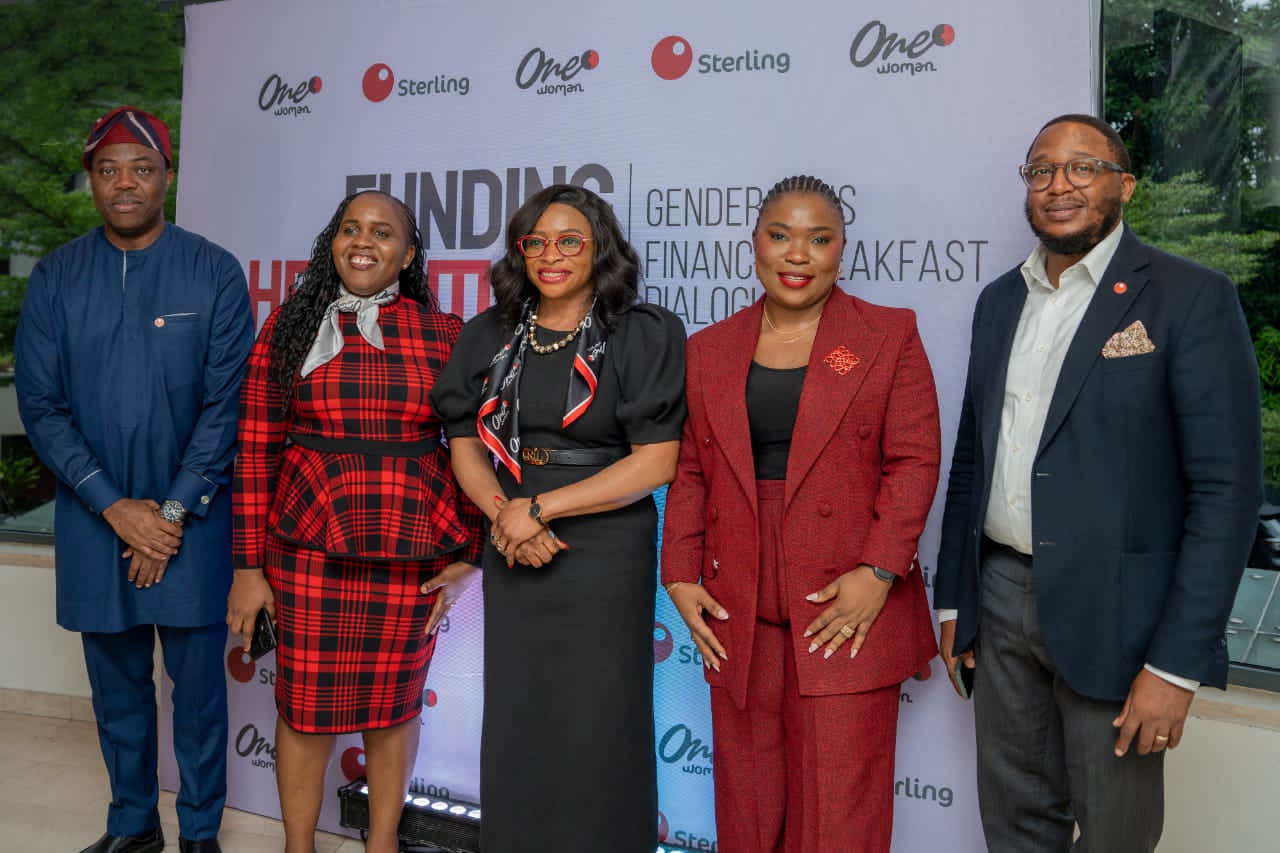
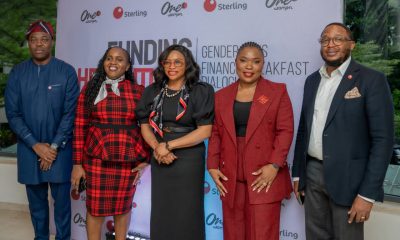
From L-R: Akporee Idenedo, Divisional Head, Commercial Banking, Sterling Bank; Ezinne Nwokafor, Head, OneWoman Initiative, Sterling Bank; Thelma Luke Nwoye, Group Head, Business Finance, Sterling Bank; ‘Solape Akinpelu, CEO/Founder , HerVest; Edward Ogunmekan, Chief Growth Officer, Sterling Bank at the OneWoman Gender Lens Breakfast Dialogue held at The Wheatbaker Hotel, Ikoyi recently.
“We are honoured to host such a distinguished gathering of partners, investors, women entrepreneurs, and business leaders, all brought together by one important question. How do we expand access to meaningful finance for women-led businesses in a way that is scalable, sustainable, and commercially sound?”
He explained that the conversation reflects a long- standing conviction at Sterling that real prosperity is built by backing people, ideas, and sectors with strong potential. This belief, he noted, is what gave rise to the OneWoman initiative.
According to him, OneWoman was created to support women through three key pillars which are capital, capacity, and community.
He added that while access to finance is critical, it is only one part of the equation.
“Women-led businesses need the right support systems, the right networks, and the right ecosystem to grow with confidence and scale with resilience,” he said.
The event also featured two panel sessions with representatives from funding institutions, women focused organisations, entrepreneurs, and ecosystem partners. These conversations provided practical insights into financing opportunities available to women, while also examining the broader support systems required for sustainable growth.
Also speaking at the event, Ezinne Nwokafor, Head of the OneWoman Initiative, highlighted the urgency of addressing the financing gap facing women in Nigeria.
She noted that a significant majority of Nigerian women remain excluded from formal credit, with only a small percentage able to access structured financing. Despite improvements in financial inclusion, women continue to face systemic barriers that limit their ability to secure funding.
Nwokafor pointed out that women account for a substantial share of micro, small, and medium enterprises and contribute meaningfully to the economy, yet face a financing gap estimated at 42 billion dollars (USD) annually according to the International Finance Corporation.
She also referenced data showing that more than half of women led businesses identify access to finance as a major constraint, while rejection rates for loan applications remain significantly higher for women than for men.
According to her, these challenges are often linked to structural issues such as gaps in asset ownership, social norms, and limited access to financial data and visibility.
Despite these barriers, she emphasised that the opportunity is significant.
“Sterling’s OneWoman initiative is positioned to bridge this gap by combining financial solutions, mentorship, capacity building, and community support for women across different stages of their journey,” she said.
She added that in 2025 alone, the initiative gave out N43.9 billion loans to 2,450 female entrepreneurs, trained 6,000 of them, served about 380,000 women across three sectors of career women, women in business and freshers and their vision 2030 is to give out N500 billion loans to one million women across their three sectors.
Also speaking, Akporee Idenedo, Divisional Head of Commercial Banking, reaffirmed the bank’s commitment to addressing the concerns raised during the dialogue. He stressed that building skills and strengthening capacity will remain essential to creating a sustainable ecosystem for women entrepreneurs.
The Funding Her Future Breakfast Dialogue forms part of Sterling Bank’s broader effort to deepen its support for women through targeted financing, enterprise development, and community driven growth.
Through OneWoman, the bank continues to build platforms and solutions that empower women to grow sustainable businesses, create jobs, and contribute more meaningfully to economic progress.
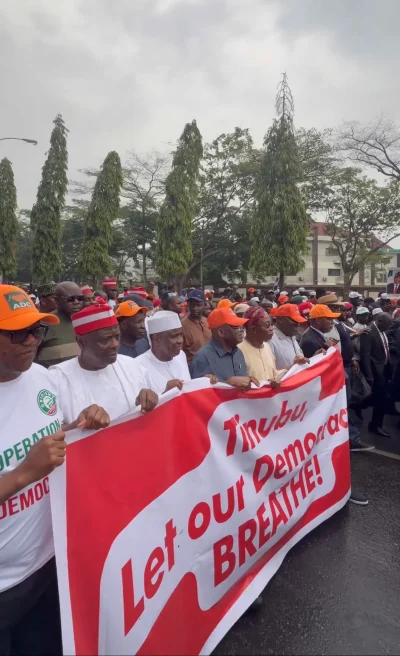
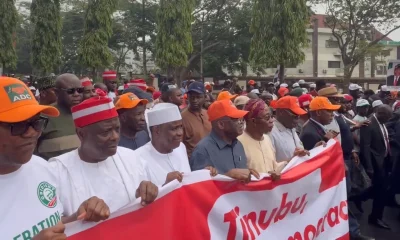
Prominent opposition leaders including Atiku Abubakar, Peter Obi, and Rabiu Kwankwaso have joined a mass protest tagged #OccupyINEC in Abuja.
The demonstration, led by members of the African Democratic Congress (ADC), targeted the Independent National Electoral Commission (INEC) over its recent decisions regarding the party’s internal leadership.
The protest, tagged #OccupyINEC, drew former presidential candidates and prominent politicians, including Rotimi Amaechi, Atiku Abubakar, Peter Obi, Rabiu Kwankwaso, Rauf Aregbesola, Aminu Tambuwal, and Dino Melaye, to Maitama Roundabout. Among others, hundreds of Kwankwasiyya members also participated.
The demonstration saw participants singing Nigeria’s former national anthem, “Arise, O Compatriots!”, despite the fact that it was replaced on May 29, 2024, by President Bola Tinubu with the country’s 1960 independence anthem, “Nigeria, We Hail Thee.”
The ADC further confirmed that the act was done “in an act of defiance.”
Several demonstrators also held placards supporting Senator David Mark, including ones that read, “In David Mark’s NWC we trust.”
Addressing the protest, former presidential candidate Peter Obi spoke on behalf of ADC members and other opposition leaders, urging Nigerians to defend the country’s democracy.
He said on X: “We, members and leaders of the ADC, and other well-meaning Nigerians, lovers of democracy, are saying that our democracy must not be killed.
“We say NO to a one-party system, and for that, today we’re calling out Nigerians who believe in unity, peace, and security of our country to join us as we defend democracy in our land.”
The protest follows INEC’s recent decision to no longer accept correspondence from either faction of the ADC led by Senator David Mark or Nafiu Bala, after a Court of Appeal judgment on the party’s leadership dispute. ADC and other opposition groups described the move as a restriction on party autonomy and an interference with internal party affairs.
National Coordinator of the Obidient Movement, Yunusa Tanko, had earlier told The PUNCH the demonstration aimed to mobilise Nigerians in defence of democracy.
“This commission is now becoming the arbiter, judge, accuser and defender at the same time. Our major issue is the manner in which INEC has been going about creating disaffection in the opposition.
“The people are really angry and plan to show this anger by coming out. So, we’ll expect them to come out en masse for a peaceful rally. Then we’ll just demonstrate and protest,” he said.
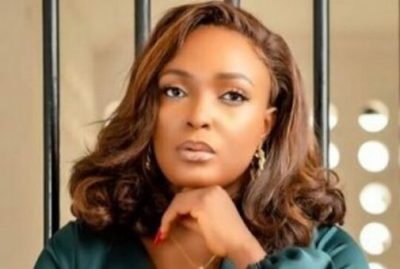
The Nigerian Medical Association (NMA), Delta State branch, has officially debunked the cancer claims made by relationship influencer Blessing Okoro, popularly known as Blessing CEO.
In a statement on Tuesday, the association revealed that the document is an altered version of an original medical report belonging to a different patient diagnosed with breast cancer.
The statement, jointly signed by NMA Delta State Chairman, Dr. Israel Adaigho, and Secretary, Dr. Usamah Hannah, was sighted by The Nation on Tuesday.
According to the NMA, the viral report was purportedly issued by Xinus Medical Diagnostics and signed by consultant pathologist Dr. O.A. Odigwe.
However, Dr. Odigwe, who is the proprietor of the diagnostic centre, clarified that his facility never issued any report to Blessing Okoro.
The association explained that Xinus Medical Diagnostics is located in Asaba, Delta State not Enugu State as claimed in the circulating document.
The centre was contacted in May 2025 by a doctor from a private hospital in Asaba to conduct a confirmatory histology test for a patient identified as Mbara Deborah, who had a suspected case of breast cancer.
The test confirmed breast cancer, and the original result was issued to the referring doctor on May 9, 2025.
The NMA stated that the document currently being paraded online by the law firm Allen Juris Law is the original report bearing the name Mbara Deborah.
The version linked to Blessing CEO appears to be a doctored copy of this same report.
The statement read in part: “Our attention has been drawn to an online histology report purportedly issued to one Blessing Okoro, aka Blessing CEO, by Xinus Medical Diagnostics allegedly located in Enugu State. The said histology report was also alleged to have been signed by Dr. O.A. Odigwe, a consultant pathologist.
“The proprietor of Xinus Medical Diagnostics, Dr. O.A. Odigwe, who is also a member of the Nigerian Medical Association, Delta State chapter, has reached us and offered the following clarification: that Xinus Medical Diagnostics is located in Asaba, Delta State and did not at any time issue any report to Blessing Okoro.
“The centre was contacted in May 2025 by a doctor from a private hospital in Asaba to do a confirmatory test on a possible case of breast cancer for a patient, Mbara Deborah. The test was done and the result issued to the referring doctor as a case of breast cancer on May 9, 2025.
“A copy of that result is the one currently being circulated online by the law firm, Allen Juris Law, with the name Mbara Deborah as the patient. That result from the law firm is the original version issued to the patient through her hospital.”
The NMA said the clarification became necessary because of the way the altered report was allegedly being used to solicit public sympathy and financial assistance.
It urged the public to be cautious and warned against actions that could tarnish the integrity of medical professionals.
The association also called on relevant security agencies to take appropriate steps to protect unsuspecting members of the public.
“The integrity of our association and its members is very paramount and should not therefore be taken for granted.
“We call on the authorities responsible for maintaining law and order to do the needful and save unsuspecting members of the public from being unduly taken advantage of,” it added.
Recall that Blessing CEO recently solicited financial help from the public for the treatment of what she claimed was stage four cancer.
Following widespread backlash and allegations that her medical report had been edited, she made a U-turn, stating in an interview: “I don’t have stage 4 cancer. That was a miscommunication.”

Sterling Bank Deepens Commitment to Women Entrepreneurs with OneWoman Financing Dialogue

#OccupyINEC: Nigeria’s Opposition Giants Join Forces In Massive Abuja Rally

Delta NMA Declares Blessing CEO’s Cancer Report Fraudulent

Abuja Court Jails Boko Haram Food Supplier, Hamatu Modu For 40 Years

Just In: Kebbi Assembly Speaker Muhammad Ankwai Passes Away

Gbenga Daniel Slams Successor As ‘Enfant Terrible’ Who Showed Him Hell

Scores Of Terrorists Neutralised As Military Foils Major Borno Offensive

Easter Tragedy: Herdsmen Strike Benue Again, 9 Dead

President Tinubu Authorizes ₦3.3tn For Power Sector Liquidity, Recovery

Tinubu Commiserates With Former INEC Chair Jega Following Death Of Wife
-
 News1 day ago
Delta NMA Declares Blessing CEO’s Cancer Report Fraudulent
-
 News1 day ago
Abuja Court Jails Boko Haram Food Supplier, Hamatu Modu For 40 Years
-
 News1 day ago
Just In: Kebbi Assembly Speaker Muhammad Ankwai Passes Away
-
 News2 days ago
Gbenga Daniel Slams Successor As ‘Enfant Terrible’ Who Showed Him Hell
-
 News3 hours ago
Sterling Bank Deepens Commitment to Women Entrepreneurs with OneWoman Financing Dialogue
-
 News3 hours ago
#OccupyINEC: Nigeria’s Opposition Giants Join Forces In Massive Abuja Rally