
News
Pope Emeritus Benedict XVI Dies At Age 95

Pope Benedict XVI, who served as leader of the Catholic church from 2005 until his resignation in 2013, has died aged 95, the Vatican has announced.
A statement from Vatican spokesman Matteo Bruni said: “With sorrow, I inform you that Pope Emeritus Benedict XVI passed away today at 9.34 in the Mater Ecclesiae Monastery in the Vatican. Further information will be provided as soon as possible.”
His death comes after Pope Francis announced during his weekly audience on 28 December that Benedict was “very sick”.
Benedict’s death brings to a close an unprecedented period in recent history where two popes have co-existed, a situation that has caused tensions within rival camps in the Vatican. It paves the way for his successor, Pope Francis, to consider whether to follow Benedict by retiring at some point – impossible while the outcome would have been three popes.
Benedict, born Joseph Aloisius Ratzinger in Germany in 1927, was a deeply conservative pontiff, whose tenure was overshadowed by sex abuse scandals in the church. He retired leaving a chequered reputation after a papacy that was at times divisive.
The results of a German investigation published in January 2022 said Benedict had failed to act against four priests accused of child sexual abuse when he was archbishop of Munich.
The son of a policeman, he grew up in rural Bavaria and at the age of 14 joined the Hitler Youth, a requirement, and served in the German army in the second world war. Towards the end of the war he deserted, and was briefly held as a prisoner of war by American forces.
He later became a major figure in the Vatican and, as Cardinal Ratzinger, served as a right-hand man to his predecessor, Pope John Paul II. He headed the Congregation for the Doctrine of the Faith, a Vatican department once known as the Inquisition, for 24 years, a position that earned him the nickname “God’s Rottweiler”.
During his tenure, allegations of clerical sexual abuse and its cover-up began to surface. His critics said he failed to grasp the gravity of the crimes and the scale of the crisis, which reached a peak several years after he was elected pope in April 2005.
As well as the flood of allegations, lawsuits and official reports relating to sexual abuse and the priests’ complicity in covering it up, the Vatican was also rocked by the theft of confidential documents, many of which later appeared in an exposé of alleged corruption. In October 2012, a Vatican court convicted the pope’s personal butler, Paolo Gabriele, of stealing the papers. He told the trial he had been acting against “evil and corruption”.
Benedict was a theological conservative, holding uncompromising positions on homosexuality and contraception. He had strongly opposed liberation theology, a radical movement that began in South American in the 1960s and advocated clerical social activism among the poor and marginalised.
His sudden resignation, at the age of 85, in February 2013, the first pope to do so since the middle ages, left the church reeling. He said at the time that he did not have the strength to carry on as leader of the world’s estimated 1.2 billion Catholics. “I have had to recognise my incapacity to adequately fulfil the ministry entrusted to me,” he said.
He took the title of Pope Emeritus, and pledged to remain “hidden to the world”, devoting himself to private prayer. He retired to in a monastery in Vatican City, where he read, wrote letters and articles, received guests and played the piano.
But the former pope remained a powerful conservative influence and a focus for opponents of Francis’s efforts to reform the church and redirect it to serving the poor He repeatedly made his views known through letters, articles and interviews. In April 2019, two months after Francis convened a groundbreaking Vatican conference on sexual abuse, Benedict published a 6,000-word letter saying abuse was a product of a culture of sexual freedom dating from the 1960s.
In January 2020, Benedict publicly defended clerical celibacy, as Francis was considering allowing married men to become priests in limited circumstances. “I cannot keep silent,” he wrote in a book, From the Depths of our Hearts: priesthood, celibacy and the crisis of the Catholic church, arguing that priestly celibacy protected the mystery of the church.
In the resulting furore, Benedict asked for his name to be removed as co-author with Cardinal Robert Sarah, a key conservative tipped to succeed Francis.
The controversy, which erupted just before the Two Popes, a film about the apparently warm relationship between Benedict and Francis, was aired on Netflix, exposed tensions between rival Vatican camps.
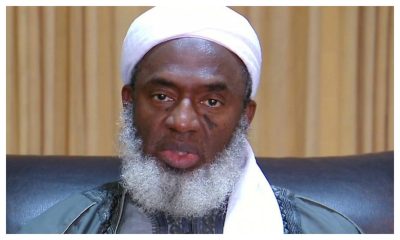
Islamic cleric Sheikh Ahmad Gumi recently defended his past interactions with armed groups, stating he “took the bull by the horns” in 2021 as a necessary step to address Nigeria’s insecurity.
In a post shared on Facebook on Thursday, Gumi said decades of neglect of disadvantaged populations had created deep socio-economic inequalities, leaving many youths vulnerable to manipulation by external forces seeking to destabilise the country.
According to him, the widening gap between the rich and the poor has turned many young people into “ready-made foot soldiers” in cycles of violence that enable the exploitation of Nigeria’s resources.
He also criticised the political class for being largely unresponsive, while noting that the intellectual community is preoccupied with survival struggles.
Reflecting on his past efforts, Gumi said he “took the bull by the horns” in 2021 by attempting to reintegrate violent elements into society rather than allowing them to be further radicalised.
He wrote: “Nigeria for decades has ignored the underprivileged section of its society. There is a significant socio-economic discrepancy, and the society is stratified. This makes our teaming youth ready-made foot soldiers for any foreign interest trying to divide us and rule. To plunder our resources while we are involved in a vicious circle of violence.
”Unfortunately, the political class is unattentive while the intelligentsia is held hostage in the struggle for existence.
“In 2021, I took the bull by the horns in an attempt to bring some of these uncouth elements back to our fold rather than letting them be exploited by the devil.
“I still believe this is the only way out of our predicament. However, it needs the political will and determination to achieve.
“May Allah bring peace back to our nation.”

The Federal High Court in Abuja rejected an ex-parte application seeking to bar Senator Ireti Kingibe from participating in the activities of the African Democratic Congress (ADC).
Justice Peter Lifu declined the request from Wuse Ward leaders, ruling that such an order could not be granted without first hearing from the senator.
Instead, the judge ordered the ward leaders said to be loyal to the Minister of the FCT, Nyesom Wike, to put the senator on notice to appear in court to join issues with them on their grievances.
Justice Lifu in a ruling on Thursday held that discretion in such a request for prohibition from party activities and in political matters must be exercised judicially and judiciously.
The judge said justice would be met in the case of the plaintiffs only when the side of the defendant is heard on its merit, along with that of the plaintiffs.
Consequently, the judge ordered that Senator Ireti Kingibe should be served with all court processes by the plaintiffs to enable her become aware of the suit and to prepare her defense.
The judge fixed April 20, 2026, for the plaintiffs and the serving senator to appear before him for hearing of all applications in the matter.
Those who sued the senator in the suit marked FHC/ABJ/ CV/539/2026 are Okezuo Godfrey Anayo and Isaiah Ojonugwa Samuel, on behalf of themselves and ward members as plaintiffs. The senator is the sole defendant.
In their ex-parte application, Kingibe representing the FCT in the Senate was said to have been suspended on March 10, 2026 by her Wuse Ward executives following allegations of anti-party activities and disregard of your cnstitution of the ADC.
In the ex- parte application filed on their behalf by a Senior Advocate of Nigeria, SAN, Kolawole Olowookere, the aggrieved ADC members in Wuse Ward applied for an order of interim injunction restraining Kingibe from parading herself as a member of party, pending the hearing and determination of their motion on notice for interlocutory injunction.
They also asked the judge to restrain the senator from performing any function, attending meetings or performing activities reserved for ADC members or representing the party in any activities.
Besides, the Ward Executive Committee had asked that she be restrained from further interfering with the administration of the ward, ward register and other activities.
The suit was predicated on five grounds among which are that Mrs Kingibe was placed on suspension due to anti-party activities, gross misconduct and confiscation of the ward statutory records.
They argued that the suspension followed due process as enshrined in the ADC constitution and ratified by the two thirds majority of the EXCO members.
They averred that despite the communication of the suspension to Kingibe, she has continued to hold parallel meetings, issue press statements as an ADC member, and using her security details to intimidate the executive committee.
“Her actions constitute flagrant disregard to the internal mechanism of the party,” the plaintiffs stated.
Meanwhile, a lawyer, Abubakar Marshall who claimed to be representing the senator, announced that he had filed a preliminary objection against the suit. He added that it was served on M. S. Garba, who stood for the plaintiffs at Thursday’s proceedings.

The Chief of Army Staff (COAS), Lieutenant General Waidi Shaibu, visited Jos, Plateau State, on Thursday, April 2, 2026, to lead a high-powered security assessment following recent security breaches.
The visit was aimed at strengthening public confidence and reinforcing ongoing efforts to stabilize affected communities.
Colonel Appolonia Anele, acting Director, Army Public Relations, said in a statement that the visit forms part of ongoing efforts to restore calm and entrench lasting peace across the state.
According to the statement, upon arrival, the COAS was received by the Executive Governor of Plateau State, Caleb Mutfwang, in a clear demonstration of strong civil-military cooperation and a shared commitment to addressing emerging security challenges.
The statement said the COAS received a comprehensive operational briefing from the General Officer Commanding 3 Division and Commander, Joint Task Force Operation ENDURING PEACE, Major General Folusho Oyinlola, who highlighted ongoing operations and proactive measures being implemented in synergy with other security agencies to contain threats, protect lives and property, and stabilise affected communities.
“As part of his engagements, Lieutenant General Shaibu also interacted with community leaders and residents, reassuring them of the unwavering commitment of the Nigerian Army to safeguarding all law-abiding citizens.
He urged residents to remain calm, vigilant and supportive of security agencies by complying with the curfew and cooperating fully with ongoing operations and investigations, while going about their lawful activities.
The chairman of Jos North Local Government Area, Hon. Dachung Bagos, commended the COAS for the timely visit, noting that the presence of the nation’s top military leadership would boost public confidence and reinforce trust in ongoing security efforts.

Gumi Defends Dialogue As Sole Solution To Nigeria’s Insecurity

Court Clears Senator Ireti Kingibe To Remain Active In ADC

COAS Shaibu Hits Jos To Restore Peace, Public Confidence

President Tinubu Appoints New PTDF Executive, Reappoints TCN Head

Simi Welcomes Second Child With Adekunle Gold

United Nigeria Airlines Staff Suspended After Viral Amputee Abuse Video

Pay Your Fare: AIG Cracks Down On Officers Boarding For Free

INEC Removes David Mark, Aregbesola From ADC Leadership Portal

JUST IN: FG Approves Friday 3, Monday 6, as Easter Public Holidays

When 8 million Customers Trust You, Safety Cannot Be an Afterthought
-
 News2 days ago
When 8 million Customers Trust You, Safety Cannot Be an Afterthought
-

 News2 days ago
El-Rufai Back In Detention After Temporary Compassionate Release
-
 News1 day ago
United Nigeria Airlines Staff Suspended After Viral Amputee Abuse Video
-

 News2 days ago
2027: Kwankwaso’s Exit Marks End Of NNPP – Kwankwasiyya Movement
-
 News1 day ago
JUST IN: FG Approves Friday 3, Monday 6, as Easter Public Holidays
-
 News1 day ago
Pay Your Fare: AIG Cracks Down On Officers Boarding For Free
-

 News2 days ago
Lagos CP Withdraws Taskforce From Traffic Duties
-
 News1 day ago
INEC Removes David Mark, Aregbesola From ADC Leadership Portal