
News
Life And Times Of Pope Emeritus Benedict

Following the announcement of the passing of Pope Emeritus Benedict XVI on Saturday at the age of 95, Vatican News looks back at his long life and its main highlights with the following official biography.
Cardinal Joseph Ratzinger, Pope Benedict XVI, was born at Marktl am Inn, Diocese of Passau (Germany) on 16 April 1927 (Holy Saturday) and was baptised on the same day.
His father, a Police Commissioner, belonged to an old family of farmers from Lower Bavaria of modest economic resources.
His mother was the daughter of artisans from Rimsting on the shore of Lake Chiem. Before marrying, she worked as a cook in a number of hotels.
Joseph spent his childhood and adolescence in Traunstein, a small village near the Austrian border, thirty kilometres from Salzburg. In this environment, which he himself has defined as “Mozartian”, he received his Christian, cultural and human formation.
His youthful years were not easy. His faith and the education received at home prepared him for the harsh experience of those years during which the Nazi regime pursued a hostile attitude towards the Catholic Church. The young Joseph saw how some Nazis beat the Parish Priest before the celebration of Mass.
It was precisely during that complex situation that he discovered the beauty and truth of faith in Christ; fundamental for this was his family’s attitude, who always gave a clear witness of goodness and hope, rooted in a convinced attachment to the Church.
He was enrolled in an auxiliary anti-aircraft corps until September 1944.
Priest
From 1946 to 1951, he studied philosophy and theology in the Higher School of Philosophy and Theology of Freising and at the University of Munich.
He received his priestly ordination on 29 June 1951. A year later he began teaching at the Higher School of Freising.
In 1953, he obtained his doctorate in theology with a thesis entitled “People and House of God in St Augustine’s Doctrine of the Church”.
Four years later, under the direction of the renowned professor of fundamental theology Gottlieb Söhngen, he qualified for University teaching with a dissertation on: “The Theology of History in St Bonaventure”.
After teaching dogmatic and fundamental theology at the Higher School of Philosophy and Theology in Friezing, he went on to teach at Bonn, from 1959 to1963; at Münster from 1963 to 1966; and at Tübingen from 1966 to 1969. During this last year, he held the Chair of dogmatics and history of dogma at the University of Regensburg, where he was also Vice-President of the University.
From 1962 to 1965, he made a notable contribution to Vatican II as an “expert”, being present at the Council as theological consultant of Cardinal Joseph Frings, Archbishop of Cologne.
His intense scientific activity led him to important positions at the service of the German Bishops’ Conference and the International Theological Commission.
In 1972, together with Hans Urs von Balthasar, Henri de Lubac and other important theologians, he initiated the theological journal Communio.
Bishop and Cardinal
On 25 March 1977, Pope Paul VI named him Archbishop of Munich and Freising. On 28 May of the same year, he received episcopal ordination. He was the first diocesan priest in 80 years to take on the pastoral governance of the great Bavarian Archdiocese.
He chose as his episcopal motto: “Cooperators of the truth”. He himself explained why:
“On the one hand I saw it as the relation between my previous task as professor and my new mission. In spite of different approaches, what was involved, and continued to be so, was following the truth and being at its service.
“On the other hand I chose that motto because in today’s world the theme of truth is omitted almost entirely, as something too great for man, and yet everything collapses if truth is missing.”
Paul VI made him a Cardinal with the priestly title of “Santa Maria Consolatrice al Tiburtino”, during the Consistory of 27 June 1977.
In 1978, he took part in the Conclave of 25 and 26 August which elected John Paul I, who named him his Special Envoy to the III International Mariological Congress, celebrated in Guayaquil (Ecuador) from 16 to 24 September. In the month of October of the same year, he took part in the Conclave that elected Pope John Paul II.
He was Relator of the V Ordinary General Assembly of the Synod of Bishops which took place in 1980 on the theme: “The Role of the Christian Family in the Modern World”, and was Delegate President of the VI Ordinary General Assembly of 1983 on “Reconciliation and Penance in the Mission of the Church Today”.
Prefect
John Paul II named him Prefect of the Congregation for the Doctrine of the Faith and President of the Pontifical Biblical Commission and of the International Theological Commission on 25 November 1981. On 15 February 1982, he resigned the pastoral governance of the Archdiocese of Munich and Freising.
The Holy Father elevated him to the Order of Bishops assigning to him the Suburbicarian See of Velletri-Segni on 5 April 1993.
He was President of the Preparatory Commission for the Catechism of the Catholic Church, which after six years of work (1986-1992), presented the new Catechism to the Holy Father.
On 6 November 1998, the Holy Father approved the election of Cardinal Ratzinger as Vice-Dean of the College of Cardinals, submitted by the Cardinals of the Order of Bishops. On 30 November 2002, Pope John Paul II approved his election as Dean; together with this office he was entrusted with the Suburbicarian See of Ostia.
In 1999, he was Special Papal Envoy for the Celebration of the XII Centenary of the foundation of the Diocese of Paderborn, Germany, which took place on 3 January.
In the Roman Curia he was a member of: the Council of the Secretariat of State for Relations with States; the Congregations for the Oriental Churches, Divine Worship and the Discipline of the Sacraments, Bishops, the Evangelization of Peoples, Catholic Education, Clergy and the Causes of the Saints; the Pontifical Councils for Promoting Christian Unity and Culture; the Supreme Tribunal of the Apostolic Signatura, and of the Pontifical Commissions for Latin America, “Ecclesia Dei”, the Authentic Interpretation of the Code of Canon Law, and the Revision of the Code of Canons of Oriental Churches.
Since 13 November 2000, he was an Honorary Academic of the Pontifical Academy of Sciences.
Academic
Among his many publications, special mention should be made of his Introduction to Christianity, a compilation of University lectures on the Apostolic Creed, published in 1968; and Dogma and Preaching (1973), an anthology of essays, sermons and reflections dedicated to pastoral arguments.
His address to the Catholic Academy of Bavaria on “Why I am still in the Church” had a wide resonance; in it he stated with his usual clarity: “one can only be a Christian in the Church, not beside the Church”.
His many publications are spread out over a number of years and constitute a point of reference for many people, especially for those interested in entering deeper into the study of theology. In 1985, he published his interview-book on the situation of the faith (The Ratzinger Report) and in 1996 Salt of the Earth. On the occasion of his 70th birthday the volume At the School of Truth was published, containing articles by several authors on different aspects of his personality and production.
He received numerous honorary doctorates: in 1984 from the College of St. Thomas in St. Paul, (Minnesota, USA); in 1986 from the Catholic University of Lima (Peru); in 1987 from the Catholic University of Eichstätt (Germany); in 1988 from the Catholic University of Lublin (Poland); in 1998 from the University of Navarre (Pamplona, Spain); in 1999 from the LUMSA (Libera Università Maria Santissima Assunta) of Rome and in 2000 from the Faculty of Theology of the University of Wrocław in Poland.
Pope Joseph Cardinal Ratzinger was elected on 19 April 2005 as the 265th Pope.
He was the oldest person to be elected Pope since 1730, and had been a Cardinal for a longer period of time than any Pope since 1724.
On 11 February 2013, during the Ordinary Public Consistory for the Vote on several Causes for Canonization, Benedict announced his decision to resign from the Petrine ministry with these words:
“After having repeatedly examined my conscience before God, I have come to the certainty that my strengths, due to an advanced age, are no longer suited to an adequate exercise of the Petrine ministry.
“I am well aware that this ministry, due to its essential spiritual nature, must be carried out not only with words and deeds, but no less with prayer and suffering.
“However, in today’s world, subject to so many rapid changes and shaken by questions of deep relevance for the life of faith, in order to govern the barque of Saint Peter and proclaim the Gospel, both strength of mind and body are necessary, strength which in the last few months, has deteriorated in me to the extent that I have had to recognise my incapacity to adequately fulfill the ministry entrusted to me.
“For this reason, and well aware of the seriousness of this act, with full freedom I declare that I renounce the ministry of Bishop of Rome, Successor of Saint Peter.”
His pontificate came to an end on 28 February 2013.
After his resignation took effect, Pope Emeritus Benedict XVI lived within the Vatican in the Mater Ecclesiae Monastery until his death
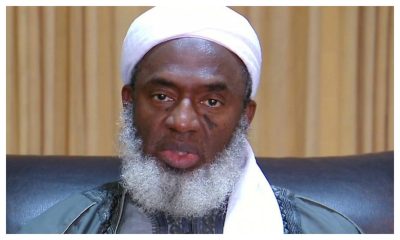
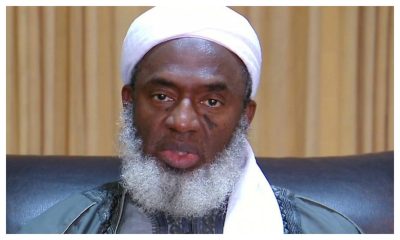
Islamic cleric Sheikh Ahmad Gumi recently defended his past interactions with armed groups, stating he “took the bull by the horns” in 2021 as a necessary step to address Nigeria’s insecurity.
In a post shared on Facebook on Thursday, Gumi said decades of neglect of disadvantaged populations had created deep socio-economic inequalities, leaving many youths vulnerable to manipulation by external forces seeking to destabilise the country.
According to him, the widening gap between the rich and the poor has turned many young people into “ready-made foot soldiers” in cycles of violence that enable the exploitation of Nigeria’s resources.
He also criticised the political class for being largely unresponsive, while noting that the intellectual community is preoccupied with survival struggles.
Reflecting on his past efforts, Gumi said he “took the bull by the horns” in 2021 by attempting to reintegrate violent elements into society rather than allowing them to be further radicalised.
He wrote: “Nigeria for decades has ignored the underprivileged section of its society. There is a significant socio-economic discrepancy, and the society is stratified. This makes our teaming youth ready-made foot soldiers for any foreign interest trying to divide us and rule. To plunder our resources while we are involved in a vicious circle of violence.
”Unfortunately, the political class is unattentive while the intelligentsia is held hostage in the struggle for existence.
“In 2021, I took the bull by the horns in an attempt to bring some of these uncouth elements back to our fold rather than letting them be exploited by the devil.
“I still believe this is the only way out of our predicament. However, it needs the political will and determination to achieve.
“May Allah bring peace back to our nation.”

The Federal High Court in Abuja rejected an ex-parte application seeking to bar Senator Ireti Kingibe from participating in the activities of the African Democratic Congress (ADC).
Justice Peter Lifu declined the request from Wuse Ward leaders, ruling that such an order could not be granted without first hearing from the senator.
Instead, the judge ordered the ward leaders said to be loyal to the Minister of the FCT, Nyesom Wike, to put the senator on notice to appear in court to join issues with them on their grievances.
Justice Lifu in a ruling on Thursday held that discretion in such a request for prohibition from party activities and in political matters must be exercised judicially and judiciously.
The judge said justice would be met in the case of the plaintiffs only when the side of the defendant is heard on its merit, along with that of the plaintiffs.
Consequently, the judge ordered that Senator Ireti Kingibe should be served with all court processes by the plaintiffs to enable her become aware of the suit and to prepare her defense.
The judge fixed April 20, 2026, for the plaintiffs and the serving senator to appear before him for hearing of all applications in the matter.
Those who sued the senator in the suit marked FHC/ABJ/ CV/539/2026 are Okezuo Godfrey Anayo and Isaiah Ojonugwa Samuel, on behalf of themselves and ward members as plaintiffs. The senator is the sole defendant.
In their ex-parte application, Kingibe representing the FCT in the Senate was said to have been suspended on March 10, 2026 by her Wuse Ward executives following allegations of anti-party activities and disregard of your cnstitution of the ADC.
In the ex- parte application filed on their behalf by a Senior Advocate of Nigeria, SAN, Kolawole Olowookere, the aggrieved ADC members in Wuse Ward applied for an order of interim injunction restraining Kingibe from parading herself as a member of party, pending the hearing and determination of their motion on notice for interlocutory injunction.
They also asked the judge to restrain the senator from performing any function, attending meetings or performing activities reserved for ADC members or representing the party in any activities.
Besides, the Ward Executive Committee had asked that she be restrained from further interfering with the administration of the ward, ward register and other activities.
The suit was predicated on five grounds among which are that Mrs Kingibe was placed on suspension due to anti-party activities, gross misconduct and confiscation of the ward statutory records.
They argued that the suspension followed due process as enshrined in the ADC constitution and ratified by the two thirds majority of the EXCO members.
They averred that despite the communication of the suspension to Kingibe, she has continued to hold parallel meetings, issue press statements as an ADC member, and using her security details to intimidate the executive committee.
“Her actions constitute flagrant disregard to the internal mechanism of the party,” the plaintiffs stated.
Meanwhile, a lawyer, Abubakar Marshall who claimed to be representing the senator, announced that he had filed a preliminary objection against the suit. He added that it was served on M. S. Garba, who stood for the plaintiffs at Thursday’s proceedings.
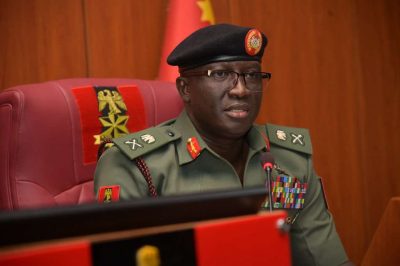
The Chief of Army Staff (COAS), Lieutenant General Waidi Shaibu, visited Jos, Plateau State, on Thursday, April 2, 2026, to lead a high-powered security assessment following recent security breaches.
The visit was aimed at strengthening public confidence and reinforcing ongoing efforts to stabilize affected communities.
Colonel Appolonia Anele, acting Director, Army Public Relations, said in a statement that the visit forms part of ongoing efforts to restore calm and entrench lasting peace across the state.
According to the statement, upon arrival, the COAS was received by the Executive Governor of Plateau State, Caleb Mutfwang, in a clear demonstration of strong civil-military cooperation and a shared commitment to addressing emerging security challenges.
The statement said the COAS received a comprehensive operational briefing from the General Officer Commanding 3 Division and Commander, Joint Task Force Operation ENDURING PEACE, Major General Folusho Oyinlola, who highlighted ongoing operations and proactive measures being implemented in synergy with other security agencies to contain threats, protect lives and property, and stabilise affected communities.
“As part of his engagements, Lieutenant General Shaibu also interacted with community leaders and residents, reassuring them of the unwavering commitment of the Nigerian Army to safeguarding all law-abiding citizens.
He urged residents to remain calm, vigilant and supportive of security agencies by complying with the curfew and cooperating fully with ongoing operations and investigations, while going about their lawful activities.
The chairman of Jos North Local Government Area, Hon. Dachung Bagos, commended the COAS for the timely visit, noting that the presence of the nation’s top military leadership would boost public confidence and reinforce trust in ongoing security efforts.

Gumi Defends Dialogue As Sole Solution To Nigeria’s Insecurity

Court Clears Senator Ireti Kingibe To Remain Active In ADC

COAS Shaibu Hits Jos To Restore Peace, Public Confidence

President Tinubu Appoints New PTDF Executive, Reappoints TCN Head

Simi Welcomes Second Child With Adekunle Gold

United Nigeria Airlines Staff Suspended After Viral Amputee Abuse Video

Pay Your Fare: AIG Cracks Down On Officers Boarding For Free

INEC Removes David Mark, Aregbesola From ADC Leadership Portal

JUST IN: FG Approves Friday 3, Monday 6, as Easter Public Holidays

When 8 million Customers Trust You, Safety Cannot Be an Afterthought
-
 News2 days ago
COAS Shaibu Hits Jos To Restore Peace, Public Confidence
-
 Entertainment2 days ago
Simi Welcomes Second Child With Adekunle Gold
-
 News2 days ago
President Tinubu Appoints New PTDF Executive, Reappoints TCN Head
-
 News1 day ago
Court Clears Senator Ireti Kingibe To Remain Active In ADC
-
 News1 day ago
Gumi Defends Dialogue As Sole Solution To Nigeria’s Insecurity