
News
APC Ticket: Osinbajo, Tinubu, Fayemi, Others Fail To Agree On Consensus (Video)

Leaders of the All Progressives Congress in the South-West, on Friday, cautioned presidential aspirants from the zone to guard against their utterances.
It was gathered that the meeting, which was held behind closed doors at the Lagos House, Marina, also resolved that name calling and other personal attacks should not be encouraged by the aspirants and their supporters.
It was learnt that the aspirants were asked to work with whomever among them emerges as the party’s candidate for the presidential election.
According to sources, the leaders also impressed the aspirants to ensure that the South-West does not lose the opportunity to produce the President in 2023.
A source at the meeting said, “The issue of betrayal was put to rest as the elders affirmed that everyone who desired to run for any political office whatsoever was not encumbered in any way at all.”
It was gathered that the meeting did not agree on the issue of consensus.
A source, who was at the meeting, said the issue was also not listed as part of its agenda, but that it was stylishly introduced by one of the leaders.
He said one of the speakers asked if the aspirants from the zone could still step down for one another if they realised that the zone would be defeated at the party’s presidential primary slated for the end of the month.
But he said none of the aspirants in attendance responded as they were not ready to step down for the other.
The source stated, “How do you ask someone who has paid N100m to step down? Step down for who? All the aspirants believe that they are popular and can win.
“Funnily enough, the issue of consensus was not listed in the agenda of the meeting. It was also not part of the text messages sent to us for the meeting. The meeting was majorly concerned about the utterances that are already portraying us as being divided and that the zone is behaving as if we have no leaders.
“Yet, there are concerns that the large number of aspirants could put the zone in danger if we go into the primary like that. But nobody was asked to step down for the other.”
The meeting was convened by the former interim National Chairman of the APC, Chief Bisi Akande, and a former governor of Ogun State, Chief Segun Osoba.
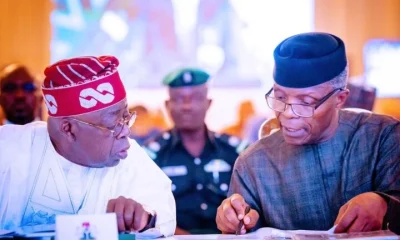
Present at the meeting were the Vice-President, Prof Yemi Osinbajo; a former Lagos State governor, Asiwaju Bola Tinubu; and the Ekiti State Governor Kayode Fayemi.
Also at the meeting were the Minister of Works and Housing, Babatunde Fashola; Speaker of the House of Representatives, Femi Gbajabiamila; Minister of Industry, Trade and Investment, Chief Niyi Adebayo; governors Rotimi Akeredolu of Ondo, Dapo Abiodun of Ogun and Oyetola of Osun states.
Others include the Minister of Interior, Rauf Aregbesola; the APC National Secretary, Otunba Iyiola Omisore; a former governor of Ogun State, Otunba Gbenga Daniel; a former Deputy Governor of Oyo State, Moses Adeyemo; and a former National Vice Chairman of the APC, South-West Zone, Chief Pius Akinyelure.
However, two presidential aspirants from the South-West, Pastor Tunde Bakare, and a former Speaker of the House of Representatives, Dimeji Bankole; and the Deputy Majority Leader of the Senate, Ajayi Boroffice, who have all purchased forms, were absent at the meeting.
While commending Osinbajo, who is the highest ranking public officer from the region, for a job well done, sources said the APC elders stated that all the aspirants had the right to aspire to be the President, but enjoined them to exhibit the ‘Omoluabi’ ethos in their politicking by shunning divisive rhetoric.
While stating that consultation with them would be continuous, the meeting advised the aspirants to queue behind whoever among them eventually emerges as the party’s candidate, stating that the cohesion of the South-West must be sacrosanct.
Akande said the presidential aspirants were united that the presidency should come to the South-West region.
He stated, “We the APC are united and we will ensure that the presidency comes to our region, the South-West. We had a fruitful discussion at the meeting today (Friday).
“We had a fruitful discussion. We also resolved that everybody should maintain absolute decorum because we are united.”
Impeccable sources at the meeting told Saturday PUNCH that Aregbesola pointedly refused to shake Omisore’s hand or sit next to him and Oyetola.
“Aregbesola was expected to sit down next to Omisore and Oyetola, but he refused to associate with them, deciding instead to sit far off. Attempts by the elders to make Aregbesola change his mind proved abortive as he said he didn’t want to be associated with Omisore,” one of the sources said.
At the meeting, Akande called on all aspirants and governors to ensure that they carry on with their campaigns with decorum.
The APC chieftain was said to have called on them to put the interest of the South-West first and ensure that they would not lose the ticket at the primary, which comes up at the end of the month.
A source said, “Baba Akande said it is better for one of us to have the Presidency than for none of us to have it. He said we should carry on our campaigns with decorum. The ultimate goal is to have a small number of aspirants through consensus. However, this will be discussed in subsequent meetings.
“Everything was done to ensure that the impression was not given that Baba Akande was supporting anyone. They also will encourage consensus among all aspirants in order to strengthen the unity of the Yoruba,” he said.
When asked why Bakare, Bankole and Boroffice were not invited, he said, “A list was given to Niyi Adebayo to invite people. I think all these people you mentioned had not yet declared as of the time this meeting was put together.”








The Nigerian Medical Association (NMA), Delta State branch, has officially debunked the cancer claims made by relationship influencer Blessing Okoro, popularly known as Blessing CEO.
In a statement on Tuesday, the association revealed that the document is an altered version of an original medical report belonging to a different patient diagnosed with breast cancer.
The statement, jointly signed by NMA Delta State Chairman, Dr. Israel Adaigho, and Secretary, Dr. Usamah Hannah, was sighted by The Nation on Tuesday.
According to the NMA, the viral report was purportedly issued by Xinus Medical Diagnostics and signed by consultant pathologist Dr. O.A. Odigwe.
However, Dr. Odigwe, who is the proprietor of the diagnostic centre, clarified that his facility never issued any report to Blessing Okoro.
The association explained that Xinus Medical Diagnostics is located in Asaba, Delta State not Enugu State as claimed in the circulating document.
The centre was contacted in May 2025 by a doctor from a private hospital in Asaba to conduct a confirmatory histology test for a patient identified as Mbara Deborah, who had a suspected case of breast cancer.
The test confirmed breast cancer, and the original result was issued to the referring doctor on May 9, 2025.
The NMA stated that the document currently being paraded online by the law firm Allen Juris Law is the original report bearing the name Mbara Deborah.
The version linked to Blessing CEO appears to be a doctored copy of this same report.
The statement read in part: “Our attention has been drawn to an online histology report purportedly issued to one Blessing Okoro, aka Blessing CEO, by Xinus Medical Diagnostics allegedly located in Enugu State. The said histology report was also alleged to have been signed by Dr. O.A. Odigwe, a consultant pathologist.
“The proprietor of Xinus Medical Diagnostics, Dr. O.A. Odigwe, who is also a member of the Nigerian Medical Association, Delta State chapter, has reached us and offered the following clarification: that Xinus Medical Diagnostics is located in Asaba, Delta State and did not at any time issue any report to Blessing Okoro.
“The centre was contacted in May 2025 by a doctor from a private hospital in Asaba to do a confirmatory test on a possible case of breast cancer for a patient, Mbara Deborah. The test was done and the result issued to the referring doctor as a case of breast cancer on May 9, 2025.
“A copy of that result is the one currently being circulated online by the law firm, Allen Juris Law, with the name Mbara Deborah as the patient. That result from the law firm is the original version issued to the patient through her hospital.”
The NMA said the clarification became necessary because of the way the altered report was allegedly being used to solicit public sympathy and financial assistance.
It urged the public to be cautious and warned against actions that could tarnish the integrity of medical professionals.
The association also called on relevant security agencies to take appropriate steps to protect unsuspecting members of the public.
“The integrity of our association and its members is very paramount and should not therefore be taken for granted.
“We call on the authorities responsible for maintaining law and order to do the needful and save unsuspecting members of the public from being unduly taken advantage of,” it added.
Recall that Blessing CEO recently solicited financial help from the public for the treatment of what she claimed was stage four cancer.
Following widespread backlash and allegations that her medical report had been edited, she made a U-turn, stating in an interview: “I don’t have stage 4 cancer. That was a miscommunication.”

Justice Binta Fatima Nyako of the Federal High Court in Abuja has sentenced Hamatu Modu, a major food supplier for Boko Haram terrorists, to 40 years imprisonment for his involvement in terrorism activities.
Modu, who confessed in the open court to supplying food items and information to terrorists, was put on trial by the federal government through the Attorney General of the Federation and Minister of Justice.
He was slammed with 4- count charges and instantly pleaded guilty to them.
The Director of the Public Prosecution of the Federation, DPPF, Rotimi Oyedepo, SAN, led the prosecution.
In his judgment, Justice Nyako sentenced him to 10 years on each of the count but due to the plea of the defense counsel, the judge ordered that the 40 years imprisonment should run concurrently, giving the convict opportunity to spend only 10 years.
In another development, Isah Ali, another food supplier also in Borno, was jailed 10 years by Justice Nyako.
His jail term will, however, start three years ago when he was arrested and clamped into detention.
The convict confessed to committing the offence as charged.
Justice Nyako ordered that the convicts be made to undergo rehabilitation and radicalization at the end of their service of the jail terms.
The Federal Ministry of Interior was ordered to determine where the two men will serve their jail terms.
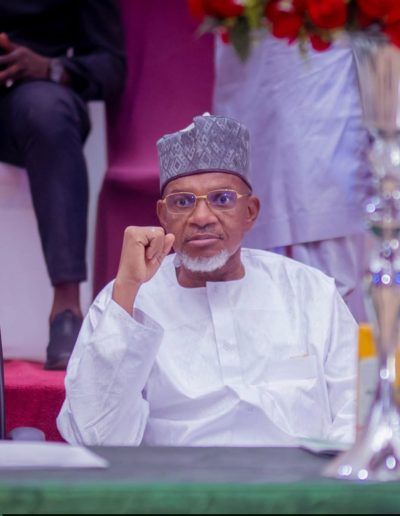
The Speaker of the Kebbi State House of Assembly, Muhammad Usman Ankwai has passed away in the late hours of Monday, 6 April 2026.
Ankwai, who represented Zuru Constituency under the All Progressives Congress (APC), was elected Speaker at the inauguration of the 10th Assembly on June 8, 2023.
Details surrounding the circumstances of his death were not immediately disclosed at the time of filing this report.
His death has, however, triggered an outpouring of condolences from fellow lawmakers, political associates, and residents across Kebbi State, many of whom have described him as a dedicated public servant who contributed to legislative development in the state.
Further announcements regarding burial arrangements are expected to be made by his family soon.

Delta NMA Declares Blessing CEO’s Cancer Report Fraudulent

Abuja Court Jails Boko Haram Food Supplier, Hamatu Modu For 40 Years

Just In: Kebbi Assembly Speaker Muhammad Ankwai Passes Away

Gbenga Daniel Slams Successor As ‘Enfant Terrible’ Who Showed Him Hell

Scores Of Terrorists Neutralised As Military Foils Major Borno Offensive

Easter Tragedy: Herdsmen Strike Benue Again, 9 Dead

President Tinubu Authorizes ₦3.3tn For Power Sector Liquidity, Recovery

Tinubu Commiserates With Former INEC Chair Jega Following Death Of Wife

IGP Disu Summons Lagos Officers To Abuja Over Viral Harassment Video

Fire Outbreak Leaves Hundreds Of Traders Stranded At Yaba Market
-
 News10 hours ago
Abuja Court Jails Boko Haram Food Supplier, Hamatu Modu For 40 Years
-
 News8 hours ago
Delta NMA Declares Blessing CEO’s Cancer Report Fraudulent
-
 News18 hours ago
Gbenga Daniel Slams Successor As ‘Enfant Terrible’ Who Showed Him Hell
-
 News14 hours ago
Just In: Kebbi Assembly Speaker Muhammad Ankwai Passes Away