
Breaking News
BREAKING: Ex-Nigerian Interim Leader, Ernest Shonekan Dies At 85

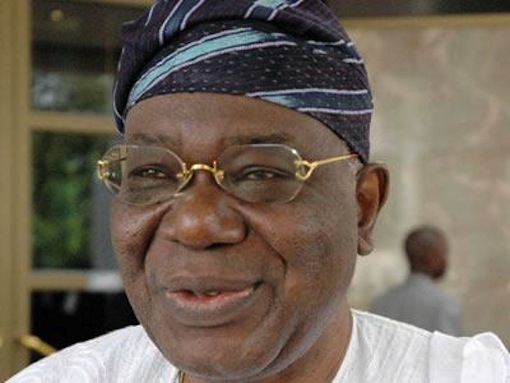
Former Head of the Interim National Government (INC), Chief Ernest Shonekan, is dead. He was aged 85.
Shonekan was chairman of the INC, which succeeded the military junta of General Ibrahim Babangida.
He died on Tuesday, January 11, at a hospital in Lagos. The news of his death was confirmed by the Ogun State government.
Shonekan was the interim head of the Nigerian Government between August 26, 1993, and November 17, 1993 until he was overthrown in a palace coup led by late General Sani Abacha who was Secretary of Defence.
Shonekan was a British-trained lawyer, industrialist, and former Chief Executive of the United African Company of Nigeria Plc (UAC) before he was appointed as Interim President of Nigeria by General Ibrahim Babangida in 1993.
He was born on May 9, 1936, in Lagos into the family of an Abeokuta-born civil servant. He was educated at CMS Grammar School and Igbobi College.
He received a law degree from the University of London and was called to the bar. He later attended Harvard Business School.
Shonekan joined the UAC in 1964. He rose through the ranks in the company and was promoted to an assistant legal adviser. He later became a deputy adviser and joined the board of directors at the age of 40.
He was made chairman and managing director in 1980 and went on to cultivate a wide array of international business and political connections.
On January 2, 1993, Shonekan assumed office as head of the transitional council and head of government under General Babangida.
At the time, the transitional council was designed to be the final phase leading to a scheduled handover to an elected democratic leader of the Third Nigerian Republic.
Babangida later resigned from office in August 1993, following the annulment of the 12 June presidential election. He had signed a decree establishing the Interim National Government led by Shonekan who was subsequently sworn-in as Head of State.
Three months into his administration, Shonekan was overthrown in a palace coup by Abacha in November that year.
In 1994, he founded the Nigerian Economic Summit Group an advocacy group and think-tank for private sector-led development of the Nigerian economy.
Since then, Shonekan went on to feature prominently as an elder statesman.
At the time of his death, he was the third oldest surviving Nigerian Head of State after Queen Elizabeth II and General Yakubu Gowon.


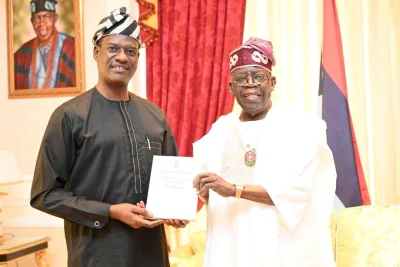
President Bola Ahmed Tinubu has officially nominated Chairman of the Presidential Committee on Fiscal Policy and Tax Reforms, Dr. Taiwo Oyedele as the new Minister of State for Finance.
Oyedele replaces Dr. Doris Anite-Uzoka, who has been redeployed to the Ministry of Budget and National Planning as Minister of State, her third portfolio in the administration.
The President on Tuesday conveyed Oyedele’s nomination to the Senate for confirmation in a letter to the Senate President, Godswill Akpabio, according to a statement by his Special Adviser on Information and Strategy, Bayo Onanuga, on Tuesday.
Until Tinubu nominated him as a minister, Oyedele from Ikaram, Akoko, Ondo State, was the chairman of the Presidential Committee on Fiscal Policy and Tax Reforms, which overhauled Nigeria’s tax system.
The 50-year-old is an economist, accountant, and public policy expert who led the comprehensive overhaul of Nigeria’s tax system through the Presidential Committee on Fiscal Policy and Tax Reforms.
The committee, inaugurated in August 2023, delivered four executive bills that consolidated over 60 taxes into fewer than 10 statutes and introduced significant reforms, including zero income tax for Nigerians earning N800,000 annually or less.
The Tax Reform Acts, which became effective on January 1, 2026, also exempted small businesses with turnover below N50m from company income tax, capital gains tax, and development levy.
Other provisions include a 50 per cent tax deduction for companies hiring new workers for three years, a 50 per cent deduction for wage increases to the lowest-paid employees, and a five-year corporate tax holiday for agricultural enterprises.
Oyedele attended Yaba College of Technology, where he obtained a Higher National Diploma in Accountancy and Finance, before proceeding to Oxford Brookes University for a BSc in Applied Accounting.
He also completed executive education programmes at the London School of Economics, Yale University, the Gordon Institute of Business Science, and the Harvard Kennedy School.
Oyedele spent 22 years at PricewaterhouseCoopers, joining in 2001 and rising to become the Fiscal Policy Partner and Africa Tax Leader before his appointment to head the tax reform committee.
He is currently a professor at Babcock University in Ogun State and a visiting scholar at the Lagos Business School.
As Minister of State for Finance, Oyedele is expected to oversee the implementation of the tax reforms he championed, particularly as the government seeks to improve revenue generation and deepen economic reforms.
Anite-Uzoka, who is being redeployed to the Ministry of Budget and National Planning, previously served as Minister of State for Industry, Trade and Investment before her appointment as Minister of State for Finance.
The Senate is expected to screen and confirm Oyedele’s nomination in the coming weeks, following which he will be sworn in to assume his ministerial duties.
The Finance Ministry, currently led by Wale Edun as substantive minister, oversees fiscal policy, revenue mobilisation, debt management, and economic planning.

Taiwo Adegbodu, one half of the popular Nigerian gospel duo Adegbodu Twins, has passed away.
The tragic news was officially confirmed by his twin brother and musical partner, Kehinde Adegbodu, through a heartfelt post on the duo’s official Facebook handle.
In a heartfelt post, Kehinde conveyed his profound grief over the loss of both his brother and ministry partner.
He wrote: “TAIWO, why will you leave me and your kids without notification?
My heart is bleeding, Lord how do you want me to cope without him?
God why? This is too much for me to bear!!!”
Taiwo and Kehinde Adegbodu were renowned in gospel circles for their spirited worship sessions, twin-stage performances, and dynamic ministrations, which resonated with churches and Christian gatherings across Nigeria.
Their music and live performances earned them a devoted following, particularly in the South-West region.
As of the time of this report, the cause of Taiwo Adegbodu’s death and details of his funeral arrangements have not been disclosed.

Israeli Prime Minister Benjamin Netanyahu has stated there are growing signs that Iranian Supreme Leader Ayatollah Ali Khamenei has been killed following a massive joint military operation by Israel and the United States.
Netanyahu spoke in a televised address on Saturday evening saying that Israel’s military campaign in Iran will go on “as long as it is needed”, adding that the conflict will bring about “true peace”.
According to the Israeli leader, everyone knows that “such a murderous regime” should not have nuclear weapons that can “continue threatening the entire humankind”.
“We would like to thank the brave Iranian people, that they are being freed of those horrific ties with that regime,” he said.
He said that “Signs show that Khameini is no longer with us,” adding that airstrikes have destroyed Khameini’s compound.
“All indications show this tyrant is no longer with us,” he said.
This contradicts reports from the Iranian foreign ministry earlier claiming that the supreme leader and Iran’s president were both “safe and sound”.
Addressing the Iranian people, who he described as ‘courageous’, Netanyahu said the strikes will help them “unshackle themselves from tyranny”.
He said that Iranian people have a “once in a generation chance” to overthrow the Iranian regime, he said
He urged them to “take to the streets en masse” and “get the job done”.
It is “high time you came together” and “unite for a historic mission”, he said.
“This is an opportunity to do something. Do not sit with your arms crossed, because this moment will come and you will be demanded to go out of the streets in the masses, because you have to complete this work, and you have to bring down and eradicate this regime.”
Netanyahu said they managed to target senior members of Iran’s nuclear operation as well as senior officials.

Delta NMA Declares Blessing CEO’s Cancer Report Fraudulent

Abuja Court Jails Boko Haram Food Supplier, Hamatu Modu For 40 Years

Just In: Kebbi Assembly Speaker Muhammad Ankwai Passes Away

Gbenga Daniel Slams Successor As ‘Enfant Terrible’ Who Showed Him Hell

Scores Of Terrorists Neutralised As Military Foils Major Borno Offensive

Easter Tragedy: Herdsmen Strike Benue Again, 9 Dead

President Tinubu Authorizes ₦3.3tn For Power Sector Liquidity, Recovery

Tinubu Commiserates With Former INEC Chair Jega Following Death Of Wife

IGP Disu Summons Lagos Officers To Abuja Over Viral Harassment Video

Fire Outbreak Leaves Hundreds Of Traders Stranded At Yaba Market
-
 News19 hours ago
Abuja Court Jails Boko Haram Food Supplier, Hamatu Modu For 40 Years
-
 News16 hours ago
Delta NMA Declares Blessing CEO’s Cancer Report Fraudulent
-
 News1 day ago
Gbenga Daniel Slams Successor As ‘Enfant Terrible’ Who Showed Him Hell
-
 News23 hours ago
Just In: Kebbi Assembly Speaker Muhammad Ankwai Passes Away