
News
That Yoruba Race May Survive Beyond This Generation


The Indians were evicted by Idi Amin in the 70s and they were granted asylum in most Western countries, but what did they do?
They formed ecosystems. Ecosystems are legal and can be formed as consortiums to take loans from banks and access other beneficial services such as grants etc in Western countries.
Families would come together, pooled resources together and buy businesses where parents and kids would work to build what looked like pyramid with branches.
A family would opt out of the joint venture to purchase another with the support of others and this has greatly made them wealthy and powerful.
Today, the woman who calls the shot on immigration in the UK was a daughter of an evictee family from the East Africa and there are many other success stories of such that abound in Western countries up to Australia amongst the Indians.
In the Yoruba communities of the Western countries, nothing of such exists, not even the basic grouping you often find even amongst the Igbo communities.
Igbo associations are mostly cultural, burial collections and end of year gatherings. This is not bad, they do these to introduce their kids to Igbo culture.
Their kids experience their culture first hands through all these. But these are utterly absent in Yoruba communities.
An ugly trend is actually rearing its head in our communities from Dublin to London and up to New York; this is the abuse of the social media by a clique of uncouth Yoruba women and some men as well by projecting trashes as culture.
A son to one popular Yoruba blogger has allegedly being quoted as saying that his mum was fond of sleeping randomly with men and planning evil against individuals.
This is really sad when you look around and listen to trashes being ditched out by these so called Yoruba bloggers here and there.
Can’t we think of ways we could have Yoruba Credit Unions? This could be a step to a future Oodua International Banking Corporation, where remittances are done to favour our community, where the future homebuyer could walk in and secure a loan to do so.
I must confess that we are not doing enough in our communities to expose our children to the positive sides of our culture, we have given too much relevance to negative carriers amongst us. Nothing can be sadder than this.
Yoruba outside Nigeria tend to isolate themselves from each other and has caused reverberating effects on our people. You often hear people of Yoruba descent die in isolation at their homes and many too, unjustly treated by the legal system.
We are often rebuked by others as the enemies of ourselves, just as being played out in our political system in Nigeria and elsewhere .
We attack and ignore each other too often and fail to see between lines by appreciating those who are making efforts at elevating the race. This bothers me a lot as I often ask if we are so dark hearted.
Maybe, we may need to call for a conference to discuss this and chart a way forward for ourselves and generations to come.
Yoruba Leaders’ Forum was essentially formed to fill the vacuum but unfortunately we are still tottering.
Bamofin Olufemi Ogunjimi writes from London, UK.

The Nigerian Medical Association (NMA), Delta State branch, has officially debunked the cancer claims made by relationship influencer Blessing Okoro, popularly known as Blessing CEO.
In a statement on Tuesday, the association revealed that the document is an altered version of an original medical report belonging to a different patient diagnosed with breast cancer.
The statement, jointly signed by NMA Delta State Chairman, Dr. Israel Adaigho, and Secretary, Dr. Usamah Hannah, was sighted by The Nation on Tuesday.
According to the NMA, the viral report was purportedly issued by Xinus Medical Diagnostics and signed by consultant pathologist Dr. O.A. Odigwe.
However, Dr. Odigwe, who is the proprietor of the diagnostic centre, clarified that his facility never issued any report to Blessing Okoro.
The association explained that Xinus Medical Diagnostics is located in Asaba, Delta State not Enugu State as claimed in the circulating document.
The centre was contacted in May 2025 by a doctor from a private hospital in Asaba to conduct a confirmatory histology test for a patient identified as Mbara Deborah, who had a suspected case of breast cancer.
The test confirmed breast cancer, and the original result was issued to the referring doctor on May 9, 2025.
The NMA stated that the document currently being paraded online by the law firm Allen Juris Law is the original report bearing the name Mbara Deborah.
The version linked to Blessing CEO appears to be a doctored copy of this same report.
The statement read in part: “Our attention has been drawn to an online histology report purportedly issued to one Blessing Okoro, aka Blessing CEO, by Xinus Medical Diagnostics allegedly located in Enugu State. The said histology report was also alleged to have been signed by Dr. O.A. Odigwe, a consultant pathologist.
“The proprietor of Xinus Medical Diagnostics, Dr. O.A. Odigwe, who is also a member of the Nigerian Medical Association, Delta State chapter, has reached us and offered the following clarification: that Xinus Medical Diagnostics is located in Asaba, Delta State and did not at any time issue any report to Blessing Okoro.
“The centre was contacted in May 2025 by a doctor from a private hospital in Asaba to do a confirmatory test on a possible case of breast cancer for a patient, Mbara Deborah. The test was done and the result issued to the referring doctor as a case of breast cancer on May 9, 2025.
“A copy of that result is the one currently being circulated online by the law firm, Allen Juris Law, with the name Mbara Deborah as the patient. That result from the law firm is the original version issued to the patient through her hospital.”
The NMA said the clarification became necessary because of the way the altered report was allegedly being used to solicit public sympathy and financial assistance.
It urged the public to be cautious and warned against actions that could tarnish the integrity of medical professionals.
The association also called on relevant security agencies to take appropriate steps to protect unsuspecting members of the public.
“The integrity of our association and its members is very paramount and should not therefore be taken for granted.
“We call on the authorities responsible for maintaining law and order to do the needful and save unsuspecting members of the public from being unduly taken advantage of,” it added.
Recall that Blessing CEO recently solicited financial help from the public for the treatment of what she claimed was stage four cancer.
Following widespread backlash and allegations that her medical report had been edited, she made a U-turn, stating in an interview: “I don’t have stage 4 cancer. That was a miscommunication.”

Justice Binta Fatima Nyako of the Federal High Court in Abuja has sentenced Hamatu Modu, a major food supplier for Boko Haram terrorists, to 40 years imprisonment for his involvement in terrorism activities.
Modu, who confessed in the open court to supplying food items and information to terrorists, was put on trial by the federal government through the Attorney General of the Federation and Minister of Justice.
He was slammed with 4- count charges and instantly pleaded guilty to them.
The Director of the Public Prosecution of the Federation, DPPF, Rotimi Oyedepo, SAN, led the prosecution.
In his judgment, Justice Nyako sentenced him to 10 years on each of the count but due to the plea of the defense counsel, the judge ordered that the 40 years imprisonment should run concurrently, giving the convict opportunity to spend only 10 years.
In another development, Isah Ali, another food supplier also in Borno, was jailed 10 years by Justice Nyako.
His jail term will, however, start three years ago when he was arrested and clamped into detention.
The convict confessed to committing the offence as charged.
Justice Nyako ordered that the convicts be made to undergo rehabilitation and radicalization at the end of their service of the jail terms.
The Federal Ministry of Interior was ordered to determine where the two men will serve their jail terms.
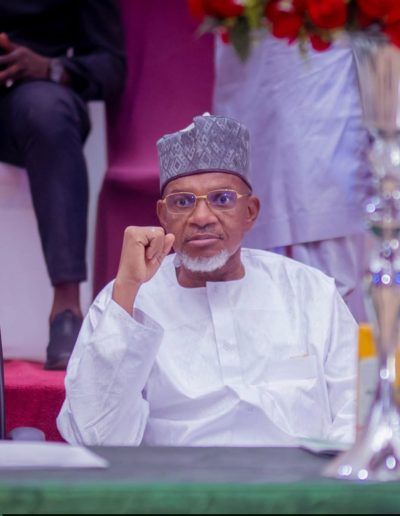
The Speaker of the Kebbi State House of Assembly, Muhammad Usman Ankwai has passed away in the late hours of Monday, 6 April 2026.
Ankwai, who represented Zuru Constituency under the All Progressives Congress (APC), was elected Speaker at the inauguration of the 10th Assembly on June 8, 2023.
Details surrounding the circumstances of his death were not immediately disclosed at the time of filing this report.
His death has, however, triggered an outpouring of condolences from fellow lawmakers, political associates, and residents across Kebbi State, many of whom have described him as a dedicated public servant who contributed to legislative development in the state.
Further announcements regarding burial arrangements are expected to be made by his family soon.

Delta NMA Declares Blessing CEO’s Cancer Report Fraudulent

Abuja Court Jails Boko Haram Food Supplier, Hamatu Modu For 40 Years

Just In: Kebbi Assembly Speaker Muhammad Ankwai Passes Away

Gbenga Daniel Slams Successor As ‘Enfant Terrible’ Who Showed Him Hell

Scores Of Terrorists Neutralised As Military Foils Major Borno Offensive

Easter Tragedy: Herdsmen Strike Benue Again, 9 Dead

President Tinubu Authorizes ₦3.3tn For Power Sector Liquidity, Recovery

Tinubu Commiserates With Former INEC Chair Jega Following Death Of Wife

IGP Disu Summons Lagos Officers To Abuja Over Viral Harassment Video

Fire Outbreak Leaves Hundreds Of Traders Stranded At Yaba Market
-
 News19 hours ago
Abuja Court Jails Boko Haram Food Supplier, Hamatu Modu For 40 Years
-
 News16 hours ago
Delta NMA Declares Blessing CEO’s Cancer Report Fraudulent
-
 News1 day ago
Gbenga Daniel Slams Successor As ‘Enfant Terrible’ Who Showed Him Hell
-
 News23 hours ago
Just In: Kebbi Assembly Speaker Muhammad Ankwai Passes Away