
News
No TIN-For-Bank Account Requirement In Finance Bill – Presidency


The Presidency has disclosed that the Finance Bill 2022 has not mandated Nigerians to have a Tax Identification Number, TIN, before operating a bank account in the country.
The Finance Bill 2022 is currently before the Senate and House of Representatives.
But, some reports erroneously citing the bill said banks are mandated to ask for customers TIN before opening accounts.
The reports also claimed that existing customers would be required to submit their TIN to allow them continue operating their accounts.
However, a top source from the Presidency described the reports as inaccurate because the bill has no such provisions.
According to the source, there are no provisions in the Finance Bill 2022, now before the National Assembly, forcing Nigerians to have a Tax ID number in order to operate a bank account.
The source listed the changes which would be further defended at the National Assembly this week.
According to the source: “Capital gains tax at the rate of 5% to be applicable on disposal of shares in a Nigerian company worth N500m or more in any 12 consecutive months except where the proceed is reinvested in the shares of any Nigerian company within the same year of assessment. Partial re-investment will attract tax proportionately. Transfer of shares under the regulated Security Lending Transaction is exempted.
“Lottery and Gaming business to be specifically taxable under CITA including betting, game of chance, promotional competition, gambling, wagering, video poker, roulette, craps, bingo, slot or gaming machines and the likes.
“Companies engaged in petroleum operations including Midstream and Downstream operations will not be eligible for exemption on profits in respect of goods exported from Nigeria. Downstream companies were previously eligible under the old Upstream and Downstream classification.
“FIRS to be empowered to assess CIT on the turnover of a foreign digital company involved in transmitting, emitting, or receiving signals, sounds, messages, images or data of any kind including e-commerce, app stores, and online adverts.
“Capital allowance claimable on an asset is limited to the portion used for generating taxable profits. Assets partially used to generate taxable income will be eligible for pro-rata capital allowance except where the proportion of non-taxable income does not exceed 20% of the total income of the company.
“Any capital allowance or unabsorbed allowances brought forward by a small or medium company, other than a company under pioneer status, to be treated as having been claimed and consumed in each such year of assessment.
“The reduction of minimum tax rate from 0.5% to 0.25% of turnover (less franked investment income) is to be applicable to any two accounting periods between 1 Jan 2019 and 31 Dec 2021 as may be chosen by the taxpayer.
“Disputed tax assessment to be in abeyance until determination while undisputed tax assessment is to be paid within 30 days after service of the notice of assessment on the company except otherwise extended by the FIRS. Reference to provisional tax has been deleted in recognition of the well-established self-assessment tax regime.
“Withholding tax on interest earned from a unit trust to be treated as final tax. Only WHT on dividend is currently treated as final tax for local companies.
“The deployment of technology to automate tax administration including assessment and information gathering by FIRS to now include third party technology (previously only proprietary technology may be deployed). A penalty of N50,000 to be applicable where a company fails to grant access to FIRS in addition to N25,000 for each day the failure continues.
“FIRS to be the primary agency of the Federal Government responsible for the administration, assessment, collection, accounting and enforcement of taxes and levies due to the Federation, the Federal Government and any of its agencies except otherwise authorized by the Finance Minister.
“Any person or agency of the Federal Government must refer matters requiring tax investigation, enforcement and compliance to the FIRS. Relevant officers who violate the rule to be liable to a penalty of N10m and/or 5 years imprisonment on conviction.
“Deductible life assurance premium for personal income tax purposes to exclude a contract for deferred annuity.
“The Finance Minister, subject to the approval of the National Assembly, shall make regulations for the imposition, administration, collection, remittance, including distribution of arrears of stamp duty and Electronic Money Transfer levies collected between 2015 and 2019 fiscal years.
“Tertiary Education Tax to be payable within 30 days of service of assessment (currently 60 days).
“Non-residents making taxable supplies to recipients in Nigeria to have the primary obligation to charge, collect and remit VAT to FIRS. The VAT withholding obligation of Nigerian recipients now limited to where the non-resident or its appointed agent fails to collect the VAT.
“The exemption from VAT registration and compliance obligation applicable to small companies with annual turnover less than N25m to exclude companies engaged in upstream petroleum operations regardless of turnover.
“Appointment of the FIRS to assess, collect and enforce the payment of Nigerian Police Trust Fund levy. The Act enacted in 2019 imposed a tax of 0.005% on the net profit of companies operating in Nigeria.
“Amendment of the National Agency for Science and Engineering Infrastructure Act to remove the requirement for commercial companies to pay a levy of 0.25% of turnover annually to the Fund. Primary sources of fund to be limited to 1% of the Federation Account.
“Mandatory payment of gross revenue collected by federal ministries, departments or agencies to the federation account or consolidated revenue fund as the case may be except otherwise authorized by law. Any officer who violates this requirement may be liable on conviction to imprisonment of up to 5 years or a fine of N5m or both.
“Amendment of the Fiscal Responsibility Act to enable government borrow for “critical reforms of significant national impact”. Currently, government at all tiers are only empowered to borrow for capital expenditure and human development. Capital expenditure is defined as spending on an asset that lasts for more than one financial year. Human development and critical reforms are not defined.”

The Nigerian Medical Association (NMA), Delta State branch, has officially debunked the cancer claims made by relationship influencer Blessing Okoro, popularly known as Blessing CEO.
In a statement on Tuesday, the association revealed that the document is an altered version of an original medical report belonging to a different patient diagnosed with breast cancer.
The statement, jointly signed by NMA Delta State Chairman, Dr. Israel Adaigho, and Secretary, Dr. Usamah Hannah, was sighted by The Nation on Tuesday.
According to the NMA, the viral report was purportedly issued by Xinus Medical Diagnostics and signed by consultant pathologist Dr. O.A. Odigwe.
However, Dr. Odigwe, who is the proprietor of the diagnostic centre, clarified that his facility never issued any report to Blessing Okoro.
The association explained that Xinus Medical Diagnostics is located in Asaba, Delta State not Enugu State as claimed in the circulating document.
The centre was contacted in May 2025 by a doctor from a private hospital in Asaba to conduct a confirmatory histology test for a patient identified as Mbara Deborah, who had a suspected case of breast cancer.
The test confirmed breast cancer, and the original result was issued to the referring doctor on May 9, 2025.
The NMA stated that the document currently being paraded online by the law firm Allen Juris Law is the original report bearing the name Mbara Deborah.
The version linked to Blessing CEO appears to be a doctored copy of this same report.
The statement read in part: “Our attention has been drawn to an online histology report purportedly issued to one Blessing Okoro, aka Blessing CEO, by Xinus Medical Diagnostics allegedly located in Enugu State. The said histology report was also alleged to have been signed by Dr. O.A. Odigwe, a consultant pathologist.
“The proprietor of Xinus Medical Diagnostics, Dr. O.A. Odigwe, who is also a member of the Nigerian Medical Association, Delta State chapter, has reached us and offered the following clarification: that Xinus Medical Diagnostics is located in Asaba, Delta State and did not at any time issue any report to Blessing Okoro.
“The centre was contacted in May 2025 by a doctor from a private hospital in Asaba to do a confirmatory test on a possible case of breast cancer for a patient, Mbara Deborah. The test was done and the result issued to the referring doctor as a case of breast cancer on May 9, 2025.
“A copy of that result is the one currently being circulated online by the law firm, Allen Juris Law, with the name Mbara Deborah as the patient. That result from the law firm is the original version issued to the patient through her hospital.”
The NMA said the clarification became necessary because of the way the altered report was allegedly being used to solicit public sympathy and financial assistance.
It urged the public to be cautious and warned against actions that could tarnish the integrity of medical professionals.
The association also called on relevant security agencies to take appropriate steps to protect unsuspecting members of the public.
“The integrity of our association and its members is very paramount and should not therefore be taken for granted.
“We call on the authorities responsible for maintaining law and order to do the needful and save unsuspecting members of the public from being unduly taken advantage of,” it added.
Recall that Blessing CEO recently solicited financial help from the public for the treatment of what she claimed was stage four cancer.
Following widespread backlash and allegations that her medical report had been edited, she made a U-turn, stating in an interview: “I don’t have stage 4 cancer. That was a miscommunication.”

Justice Binta Fatima Nyako of the Federal High Court in Abuja has sentenced Hamatu Modu, a major food supplier for Boko Haram terrorists, to 40 years imprisonment for his involvement in terrorism activities.
Modu, who confessed in the open court to supplying food items and information to terrorists, was put on trial by the federal government through the Attorney General of the Federation and Minister of Justice.
He was slammed with 4- count charges and instantly pleaded guilty to them.
The Director of the Public Prosecution of the Federation, DPPF, Rotimi Oyedepo, SAN, led the prosecution.
In his judgment, Justice Nyako sentenced him to 10 years on each of the count but due to the plea of the defense counsel, the judge ordered that the 40 years imprisonment should run concurrently, giving the convict opportunity to spend only 10 years.
In another development, Isah Ali, another food supplier also in Borno, was jailed 10 years by Justice Nyako.
His jail term will, however, start three years ago when he was arrested and clamped into detention.
The convict confessed to committing the offence as charged.
Justice Nyako ordered that the convicts be made to undergo rehabilitation and radicalization at the end of their service of the jail terms.
The Federal Ministry of Interior was ordered to determine where the two men will serve their jail terms.
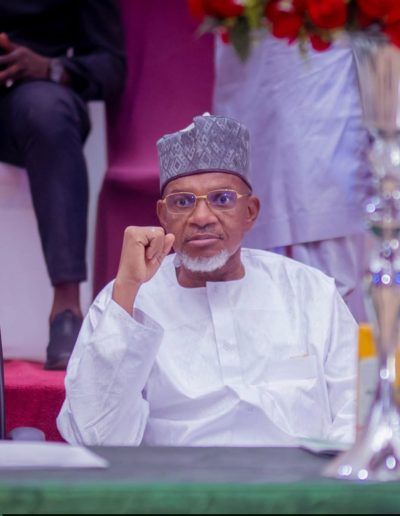
The Speaker of the Kebbi State House of Assembly, Muhammad Usman Ankwai has passed away in the late hours of Monday, 6 April 2026.
Ankwai, who represented Zuru Constituency under the All Progressives Congress (APC), was elected Speaker at the inauguration of the 10th Assembly on June 8, 2023.
Details surrounding the circumstances of his death were not immediately disclosed at the time of filing this report.
His death has, however, triggered an outpouring of condolences from fellow lawmakers, political associates, and residents across Kebbi State, many of whom have described him as a dedicated public servant who contributed to legislative development in the state.
Further announcements regarding burial arrangements are expected to be made by his family soon.

Delta NMA Declares Blessing CEO’s Cancer Report Fraudulent

Abuja Court Jails Boko Haram Food Supplier, Hamatu Modu For 40 Years

Just In: Kebbi Assembly Speaker Muhammad Ankwai Passes Away

Gbenga Daniel Slams Successor As ‘Enfant Terrible’ Who Showed Him Hell

Scores Of Terrorists Neutralised As Military Foils Major Borno Offensive

Easter Tragedy: Herdsmen Strike Benue Again, 9 Dead

President Tinubu Authorizes ₦3.3tn For Power Sector Liquidity, Recovery

Tinubu Commiserates With Former INEC Chair Jega Following Death Of Wife

IGP Disu Summons Lagos Officers To Abuja Over Viral Harassment Video

Fire Outbreak Leaves Hundreds Of Traders Stranded At Yaba Market
-
 News18 hours ago
Abuja Court Jails Boko Haram Food Supplier, Hamatu Modu For 40 Years
-
 News16 hours ago
Delta NMA Declares Blessing CEO’s Cancer Report Fraudulent
-
 News1 day ago
Gbenga Daniel Slams Successor As ‘Enfant Terrible’ Who Showed Him Hell
-
 News22 hours ago
Just In: Kebbi Assembly Speaker Muhammad Ankwai Passes Away