
News
Nnamdi Kanu’s Lawyer Counters Kenya, Says ‘They Were Deeply Involved In My Client’s Arrest’

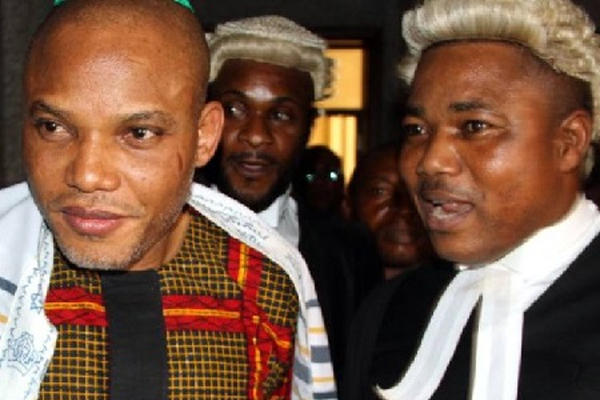
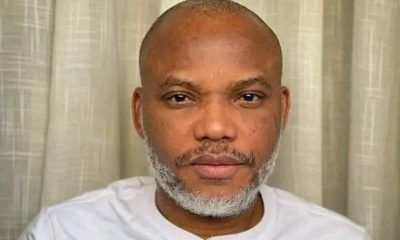
CONTRARY to claims by the Kenyan government that leader of the Indigenous People of Biafra (IPOB) Nnamdi Kanu was not arrested in Kenya, the Biafra activist’s lawyer has said Kanu was apprehended in the East African country.
Kenyan High Commissioner to Nigeria Wilfred Machage had, at a press conference on Friday in Abuja, denied the involvement of his country in the re-arrest of the secessionist leader.
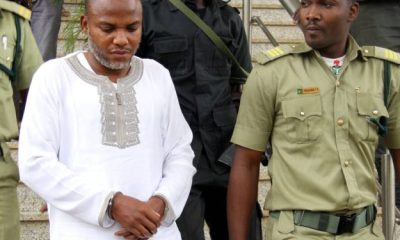
However, Kanu’s lawyer Ifeanyi Ejiofor, in an update he released on Twitter on Friday, said his client was apprehended, tortured and handed over to Nigerian security agents by operatives of Kenya’s Special Police Force.
According to Ejiofor, Kanu was arrested at Kenya’s international airport on June 18 and taken to an undisclosed location where he was detained for eight days before he was handed over to Nigeria’s State Security Service (SSS).
“He was tortured and subjected to all forms of inhuman treatment which worsened his health condition. He was illegally detained for eight good days in Kenya before being transferred to their Nigerian counterpart.
“He was purportedly investigated on a bogus charge while in their custody, ostensibly awaiting to be handed over after their findings proved him innocent of all the spurious allegations. They later beckoned on their Nigerian counterpart to take over.
“Kenyan government was deeply involved in the abduction, detention and ill-treatment of my client before the illegal handover to their Nigerian counterpart,” Ejiofor tweeted.
Ejiofor further claimed that Kanu requires prompt and proper medical check-up due to the alleged dehumanisation he suffered at the hands of Kenyan security operatives.
“A scan of his heart showed that the heart has enlarged by 13 per cent due to the dehumanizing treatment meted to him. There will be need for immediate proper medical examination and attention for him,” he added.
The lawyer assured that Kanu’s legal team would challenge his arrest at a ‘proper forum.’
The Nigerian government, through the Attorney-General and Minister of Justice Abubakar Malami, claimed Kanu was extradited two days before he was brought before an Abuja Federal High Court on Tuesday, June 29.
Kanu faces an 11-count charge of treason, treasonable felony, terrorism, and illegal possession of firearms.
The court remanded him in the custody of the SSS and adjourned the case till July 26 and 27.
Kanu jumped bail and fled Nigeria after soldiers raided his residence in Umuahia, Abia State, in 2017.
On Thursday, Minister of Information Lai Mohammed said that the Nigerian government had been on Kanu’s trail for two years.
He accused the IPOB leader of living a luxurious life.
The Nigerian government believes Kanu is liable for recent attacks and killings allegedly orchestrated by IPOB and its security arm, the Eastern Security Network (ESN) in the South-East.
The government also said on Thursday that its preliminary findings showed prominent Nigerians collaborated with Kanu. It vowed to apprehend and bring them to book, no matter how highly placed.
Kanu’s arrest has raised concerns among many Nigerians, especially people of South-East extraction – a region he’s pushing its secession from the country.





The Central Bank of Nigeria (CBN) has issued a directive to all financial institutions to immediately restrict certain banking services for large-ticket borrowers with non-performing loans (NPLs).
This move is aimed at strengthening credit discipline and protecting the stability of the Nigerian financial system following a rise in the industry’s NPL ratio to approximately 7%, exceeding the regulatory 5% threshold.
This order is specifically targeted at large-ticket obligors.
The CBN issued the directive in a circular to banks on Monday.
The latest instruction comes almost a week after the CBN asked financial institutions to stress test.
It is uncertain if the two directives are connected or what may have triggered the loan-related instruction, but the apex bank said it furthers its mandate to protect Nigeria’s financial system.
“In furtherance of its mandate to promote a sound financial system, protect depositors, and enhance prudential compliance within the banking sector, the Central Bank of Nigeria (CBN) hereby directs all banks to restrict non-performing large ticket obligors, whose activities pose systemic risk to the financial system, from accessing specified banking services,” the circular reads in part.
“Any large-ticket obligor with a non-performing facility recorded in the CRMS and/or any licensed private credit bureau shall not be granted additional credit facilities. For the purpose of this restriction, credit facilities include loans and other forms of direct credit.
“In addition, such obligors shall not be granted banking facilities or contingent liabilities such as bankers’ confirmations, letters of credit, performance bonds, or advance payment guarantees.”
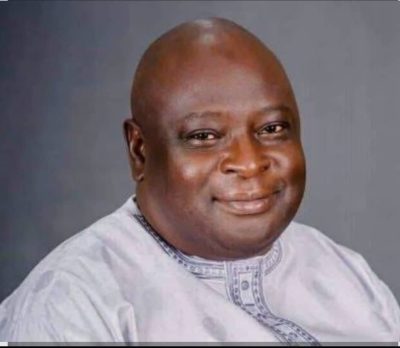
Babajide Kolade-Otitoju, the Director of News at TVC News, recently stated that Oyo State Governor Seyi Makinde would likely have defected from the People’s Democratic Party (PDP) if he was still serving his first term.
Otitoju stated this on Friday on TVC’s ‘Breakfast Show’.
He described the National Convention of the Peoples Democratic Party, PDP, in Ibadan last November as a mere waste of time.
“People must show good judgment at a critical phase. What was the point of having that convention? Two courts told you not to go ahead but you went ahead.
“I may not be a fan of former Senate President Bukola Saraki but if he says something that makes sense, I will be the first to admit it. He made sense when he said let’s go for caretaker. What’s the point of not listening to him?
“Later you will be shouting that the ruling party is behind your crisis, meanwhile you are the architect of your own misfortunes. You created this problem.
“If Makinde were in his first term, he would have fled like the dancing governor because his second term would have been in danger,” Otitoju said.
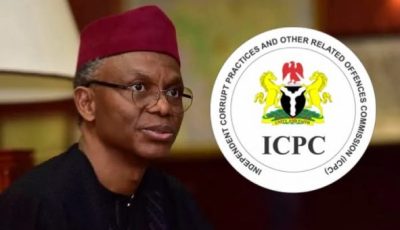
The Federal High Court in Abuja has granted the Independent Corrupt Practices and Other Related Offences Commission (ICPC) permission to access and forensically examine about 14 sets of electronic devices seized from the residence of former Kaduna State Governor, Nasir El-Rufai.
Justice Joyce Abdulmalik issued the order yesterday while ruling on an ex-parte motion filed by the ICPC and moved by its lawyer, Dr. Osuobeni Akponimisingha.
The commission said it needed to access the devices for inspection, forensic examination and extraction of data in furtherance of its ongoing investigation of the former governor.
The devices include a Sony HD-EGS storage device, an ITB Transcend storage device, a Toshiba storage device, a Samsung mobile phone, a Nokia mobile phone – N958GB, a Blackberry mobile phone device and a Google IDEOS phone.
Others are a Samsung storage device – SPO802N, a Remarkable tablet, an Apple MacBook Pro – black, a Seagate FreeAgent Desk external drive, a ZTE mobile phone, 10 pieces of flash drives and a Microcell memory card.
Justice Abdulmalik, in the ruling, granted the commission access to the gadgets “for inspection, forensic examination and forensic extraction of data, including public documents, WhatsApp conversations, text messages, pictures, call logs and related information, and to analyse same forensically or otherwise from the said electronic devices which were seized in the course of investigation for the purpose of investigation activity.”
El-Rufai is currently before the same court challenging the search of his house and seeking, among others, N1 billion in compensation.
Listed as respondents in the suit, marked FHC/ABJ/CS/345/2026, are the ICPC; the Chief Magistrate at the Magistrate’s Court of the FCT, Abuja; the Inspector-General of Police (IGP); and the Attorney-General of the Federation (AGF).
El-Rufai is challenging the propriety of the recent search of his Asokoro, Abuja residence by agents of the ICPC, during which some items were recovered.
The former governor, who is seeking a number of reliefs, wants the court to declare that the search warrant issued on February 4 by the Chief Magistrate of the Magistrate’s Court of the FCT (2nd respondent), authorising the search of his residence and seizure of items, was invalid, null and void.
He also wants a declaration that the search warrant is “null and void for lack of particularity, material drafting errors, ambiguity in execution parameters, overbreadth and absence of probable cause, thereby constituting an unlawful and unreasonable search in violation of Section 37 of the Constitution.”
El-Rufai is urging the court to declare that the alleged invasion and search of his residence at House 12, Mambilla Street, Aso Drive, Abuja, on February 19 at about 2 pm by agents of the ICPC and the IGP, who were armed with the said warrant, amounted to a gross violation of his rights to dignity of the human person, personal liberty, fair hearing and privacy under Sections 34, 35, 36 and 37 of the Constitution.
He is also asking the court to award N1,000,000,000.00 (one billion naira) “as general, exemplary and aggravated damages against the respondents jointly and severally for the violations of the applicant’s fundamental rights, including trespass, unlawful seizure and the resultant psychological trauma, humiliation, distress, infringement of privacy and reputational harm.”
He contends that the search warrant was fundamentally defective, lacking specificity in the description of items to be seized, containing material typographical errors, ambiguous execution terms, overbroad directives and no verifiable probable cause.
He argued that the lack of specificity in the warrant contravenes Sections 143–148 of the Administration of Criminal Justice Act 2015, Section 36 of the ICPC Act 2000 and constitutional protections against arbitrary intrusions.
According to him, Section 143 of the ACJA requires that an application for a search warrant be supported by information in writing and on oath, setting forth reasonable grounds for suspicion, which he said was absent in this case, as evidenced by the incomplete initiating clause.
He said Section 144 mandates particular descriptions of the place to be searched and the items sought to prevent general warrants, adding that the search was conducted without legal justification and in a manner that inflicted humiliation and distress.
El-Rufai further argued that execution of the said invalid warrant on February 19 resulted in an unlawful invasion of his premises, constituting violations of the rights to dignity (Section 34), personal liberty (Section 35), fair hearing (Section 36) and privacy (Section 37) of the Constitution.

CBN Bars Chronic Loan Defaulters from Accessing New Banking Services

Makinde Only In PDP Because He’s Not Seeking Re-election – Otitoju

Corruption Probe: Court Grants ICPC Access To Data On El-Rufai’s Seized Gadgets

Beyond My Wildest Dreams: Disu Opens Up During Handover From Egbetokun

Terror Surge: Tinubu Demands Results from Security Chiefs

2027 Shakeup: 12 Lawmakers Defect To APC, ADC

World War III Fears: Zelensky Reveals Warning To Trump

Tensions Rise As Makoko Communities Vow To Resist Relocation Order

Union Bank Of Nigeria Marks International Women’s Month 2026 With Inclusion-First “Give to Gain” Campaign

IWD: Fidelity Bank Signs MoU with Partners, Launch ‘Give Her Power’ Initiative to Empower Nigerian Women
-
 News1 day ago
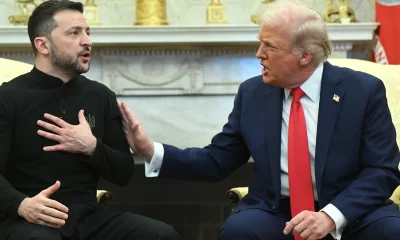
World War III Fears: Zelensky Reveals Warning To Trump
-
 News1 day ago
2027 Shakeup: 12 Lawmakers Defect To APC, ADC
-
 News2 days ago
Tensions Rise As Makoko Communities Vow To Resist Relocation Order
-
 News22 hours ago
Terror Surge: Tinubu Demands Results from Security Chiefs
-
 News15 hours ago
Beyond My Wildest Dreams: Disu Opens Up During Handover From Egbetokun
-
 News11 hours ago
Corruption Probe: Court Grants ICPC Access To Data On El-Rufai’s Seized Gadgets
-
 News7 hours ago
Makinde Only In PDP Because He’s Not Seeking Re-election – Otitoju
-
 News6 hours ago
CBN Bars Chronic Loan Defaulters from Accessing New Banking Services