
News
Neighbourhood Watch, Amotekun, Community Police and Nigeria’s Complex Security Network


NAOSRE examines Neighbourhood Watch, Amotekun, Community Police and Nigeria’s Complex Security Network.
The Editorial Research and Intelligent unit of the National Association of Online Security Reporters, NAOSRE, in this report, examines Nigeria’s unco-ordinated security initiatives arising from federal government’s centralist community policing and South West federalist Amotekun.
In the past 10 years, Nigeria has been fighting Jihadist terrorism. The situation has been worsened by importation of agents of Al Qaeda and the Islamic Caliphate into Nigeria from other countries in the Sahel.
As if terrorism by home-grown Boko Haram is not enough, citizens, since 2016, have been victims of bandits, kidnappers and killers.
Several Nigerians, including farmers, have lost their lives, farms and businesses to herdsmen attacks.
So terrible is the situation that several development partners have warned their citizens against travelling to many parts of Nigeria.
But given that the condition of Nigeria’s security is of utter concern to NAOSRE, whose pre occupation is bridging the communication gaps between functional security institutions cum operatives and citizens, the association is worried about the distracting bedlam eclipsing federal and state governments’ funding, control and sustainability of security initiatives
By NAOSRE Reporters
Only recently, advocates for state police found another fertile opportunity to advance their persuasions following the gruesome murder of Funke Olakunrin, the second daughter of late Afenifere leader, Reuben Fasoranti,.
Before then, Mudashiru Obasa, the Speaker, Lagos State House of Assembly, on two occasions in 2015 and early 2016, raised the need for a collective security outfit with a will and goal to support the Nigeria Police Force,NPF, especially in the South Western part of the country.

The first was at a meeting with some youths, most of whom he often relates with to gauge the pulse of the majority.
The second was when he sat with few lawmakers, aides and friends during a non-formal discussion.
Obasa understood what he meant even when the concerns about threats from bandits and kidnappers were narrated in hush discussions.
He observed that the call for state and community policing had constantly hit the brickwall.
To Obasa, it would make sense to have an organisation that is considered closest to the grassroots.
Obasa never discarded the thought. He single-handedly sponsored the bill, which later became a law establishing State Neighbourhood Safety Agency.
The agency, which also controls the activities of the Vigilante Corps in the state, is the result of that thought.
Thus, Neighbourhood Watch was born. The first test case for Neighbourhood Watch was Badoo, the dreaded cult-like body that had a particularly strange way of killing their victims mainly in Ikorodu.
At that time, the police, under the supervision of Edgal Imohimi as commissioner, was having sleepless nights. Communities affected were in disarray, those not yet hit could not live in peace. Local vigilance groups were set up.
Then, Neighbourhood Watch drafted its men to support the police. It took a little more time for the cult group to be run over. Its leaders were arrested and peace returned to Ikorodu.
Since its establishment of the Neighbourhood Watch, the organisation has assisted in cooling tensions, supported the state’s traffic management agency in resolving traffic issues, liaised with law enforcement agencies and carried out emergency activities.
However, it is not certain whether Obasa later sold the idea to any of the governors in the South West.
But whether he breathed the idea to others or not, what is not in doubt is that the establishment of the Neighbourhood Watch was the forerunner for the creation of Amotekun almost four years after.
As it turned out, Obasa’s agitation soon gained national currency, a development that got Abuja thinking on a fastest solution to an endless agitation.
The federal government’s latest “community police” which has been launched across tiers of government is, to say the least, an attempt to dig deeper to the hole of solutions.
First to launch Amotekun is Ondo State and as of last count, many States in South West have followed Ondo in the full implementation of Amotekun.
Just last week, Ekiti State Board Security Network announced the commencement of recruitment of personnel into Amotekun.

The recruitment is sequel to the passage of the State Security Network Bill by the state House of Assembly and signed into law by Governor Kayode Fayemi in March 2020.
As it seems, Amotekun and community police, twin-drivers of the latest security controversy, must be placed in requisite conceptual blocs of clash between federalist and centralist pulls in a country craving a workable security balance.
It must however, be noted that this has been long in coming, dating back to pre independence Nigeria.
Back then, local police in pre-1st Republic turned out an epochal miscalculation due to gross regions’ abuse.
It was on the basis of that experience that many top Nigerians like former President Ibrahim Babangida fear that State security control can easily get abused by desperate politicians and at best, the idea of State police is not only immature but a catastrophe waiting to happen.
But in some important respects, Aminu Bello Masari, Katsina governor, complains his State has become a comfortable zone to bandits of all hues. He submits that Katsina State, incidentally, President Buhari’s home State, is thinly policed.
His lamentation arises from federal security agencies’ clinical inefficiency.
Therefore, with the failure of the central security apparatus, the Amotekun concept of decentralized policing, spiced with a vibrant local content, to aid intelligence-gathering and forestall crime, seems the sane way to go vis-à-vis Masari’s security woes.
Nonetheless, as interesting as these initiatives are, NAOSRE is basically concerned about funding which has, from time immemorial, been the bane of photo-finish execution of government initiatives.
At the moment, for instance, Abuja has hinted plans for states to fund the central government’s superfluous community policing. They have also requested the Southwest states to submit control of their community police system to the leadership of the Nigeria Police Force.
To many, it is illogical. The interpretation is that indeed, community police, unleashed from Abuja, would be a violent contradiction in terms.
Perhaps it could offer some comfort if it were conceived to link the central Police command with the outlying communities to savage the butt of the serious insecurity crisis.
That way, there would be some built-in flexibility in the operational command structure, featuring Abuja and local players.
But the state players see Abuja community police portraiture, under Inspector General of Police control, is much of antithesis of expectations.
It is seem as a design for yet another bureaucratic layer, which further pushes urgent solution away from a crying crisis.
Therefore, Abuja’s request for wholesale control of Amotekun is not well reconceived.
Some have argued that it was the failure of the existing security architecture to tackle the menace and secure life and property in the Southwest region that led to the clamour for Amotekun.
To them, it makes no sense to place the same Amotekun under an organization that has proved incapable and inadequate to provide the much-needed security in the first place.
Adequate funding fears which have gripped critical stakeholders appeared to have been addressed by Abuja when it announced that N13 billion has been released for community policing across the 36 states by President Muhammadu Buhari.
However, it appeared citizens rejoiced too early as what ordinarily would have allayed their fears has turned another round of intrigues, debates and propaganda.
Already, the Yoruba World Congress (YWC) has expressed support for Akeredolu and Makinde on the decision not to put Amotekun under the control of the Inspector General of Police, saying the body should not be subsumed under the police.
President General of the group, Professor Banji Akintoye, said in a statement that the governors’ position on the issue was in the right direction.
He said: “We support the stand of Governor Rotimi Akeredolu of Ondo State and Governor Seyi Makinde of Oyo State that the Southwest security outfit codenamed Amotekun shall not be subsumed under the control of the Nigeria Police Force. “Amotekun, as rightly posited by the governors, is an independent security outfit necessitated by the clear danger of murderous herdsmen internationally accepted as terrorists, heartless bandits and sundry criminals who have turned Yorubaland into killing fields.”
In the light of this, NAOSRE is worried that there is yet any point of agreement on the workability of the various security initiatives.
The association sadly observes the inability of both Abuja and State governments to find a common path of resolution since they both accepted the need for new approaches to law enforcement in all parts of the country and therefore tasks legislators to pluck the courage and do the needful through constitutional interventions by redesigning the governance of Nigeria’s security architecture.




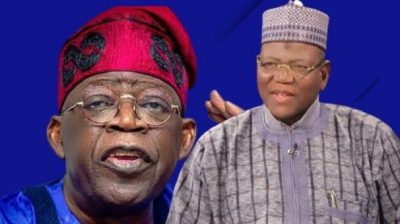
Former Jigawa State Governor Sule Lamido has expressed his willingness to meet with President Bola Tinubu if such an engagement would promote Nigeria’s progress and national development.
Lamido, who spoke exclusively to The Nation at Bamaina, his country home on Sallah day, said he remains open to dialogue with the President if it would advance the nation’s well-being.
Despite being a vocal PDP critic of the administration, Lamido emphasized that his openness to dialogue is driven by national interest rather than partisan politics.
“I will be more than willing. So when are we going to see him?” he said, emphasising his readiness to engage constructively.
The former governor, however, dismissed claims that he had turned down an invitation from the President to join the ruling All Progressives Congress (APC), insisting that no such offer was ever made to him.
“When was I invited? Let me know, please. Did he send you to me? I’m hearing this from you for the first time,” he stated.
He maintained that any meaningful interaction between him and the President should be focused on national interest rather than partisan considerations.
“If it is about the progress and development of Nigeria, I am open. I will be willing to meet him,” Lamido added.
On reports linking him to the African Democratic Congress (ADC), following viral images showing him with the party’s logo, Lamido described the claims as products of social media manipulation.
“In this era of social media and content creation, anything is possible. People sit in their rooms and create stories. I have not seen such pictures,” he said.
Commenting on recent developments in the country, the former governor stressed the need for Nigerians to take responsibility for their electoral decisions, noting that leadership outcomes reflect the choices made by the electorate.
“When we were campaigning, we urged Nigerians to vote right, with integrity and conscience. People voted, and whatever you put in is what you get out,” he said.
He also used the occasion of the Eid al-Fitr to felicitate with Muslims, urging prayers for peace, unity and stability in Nigeria.
“We thank Allah Almighty for sparing our lives to witness Ramadan. It was a period of repentance, prayers and supplications,” he said.
Lamido further prayed for national peace and prosperity, calling for divine guidance for leaders at all levels.
“We pray that Allah secures Nigeria, restores peace, stability and prosperity, and guides our leaders to do the right thing,” he added.
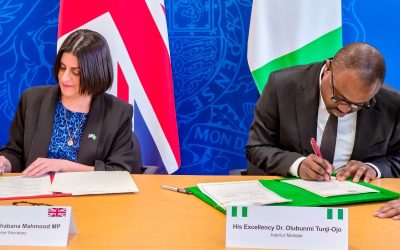
The Nigerian government has signed a landmark agreement with the United Kingdom to fast-track the deportation of failed asylum seekers, visa overstayers, and foreign criminals.
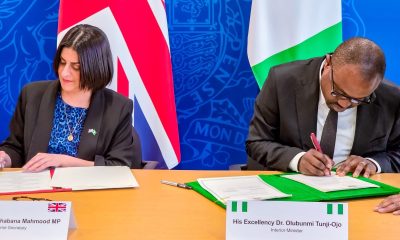
The deal was formalised during President Bola Tinubu’s state visit to the UK by Nigeria’s Minister of Interior, Olubunmi Tunji-Ojo, and UK Home Secretary Shabana Mahmood.
This was announced by the UK Home Office on Thursday.
The agreement was made during President Bola Ahmed Tinubu’s visit to the UK this week.
According to the Daily Mail, there are about 961 Nigerian asylum seekers in the UK who have used up all their appeal rights.
This means they have been officially decided not to qualify for refugee status in the UK.
There are also 1,110 Nigerian nationals who are offenders and the Home Office is waiting to send them back.
The agreement will also help send back Nigerians who stayed in the UK longer than their visa allowed.
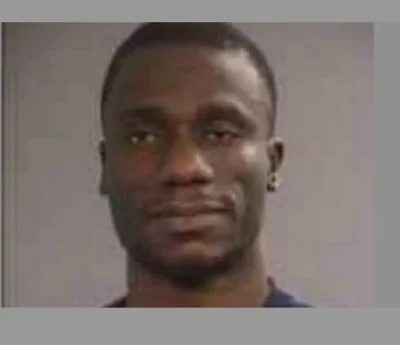
The United States Department of Justice (DOJ) has filed a lawsuit to revoke the citizenship of Emmanuel Oluwatosin Kazeem, a Nigerian national previously convicted for his role in an $11 million (and in some reports linked to up to $91 million) wire fraud and identity theft scheme.
The United States Department of Justice says it has filed a lawsuit seeking to revoke the citizenship of a Nigerian, Emmanuel Oluwatosin Kazeem, who was jailed in 2018 over an $11m fraud.
PUNCH Metro learnt from a statement obtained on the DoJ website on Thursday that Kazeem was convicted on 19 counts bordering on wire fraud, aggravated identity theft, and conspiracy to commit wire and mail fraud.
According to the statement, in May 2013, a victim in Medford, Oregon, notified the Internal Revenue Service that false federal and Oregon state tax returns had been filed electronically using her and her husband’s personal identifying information, including Social Security numbers and dates of birth.
The statement noted that an IRS investigation led to the execution of search warrants at residences in Illinois, Maryland, and Georgia, as well as multiple email and instant messaging accounts used by Kazeem and other co-conspirators.
It continued, “At a Chicago residence, agents seized approximately 150 prepaid debit cards and $50,000 in money orders. In Maryland and Georgia, agents seized more than 50 electronic devices, 40 money orders exceeding $29,000, $14,000 in cash, and numerous prepaid debit cards containing over $12,000 in fraudulent tax refunds.
The search warrants helped agents identify Kazeem as the leader and mastermind of the scheme.
“The scheme resulted in the conspirators possessing stolen personal identifying information of more than 259,000 victims. Kazeem purchased more than 91,000 identities from a Vietnamese hacker who originated from an Oregon company’s private database.
“The company provided pre-employment and volunteer background checks for thousands of clients. Kazeem divided the identities into batches and shared them with other co-conspirators, which were then used them to file fraudulent tax returns between 2012 and 2015.”
The statement added that investigations revealed that Kazeem trained and directed other co-conspirators, including his younger brother, Michael Oluwasegun Kazeem, to use stolen identities to obtain thousands of electronic filing PINs to bypass IRS authentication procedures.
It added that Kazeem and his accomplices acquired over 19,500 E-File PINs during the conspiracy and used taxpayers’ identities to gain unauthorised access to IRS transcripts, while stolen prepaid debit cards were used to receive tax refunds.
It further stated, “In total, Kazeem was linked to 10,139 fraudulent federal tax returns attempting to obtain over $91m in refunds and successfully receiving over $11.6m.
“Refunds were withdrawn from the debit cards, and at least 2,000 wire transfers totalling over $2.1m were sent to Nigeria. Over 700 of those transfers, amounting to more than $690,000, were directly linked to Kazeem.
“Kazeem used the proceeds to make a nearly $200,000 down payment on a newly constructed house and to purchase a $175,000 townhouse, both in Maryland. His average monthly credit card payment between 2012 and 2015 exceeded $8,300. He also attempted to use the funds to develop a $6m four-star hotel in Lagos.”
The statement added that in May 2015, Kazeem transferred the townhouse to his sister in Nigeria for $10 and also added her to the deed of his Maryland residence for the same amount before his arrest the following day.
The DoJ said Kazeem was sentenced to 15 years’ imprisonment in 2018 and ordered to pay more than $12m in restitution, but his sentence was later commuted and he was released from prison by former US President, Joe Biden.
In the fresh suit, the department alleged that Kazeem’s actions disqualified him from lawful naturalisation.
“The complaint alleges that Kazeem’s fraud scheme, committed before and after his naturalisation, along with the concealment of his crimes, precluded him from obtaining citizenship lawfully.
“It also alleges that Kazeem engaged in a sham marriage to obtain permanent resident status and later married a second woman, further disqualifying him from naturalisation,” the statement added.
The move comes amid renewed immigration enforcement under the administration of Donald Trump, which has reiterated its stance against criminal migrants through crackdowns and deportations.

I’ll meet Tinubu For The Sake Of Nigeria – Sule Lamido

Juvenile Prosecution Commences For Suspects In Igbinedion School Assault

Tinubu’s Govt Signs Landmark Migration Pact With UK To Fast-Track Deportations

US Govt Seeks Revocation Of Naturalized Status Following $11M Fraud Conviction

Tinubu Secures £746m UK Support To Modernize Nigeria’s Gateway Ports

Nigeria Surpasses Afghanistan, Iraq As World’s 4th Most Terrorised Nation

Fidelity Bank Powers Women’s Growth ith “Give Her Power” Skills And Support Series

2027: Peter Obi Admits Uncertainty Over ADC Presidential Ticket

Corps Members Get Full Insurance Protection, NYSC Boss Confirms

Gumi’s Security Bombshell Forces New National Debate on Terrorism
-
 News2 days ago
Tinubu Secures £746m UK Support To Modernize Nigeria’s Gateway Ports
-
 News2 days ago
Nigeria Surpasses Afghanistan, Iraq As World’s 4th Most Terrorised Nation
-
 News1 day ago
Tinubu’s Govt Signs Landmark Migration Pact With UK To Fast-Track Deportations
-
 Education7 hours ago
Juvenile Prosecution Commences For Suspects In Igbinedion School Assault
-
 News5 hours ago
I’ll meet Tinubu For The Sake Of Nigeria – Sule Lamido
-
 News1 day ago
US Govt Seeks Revocation Of Naturalized Status Following $11M Fraud Conviction