
News
Poet and Social Activist, Valentine Okolo, talks on Rape, Genocide, and the Power of Words


Here is my latest interview questions for Valentine Okolo, author of the thought provoking poetry book: I Will Be Silent.

Enjoy.
Godwin Iheancho: Where did you get the idea for your most recent book?
Valentine Okolo: I got it from the title of a poem I wrote called “I Will Be Silent.” This was a poem I wrote concerning the genocide which happened in Darfur, Sudan, many years ago. I wrote it in response to the then international media blackout that occurred during that period and how men and young male children were systematically slaughtered by government supported Janjaweed militia. And how women were also gang raped, and impregnated by their oppressors, and sometimes mutilated.
In genocides rape is most times weaponized by the aggressive side, and the suffering sides to such wickedness are women, old and young. Such actions tear at my core and reveal mankind’s depravity at its worst. That poem and a few others similar to it form the back bone of the book.

Genocides, sex slavery, rape and a few other indignities suffered by many women in improvished regions of the world continue still. Boko Haram, and it’s aftermath, the Fulani Herdsmen follow in the footsteps of the Janjaweed militia in Sudan which commited those attrocities with government blessings.
In Nigeria, it is apparent that the government is in accord with Boko Haram and the Fulani Herdsmen as it has repeatedly played to the gallery whenever it is called to question regarding the poor equipments deployed and the improvishment of military troops sent to the effected regions to combat the insurgency. Rather, they result in the use of euphemisms by calling the terrorists “Bandits” and the deployment of mass media propaganda to negate the seriousness of the insurgency.
The entire idea of the book is centred around the themes of pain, and perseverance that these people, and may more like them in different regions of the world, face and have to endure constantly.
I Will Be Silent is not just a book to me. It is more than that. It is a call to witness. It is a series of poems which proceed not from the heart but from the gut of tribulation and endurance. It is a book which bears witness to the collected voices who cannot speak for themselves because they have been silenced.
Godwin Iheancho: How do you get inspired to write?
Valentine Okolo: Most times I feel the emotions of others when I write. In those moments I become that which I write about. I see with their eyes, I hear with their ears, I feel with their skin. In those moments I cease to be myself, and become someone else. I become her, they, it. I become someone’s dreams. And relive, sometimes, their nightmares.
I write from a place of suffering. From a place of joy. I explore the two extremes in my poetry.
In my book I Will Be Silent I wrote many poems which grew from those two extremes. Or should I say, some poems made me write them inspired by these extremes of human existence.
I most times don’t plan a poem in advance. Some poems, if I may use the expression, fall at my feet, almost fully formed. They are a few poems, however, that I do make plans to write in advance. And in order to write them I have to enter into a period of poetic gestation. A period in which I allow the idea of the poem to take root and grow within me until it is ready to be birthed. Sometimes the gestation period may take a few days. Sometimes it can take months or even years.
I like writing organically. So I don’t force anything out. I allow myself to be. I allow myself to feel. I allow the words to come to me like the wind. And I try to catch whatever message that is whispered in the breeze.
Godwin Iheancho : What’s your advice for aspiring writers?
Valentine Okolo: First, they should close their eyes and feel. And then write what they felt. Some of the notable works of literature (which includes fiction, non fiction, poetry, science fiction and so on) were written from an abundance of feelings. If you don’t feel what you have written, don’t expect someone else to feel it too. (Unless, you want to be too intellectual and write drab college textbooks.)
Your writing has to move you first before you expect it to move someone else. Write what you feel first. Then put it away for awhile, and then look at it again with the eyes of a stranger. If you read what you had written earlier with the stranger’s eyes and say to yourself: “Wow! Did I write this?” Then someone else will also be wowed by it as well.
Words convey emotions. Be successful in conveying your emotions in your lines.
Next is style.
If expressing your emotions is fuel for your writing, see style as your technique for progress.
See writing as you would a dance in progress. A dancer may have the necessary energy to prance about. But this prancing alone without an arranged motion may not result in anything beautiful to behold. A dancer uses learned dancing techniques and translates those techniques and that energy into beautiful motions (insert here any dance style of your choice: ballet, foxtrot, salsa, tango, hip-hop, contemporary, and so on). When done properly these motions of choreography capture your attention. For a writer, style is like those beautiful motions. Some you can learn from the writings of someone else. Some you can teach yourself.
If you can afford it, enrol into a good writing class with a teacher that you respect his or her style of writing. Such a person will help ground you in the proper techniques of sentence constructions, and the proper use of words, characterizations and lots more.
Godwin Iheancho: What’s the best thing about being a writer?
Valentine Okolo: It allows me to state what I feel. It allows me to display on a blank page the potency of my thoughts. I am a poet. And I write poetry. And to me words are not just a means of communication. To me words are life. Words carry with them a strong creative force. A force that makes things happen. The first thing that happened in the creation of this planet was the issue of a command. From God Almighty Himself. As documented in the Bible book of Genesis where it was written that there was darkness every where and the Earth was void and without form and the Spirit of God was hovering over the deep. And God Himself uttered the immortal words that started the beginning of life in this world. He said: “Let there be light.” And lo, light came to be. And illuminated the perpetual darkness.
Jesus Christ Himself used words to heal. It was written in the Gospels that He issued words of command and the blind were made to see, the lame walk, and the diseased were made clean. Even to the point of raising the dead. The words: “Lazarus, come forth!” are perhaps one of the most unforgettable lines I have ever read in any form of literature. Because they were more than just words. A mummified man who was dead for four days heard them from beyond the grave and rose to life!
Godwin Iheancho: How do you deal with writer’s block?
Valentine Okolo: I empty my mind. And do something else that is not related to what I am writing about. Sometimes I take long walks, and focus on being in the present. As I walk, I take note of the rise and fall of the land, the diverse faces of people, the roaming animals, and the sounds coming from cars and motorcycles. Most times when I do this ideas flow to me freely, clearing my imaginative inhibitors.
Get the book: I Will Be Silent on Amazon: www.amazon.com/author/valentineokolo
You can also follow him on Twitter. His handle: @poetval.




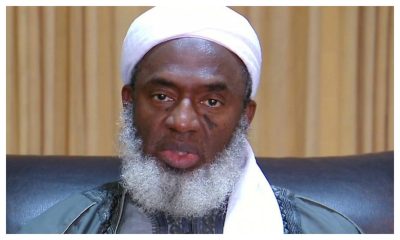
Islamic cleric Sheikh Ahmad Gumi recently defended his past interactions with armed groups, stating he “took the bull by the horns” in 2021 as a necessary step to address Nigeria’s insecurity.
In a post shared on Facebook on Thursday, Gumi said decades of neglect of disadvantaged populations had created deep socio-economic inequalities, leaving many youths vulnerable to manipulation by external forces seeking to destabilise the country.
According to him, the widening gap between the rich and the poor has turned many young people into “ready-made foot soldiers” in cycles of violence that enable the exploitation of Nigeria’s resources.
He also criticised the political class for being largely unresponsive, while noting that the intellectual community is preoccupied with survival struggles.
Reflecting on his past efforts, Gumi said he “took the bull by the horns” in 2021 by attempting to reintegrate violent elements into society rather than allowing them to be further radicalised.
He wrote: “Nigeria for decades has ignored the underprivileged section of its society. There is a significant socio-economic discrepancy, and the society is stratified. This makes our teaming youth ready-made foot soldiers for any foreign interest trying to divide us and rule. To plunder our resources while we are involved in a vicious circle of violence.
”Unfortunately, the political class is unattentive while the intelligentsia is held hostage in the struggle for existence.
“In 2021, I took the bull by the horns in an attempt to bring some of these uncouth elements back to our fold rather than letting them be exploited by the devil.
“I still believe this is the only way out of our predicament. However, it needs the political will and determination to achieve.
“May Allah bring peace back to our nation.”

The Federal High Court in Abuja rejected an ex-parte application seeking to bar Senator Ireti Kingibe from participating in the activities of the African Democratic Congress (ADC).
Justice Peter Lifu declined the request from Wuse Ward leaders, ruling that such an order could not be granted without first hearing from the senator.
Instead, the judge ordered the ward leaders said to be loyal to the Minister of the FCT, Nyesom Wike, to put the senator on notice to appear in court to join issues with them on their grievances.
Justice Lifu in a ruling on Thursday held that discretion in such a request for prohibition from party activities and in political matters must be exercised judicially and judiciously.
The judge said justice would be met in the case of the plaintiffs only when the side of the defendant is heard on its merit, along with that of the plaintiffs.
Consequently, the judge ordered that Senator Ireti Kingibe should be served with all court processes by the plaintiffs to enable her become aware of the suit and to prepare her defense.
The judge fixed April 20, 2026, for the plaintiffs and the serving senator to appear before him for hearing of all applications in the matter.
Those who sued the senator in the suit marked FHC/ABJ/ CV/539/2026 are Okezuo Godfrey Anayo and Isaiah Ojonugwa Samuel, on behalf of themselves and ward members as plaintiffs. The senator is the sole defendant.
In their ex-parte application, Kingibe representing the FCT in the Senate was said to have been suspended on March 10, 2026 by her Wuse Ward executives following allegations of anti-party activities and disregard of your cnstitution of the ADC.
In the ex- parte application filed on their behalf by a Senior Advocate of Nigeria, SAN, Kolawole Olowookere, the aggrieved ADC members in Wuse Ward applied for an order of interim injunction restraining Kingibe from parading herself as a member of party, pending the hearing and determination of their motion on notice for interlocutory injunction.
They also asked the judge to restrain the senator from performing any function, attending meetings or performing activities reserved for ADC members or representing the party in any activities.
Besides, the Ward Executive Committee had asked that she be restrained from further interfering with the administration of the ward, ward register and other activities.
The suit was predicated on five grounds among which are that Mrs Kingibe was placed on suspension due to anti-party activities, gross misconduct and confiscation of the ward statutory records.
They argued that the suspension followed due process as enshrined in the ADC constitution and ratified by the two thirds majority of the EXCO members.
They averred that despite the communication of the suspension to Kingibe, she has continued to hold parallel meetings, issue press statements as an ADC member, and using her security details to intimidate the executive committee.
“Her actions constitute flagrant disregard to the internal mechanism of the party,” the plaintiffs stated.
Meanwhile, a lawyer, Abubakar Marshall who claimed to be representing the senator, announced that he had filed a preliminary objection against the suit. He added that it was served on M. S. Garba, who stood for the plaintiffs at Thursday’s proceedings.

The Chief of Army Staff (COAS), Lieutenant General Waidi Shaibu, visited Jos, Plateau State, on Thursday, April 2, 2026, to lead a high-powered security assessment following recent security breaches.
The visit was aimed at strengthening public confidence and reinforcing ongoing efforts to stabilize affected communities.
Colonel Appolonia Anele, acting Director, Army Public Relations, said in a statement that the visit forms part of ongoing efforts to restore calm and entrench lasting peace across the state.
According to the statement, upon arrival, the COAS was received by the Executive Governor of Plateau State, Caleb Mutfwang, in a clear demonstration of strong civil-military cooperation and a shared commitment to addressing emerging security challenges.
The statement said the COAS received a comprehensive operational briefing from the General Officer Commanding 3 Division and Commander, Joint Task Force Operation ENDURING PEACE, Major General Folusho Oyinlola, who highlighted ongoing operations and proactive measures being implemented in synergy with other security agencies to contain threats, protect lives and property, and stabilise affected communities.
“As part of his engagements, Lieutenant General Shaibu also interacted with community leaders and residents, reassuring them of the unwavering commitment of the Nigerian Army to safeguarding all law-abiding citizens.
He urged residents to remain calm, vigilant and supportive of security agencies by complying with the curfew and cooperating fully with ongoing operations and investigations, while going about their lawful activities.
The chairman of Jos North Local Government Area, Hon. Dachung Bagos, commended the COAS for the timely visit, noting that the presence of the nation’s top military leadership would boost public confidence and reinforce trust in ongoing security efforts.

Gumi Defends Dialogue As Sole Solution To Nigeria’s Insecurity

Court Clears Senator Ireti Kingibe To Remain Active In ADC

COAS Shaibu Hits Jos To Restore Peace, Public Confidence

President Tinubu Appoints New PTDF Executive, Reappoints TCN Head

Simi Welcomes Second Child With Adekunle Gold

United Nigeria Airlines Staff Suspended After Viral Amputee Abuse Video

Pay Your Fare: AIG Cracks Down On Officers Boarding For Free

INEC Removes David Mark, Aregbesola From ADC Leadership Portal

JUST IN: FG Approves Friday 3, Monday 6, as Easter Public Holidays

When 8 million Customers Trust You, Safety Cannot Be an Afterthought
-
 News2 days ago
When 8 million Customers Trust You, Safety Cannot Be an Afterthought
-

 News2 days ago
El-Rufai Back In Detention After Temporary Compassionate Release
-
 News1 day ago
United Nigeria Airlines Staff Suspended After Viral Amputee Abuse Video
-

 News2 days ago
2027: Kwankwaso’s Exit Marks End Of NNPP – Kwankwasiyya Movement
-
 News1 day ago
JUST IN: FG Approves Friday 3, Monday 6, as Easter Public Holidays
-
 News1 day ago
Pay Your Fare: AIG Cracks Down On Officers Boarding For Free
-

 News2 days ago
Lagos CP Withdraws Taskforce From Traffic Duties
-
 News16 hours ago
COAS Shaibu Hits Jos To Restore Peace, Public Confidence