Connect with us

News

Soyinka To FG: Àmòtékùn Has Come To Stay

Published

on

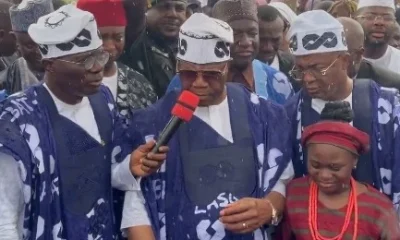
Wole Soyinka, Nobel laureate, says “Amotekun”, the regional security outfit in the south-west, has come to stay.Abubakar Malami, attorney-general of the federation, had described the outfit as illegal, saying security remains the exclusive preserve of the federal government.But at a press conference in Lagos on Wednesday, Soyinka expressed shock that the federal government could take such a position.“Our responsibility as a citizen is to take actions against events, phenomenon which militate against our existence, security, productivity and dignity as human beings,” he said.“This has been a result of collective consciousness by people of this region. These governors met and they came up with this solution, Amotekun. Now, some people who have been sleeping all this time, taking belated actions in many directions, who watched the citizens of this nation decimated, villages wiped out, farmers chased off their land. They are now coming out to tell us that this initiative is illegal, unconstitutional. I think they should go back to sleep.“I prefer to believe that the government itself has not spoken. I refuse to believe that any serious government will raise any objection to this kind of initiative. Amotekun has come to stay.“Amotekun is only a part of the story. It should not be the only solution to insecurity. We should move from Amotekun to Awosikun. In other words, we should start thinking in terms of how to feed our own people.”The scholar had earlier described the scheme as an unexpected New Year present.

Advertisement

News

Winning AFRIMA ‘Life-Changing’ Say Juma Jux, Folex as Stakeholders Meet In Tanzania

Published

on

By

Fresh from their victories at the 9th All Africa Music Awards (AFRIMA) in Lagos, Nigeria, Tanzanian stars Juma Jux and Folex have described the platform as a major driver of global visibility for African creatives, as industry stakeholders met in Dar es Salaam to review the impact of the awards on the region’s music industry.

The award-winning artistes shared their views during a Media and Stakeholders’ Parley hosted by AFRIMA’s International Committee, which brought together artistes, regulators, music executives and the media to examine opportunities created by the awards and how East Africa can better harness them.

Speaking at the event held at Urban by City Blue Hotel, Dar es Salaam, Tanzania, Juma Jux, winner of East African Artiste of the Year (Male) at the 9th AFRIMA, described the experience as career-defining.

“Winning AFRIMA changed a lot for me,” Jux said. “People who never spoke to me before now reach out. Being on a stage watched in over 84 countries gives you a new level of visibility and responsibility.”

He also called for stronger partnerships between platforms like AFRIMA and government agencies in Tanzania. “When institutions work hand in hand with platforms like AFRIMA, artistes benefit more through exposure, training and knowledge sharing,” he added.

Also speaking, Tanzanian music director Folex, who won Best Music Video of the Year for his work on Juma Jux’s Ololufemi video, said the recognition had changed his life. He explained that the Lagos experience opened doors to new networks and learning opportunities.

“Being nominated alongside international names like Pink and TG Omori and then winning the award was life-changing for me. It showed that East Africans can compete and win at the highest level. This award validates the work of music video directors in Tanzania and brings more confidence to our creative industry,” he said.

Associate Producer of AFRIMA, Victoria Nkong, said the awards had grown beyond a celebration of talent to become a strong development platform for African creatives.

“AFRIMA is designed to build an ecosystem for African music,” Nkong said. “Beyond the trophies, we focus on talent promotion, industry development and creating pathways that help African artistes move from local recognition to global visibility.”

She added that the engagement in Tanzania was important for deepening collaboration with government institutions and industry stakeholders.

“Tanzania and East Africa have rich musical identities. AFRIMA is committed to working closely with institutions and creatives here to ensure that their music and talent are well represented on the global stage,” she said.

Also speaking, Selemani Mabisso, Acting Assistant Director of the Music Department at the National Arts Council of Tanzania, BASATA, reaffirmed the council’s willingness to partner with AFRIMA and other international bodies.

“BASATA is open to collaborations that will help grow and strengthen Tanzania’s music industry,” Mabisso said. “We are ready to support initiatives that will position our creatives competitively on the global stage.”

The 9th AFRIMA was held from January 7 to 11, 2026, in Lagos, Nigeria, and was organised by the African Union Commission and the International Executive Committee of AFRIMA, in partnership with the Lagos State Government as the Official Host City.

The five-day celebration of African music featured seven major events, including a Welcome Soiree, the Africa Music Business Summit, the AFRIMA Music Village at Ikeja City Mall, where over 25 top artistes thrilled more than 30,000 fans, and a grand finale at the Eko Convention Centre, Lagos, Nigeria, which was broadcast to audiences in 84 countries worldwide.

Continue Reading

News

Polaris Bank Strengthens MSMEs Export Ecosystem At NAHCO/NACCIMA Export Group Programme

Published

on

By

Polaris Bank has reaffirmed its strategic commitment to strengthening Nigeria’s non-oil export ecosystem and empowering micro, small and medium-sized enterprises (MSMEs) at the NAHCO and NACCIMA Export Group Programme themed *Breaking Barriers: Helping SMEs Navigate Export Procedures for Agro Products and Other Commodities.”


The one-day engagement brought together regulators, industry stakeholders, exporters and trade bodies to advance practical solutions for easing trade barriers, improving access to finance and building a more resilient and diversified Nigerian economy.


The programme also marked the formal introduction and launch of the NACCIMA Export Group and the NAHCO Export Support Centre for MSMEs in Nigeria, creating a structured platform for exporters to access trade facilitation services, logistics support, regulatory guidance and financial solutions across the export value chain.


Speaking at the programme, Polaris Bank’s Executive Director, Chris Ofikulu, underscored the national importance of export diversification and the central role of SMEs in building a resilient economy. He noted that reducing Nigeria’s dependence on oil revenues requires coordinated action across the public and private sectors to strengthen non-oil exports, particularly within agro-exports and commodity trade.


“Expanding non-oil exports is not optional; it is a strategic imperative for building a resilient, inclusive and competitive Nigerian economy. SMEs, particularly in agro-exports and commodity trade, hold the key to unlocking our true comparative advantage. Polaris Bank remains committed to providing the finance, advisory support and partnerships required to help them scale confidently and compete globally,” Ofikulu said.


The engagement also focused on addressing structural challenges confronting exporters, including infrastructure gaps, port inefficiencies, logistics constraints, standards and certification requirements, and policy consistency.


Participants emphasized the need for stronger public-private collaboration among government agencies, trade bodies, financial institutions and logistics partners to simplify export procedures and improve market access for Nigerian SMEs.


Also addressing stakeholders, Olaleye Arinola, Team Lead, Trade Services, Polaris Bank, highlighted the importance of removing trade and payment bottlenecks that limit exporter competitiveness and cash flow. He emphasized the Bank’s focus on building confidence and certainty into the export process through practical financial and advisory support.


“Exports cannot grow if finance and payments remain obstacles. At Polaris Bank, our focus is on removing friction from international trade by ensuring SMEs get paid faster, safer and with greater certainty through efficient trade finance, secure cross-border payments and hands-on guidance across documentation, FX and compliance,” Arinola said.


As part of its partnership with the business and trade community, Polaris Bank unveiled a Dedicated Help Desk for NACCIMA members, designed to provide direct access to trade finance and payment support, fast-track resolution of export-related enquiries, and personalized advisory services on FX documentation and regulatory compliance.


Polaris Bank reaffirmed its commitment to working closely with NAHCO, NACCIMA and other stakeholders to strengthen exporter capacity, promote value addition across agro-exports and commodities, and unlock sustainable growth opportunities for Nigerian businesses in regional and global markets.


As Nigeria advances its economic diversification agenda, Polaris Bank remains positioned as a trusted partner for SME exporters, providing the finance, knowledge and institutional support required to compete globally and contribute meaningfully to national development and long-term economic resilience.

Continue Reading

News

Failed Coup: Musa Reveals Plotters Had Orders To Kill Him If He Resisted Arrest

Published

on

By

The Minister of Defence, Gen. Christopher Musa (retd.), on Sunday disclosed that he was among the intended targets of the recently foiled coup plot against President Bola Tinubu, revealing that the conspirators planned to arrest or shoot him if he resisted.


Musa made the disclosure while speaking as a guest on Politics Today, a Channels Television programme, where he also described the suspects behind the plot as “a bunch of very unserious individuals.”


While admitting that he played a key role in helping security agencies nip the plot in the bud, the former Chief of Defence Staff said he was personally marked for arrest by the plotters.


“I was also a target, I am sure you know. I was supposed to be arrested, and if I refused, I was supposed to be shot,” he said.


“But that’s the job. Anybody who goes into coup zeroes his mind because he knows if he succeeds, good.


If he doesn’t succeed, whatever consequences come, you are ready for it.”


Musa dismissed the capacity of the suspects to successfully challenge the Nigerian state, saying their actions showed a complete misunderstanding of Nigeria’s democratic history and the strength of its armed forces.


“But again, I think these guys were just a bunch of very unserious individuals that I really don’t know. If you look at the calibre of the individuals, I really don’t know what got into their heads to think that they could take on the armed forces like that,” he said.


He added that even without the intervention of the military, Nigerians would have resisted any attempt to overthrow a democratically elected government.


“What I even said was that even Nigerians would have fought them. Even without the armed forces, Nigerians would have stood against them. Remember how Nigerians fought against the military rule for quite some time. And that’s why Mr. President has always been one of them.


“So now, for them to think they could just wake up one morning and do that in Nigeria, I think something went wrong in there. They need to reset their brains.”


Speaking on the arrests made so far, the Defence Minister said most of those involved had been apprehended, with only “maybe one or two” still at large.


“So far, most of them have been caught. If there’s anyone, maybe one or two. It just started from the colonel himself, who felt disgruntled because he was not promoted. He didn’t meet the marks to be promoted,” he said.


Musa explained that the plot was driven largely by personal grievances, noting that the armed forces’ promotion system is strict and merit-based.


“You know that the armed forces is really very strict about its promotions system. But he didn’t make it. So what he decided to do was probably go around, look at other people that had one issue or the other…with the aim of bringing them in,” he said.


Expressing concern for junior officers allegedly drawn into the plot, Musa said, “My pain is all those young officers who didn’t understand what was going on that he put in this mess. Now they have to face the consequences.


“So everything evolves around him as an individual. But he was just a colonel. I can’t even imagine a colonel ever thinking of doing such a thing.”


The Defence Minister stressed that executing a coup in modern-day Nigeria was virtually impossible, unlike in the past.


“That was in the past. That was Nigeria of yesteryears. It’s impossible,” he said, adding that security agencies relied on verified facts, not speculation, before acting.


“If there’s a situation where you hear that somebody is trying to do something and you walk in, what facts do you have because you are going to go to the courts? If you can’t present it in the courts, then they throw you away. And then you look stupid.”


He said the investigation was thorough and collaborative, involving multiple intelligence agencies to avoid indicting innocent officers.


“Since I was there, I was the one who inaugurated the board. I made sure the board started. We sent them to DIA to do a thorough investigation along with the NIA, DSS, and every other person. So it’s a holistic investigation that was carried out because we didn’t want any innocent person to be indicted,” Musa said.


He dismissed claims that the plot was driven by dissatisfaction with the current administration, insisting it predated Tinubu’s inauguration.


“These things were planned even right before the president took office. So it was a plan they had ahead of him since they knew he was the one who won the election,” he said, describing the development as “quite unfortunate.”


Musa further noted that past coups succeeded only with the backing of top military commanders, a factor completely absent in the current case.


“If you remember, during those days when they had coups, you had to have most of the big boys like the GOCs and service chiefs…You don’t have any of such. They are just very low-ranking individuals that have no access to some of these things,” he said.


“For anybody to want to truncate democracy in this disposition, I think there’s something really wrong with them.”


Musa’s comments came a day after Sunday PUNCH reported that former Bayelsa State Governor, Timipre Sylva, may be arraigned in absentia over alleged financial crimes, amid ongoing investigations into the purported coup plot.


Sylva has remained outside the country for months after operatives of the Defence Intelligence Agency raided his Abuja residence, an action linked to investigations into the alleged attempt to overthrow Tinubu’s administration.


It was gathered that the former governor, who has also been declared wanted by the Economic and Financial Crimes Commission over alleged $14,859,257 fraud, could be arraigned in absentia.


Top officials of the Department of State Services and the EFCC disclosed that the International Criminal Police Organisation and other partners were tracking Sylva.


In October 2025, the Defence Headquarters had dismissed reports of a coup attempt, despite the arrest of 16 officers accused of sponsoring the plot.


In a statement on October 18, 2025, the then Director of Defence Information, Brig Gen Tukur Gusau, denied reports linking the arrests to a failed coup and the cancellation of the October 1 Independence Day parade, describing them as “intended to cause unnecessary tension.”


However, the military later reversed its position. Last Monday, the new Director of Defence Information, Maj. Gen. Samaila Uba confirmed that investigations had indeed uncovered a plot to topple Tinubu’s administration, adding that several officers had cases to answer.


Continue Reading

Trending