
News
MTN & Other Telcos’ Data Price War Hurts Telecoms Service Quality In Nigeria

Data price ‘war’ among telecoms operators is one of the major causes of poor service quality faced by Nigerian subscribers, especially in the download and upload of content. But while consumers have enjoyed the conflict and its attendant slash in prices, they have had to endure drop in quality and speed.
Speed is the performance of a connection based on the number of bytes per second that data travels to and from a user’s device. Depending on the type of connection, the speed differs dramatically; the download rate is higher than the upload because a short request to the website (upload) results in a much larger download of Web pages, images and videos.
As at October, the Nigerian Communications Commission (NCC) statistics showed that the country had 123 million Internet subscribers, largely via the GSM platform (narrowband), while broadband users were 72 million. It should, however, be noted that there were dual users.
The claim of 4G service offerings by operators has equally not assuaged the pains of subscribers when it comes to quality, as speed remains unsatisfactory. According to OpenSignal, in 2018, Nigeria ranked 75th out of 77 countries in the quality of 4GLTE network offerings.
A November speed test survey carried out by Ookla put global average download speed at 30.93Mbps, while upload speed is 11.38Mbps. In the survey, Nigeria ranked 107 out of 139 countries at 16.74Mbps. According to Ookla, a Seattle, USA-based firm, South Korea and Qatar ranked first and second respectively with 117.79 Mbps and 77.07 Mbps download speeds.
Checks by The Guardian showed that while operators have cut down prices amid offerings of several bonuses, subscribers are unable to enjoy the packages either because they get exhausted too quickly or are fluctuation-prone, leaving users frustrated.
While this ‘snail speed’ offering persists, Nigeria also ranked 10th among countries with the most affordable data prices in Africa. According to Research ICT Africa, data price is relatively cheaper in Nigeria.
Research ICT Africa noted that data pricing remains a contentious issue on the continent where average incomes are low and where a significant portion of paycheques are often spent on mobile communication costs, including data.
In the survey, West Africa’s prices were varied, with low prices in Guinea ($2.20), Nigeria ($2.78) and Burundi ($3.02). In Benin, Niger and Senegal, it is also quite affordable at $3.39 for 1 Gbyte. But the price for 1 Gbyte of data is higher in countries such as Sierra Leone ($6.56) and Togo ($8.48). Some of the most expensive prices across the continent were in this region. For example, in Guinea-Bissau, it’s $16.95, Chad ($11.87) and Mauritania ($9.78).
Nigeria’s $2.78 (over N1,000) is in tandem with checks carried out by The Guardian when comparing the prices. The checks revealed that most of the Mobile Network Operators (MNOs) have slashed their prices by half. For instance, 1.5GB, which was sold for as much as N3000 some six months ago now goes for between N1,200 and N1,500 depending on the network. In fact, on the MTN network, subscribers can get 4.5GB for N2,500 and 8GB for N3000, depending on the plan.
Globacom has a number of data plans suited to different groups of individuals on Android, iPhone, Blackberry and other smartphones. They include N100 for 100MB, which lasts for two days, especially for students. It also has the same plan for daily users.
Apparently, because of its submarine cable system and huge bandwidth capacity, Glo also offers 2GB/N1000 for 30 days. On the network, subscribers who are willing to pay N2,500 can get 7.2GB data valid for 30 days.
Airtel has various plans, from daily 50MB for N100 to 16GB for N8000 with a validity of 30 days, among others. 9Mobile customers can enjoy 10MB, 40MB for as much as N50 and N100 respectively. The telecommunications firm, which used to be the toast of subscribers of data services before it faced some challenges about two years back, also offers 11.5GB for N8000 and 15GB for N10,000.
Internet Service Providers (ISPs) are not left out. For instance, Spectranet sells 8GB for N3,000; 10GB for N3,500; 14GB for N5,000 and 30GB for N7,000. Smile Communications offers 1GB for N1,000; 2GB for N2,000; 10GB for N9,000 and 15GB for N10,000.
While the prices continue to vary and steeply fall, customer satisfaction is also nose-diving. To buttress this, ‘Trend Analysis on Complaints Received from January 2018 to October 2019’ by the NCC showed that complaints about poor quality of service both on voice and data topped the platform.
A report from the UK-based price comparison website, Cable, revealed that Nigeria’s Internet download speed is one of the slowest in the world. According to the report, Nigeria’s Internet download speed is ranked 176th of 207 countries measured globally.
The report further showed that it takes an average of over seven hours (7:18) to download a High Definition (HD) movie of 5GB in Nigeria. This means that Nigeria’s Internet download speed has nosedived in the past two years from 95th in 2017 to 176th in 2019.
A telecoms expert, Kehinde Aluko, while describing the report as apt, said lack of access and slow Internet connectivity, apart from hampering economic growth and job creation, also inhibit Nigeria’s move to keep up with global trends on innovations and creativity.
On the price war, which supposedly is a contributing factor to the quality of service, the chief executive officer of Spectranet, Ajay Awasthi, in an interview with The Guardian, said war of any kind is destructive by nature, and a price war is no exception.
Awashti, who called for a review of the suspended Data Price Floor policy, described price war as a shortsighted ploy to gain market share. “It may be touted as a ‘customer friendly’ move. But over a period of time, a price war results in a significant destruction of value for the industry, forcing the players to degrade quality of services. A price war is not sustainable in the longer term and is a lose-lose proposition for both the operators and the customers,” he said.
The Spectranet CEO explained further: “The hapless customers finally end up at the receiving end and are made to suffer through poor quality of service. For our firm, we stay committed to providing high quality, high speed broadband to our customers. We believe in delivering a superior customer experience through better understanding of their needs and through differentiated tariff plans backed by excellent customer service.”
Explaining how Internet speed affects the economy, a telecoms expert, David Venn, said: “If a subscriber is located in an area with access to faster technologies such as fibre or 4G, he will have a fast Internet access at home and business. For instance, let’s say the average Internet speed in Nigeria is 3.9Mbps. But if you are in Lagos, you could choose to buy a 4G connection and experience 10 to 20Mbps. If faster speeds are available, you do not need to worry about the average speed, hence it should not be a cause for slowing down economic activity.”
Venn continued: “However, if you live or work in an area without fast access, then, for certain types of business, this would be an impediment to growth. Note also that if you do not have a fast access, your average speed is likely to be considerably worse than the nation’s average, because that’s the way averages work. This is the ‘Digital Divide’.”
The president, Association of Telecommunications Companies of Nigeria (ATCON), Olusola Teniola, in one of his interviews with The Guardian, believed that with increases in Internet speed, there is a corresponding increase in efficiency and productivity in the workplace where ICT is embedded. He argued that with interconnected systems and collaborative working relationships in place, it is important that ideas, innovation and development are harnessed in a speedy manner, not only to secure the intellectual patent rights, but to also fully leverage the multiplier effect that digitalisation brings to the value chain that might already be in place.
Meanwhile, the executive vice chairman of the NCC, Prof. Umar Danbatta, said that experience of early depletion and rise in data consumption by telecoms consumers may not necessarily be the results of illegal deductions or sharp practices by mobile network operators.
Danbatta, at a recent telecoms gathering in Abuja, spoke on what the NCC had been doing in key areas of its regulatory mandate which include reduction of cost of data, stemming the tide of ‘illegal deduction’ of data, improving service quality, as well as efforts to ensure a continuous compliance with the maximum two per cent Call Drop Rate (CDR) directive to telecoms operators on quality of service.
- Culled from the GUARDIAN

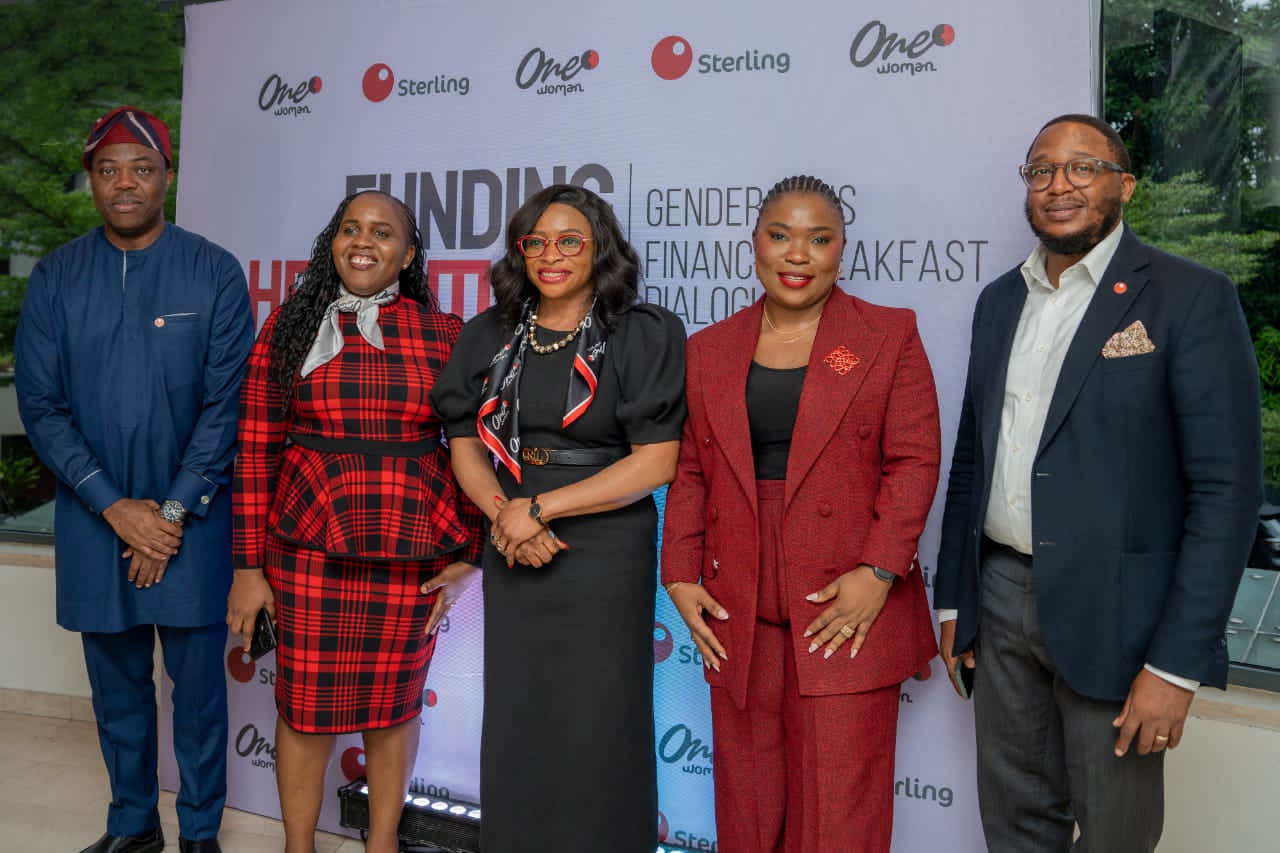
Sterling Bank, through its women focused initiative, OneWoman, convened a powerful gathering of women entrepreneurs, development finance institutions, ecosystem leaders, and business stakeholders at the Funding Her Future Breakfast Dialogue in Lagos.
The session brought together voices from across sectors for a focused and necessary conversation on how to unlock more inclusive and effective financing pathways for women led businesses in Nigeria.
At its core, the dialogue was not just about access to capital. It was about building the right systems around women entrepreneurs. Conversations explored how financing, business readiness, ecosystem support, and institutional partnerships must come together to drive long term growth and resilience.
Speaking at the event, the Managing Director and Chief Executive Officer of Sterling Bank, Abubakar Suleiman, noted that the gathering was designed to move beyond intention and into action.
“Today is about going further. It is about turning shared belief into shared action,” he said.
In his welcome remarks, delivered on his behalf by the Chief Growth Officer, Edward Ogunmekan, Suleiman described the dialogue as a meeting point of finance, enterprise, inclusion, and sustainable economic growth.
From L-R: Akporee Idenedo, Divisional Head, Commercial Banking, Sterling Bank; Ezinne Nwokafor, Head, OneWoman Initiative, Sterling Bank; Thelma Luke Nwoye, Group Head, Business Finance, Sterling Bank; ‘Solape Akinpelu, CEO/Founder , HerVest; Edward Ogunmekan, Chief Growth Officer, Sterling Bank at the OneWoman Gender Lens Breakfast Dialogue held at The Wheatbaker Hotel, Ikoyi recently.
“We are honoured to host such a distinguished gathering of partners, investors, women entrepreneurs, and business leaders, all brought together by one important question. How do we expand access to meaningful finance for women-led businesses in a way that is scalable, sustainable, and commercially sound?”
He explained that the conversation reflects a long- standing conviction at Sterling that real prosperity is built by backing people, ideas, and sectors with strong potential. This belief, he noted, is what gave rise to the OneWoman initiative.
According to him, OneWoman was created to support women through three key pillars which are capital, capacity, and community.
He added that while access to finance is critical, it is only one part of the equation.
“Women-led businesses need the right support systems, the right networks, and the right ecosystem to grow with confidence and scale with resilience,” he said.
The event also featured two panel sessions with representatives from funding institutions, women focused organisations, entrepreneurs, and ecosystem partners. These conversations provided practical insights into financing opportunities available to women, while also examining the broader support systems required for sustainable growth.
Also speaking at the event, Ezinne Nwokafor, Head of the OneWoman Initiative, highlighted the urgency of addressing the financing gap facing women in Nigeria.
She noted that a significant majority of Nigerian women remain excluded from formal credit, with only a small percentage able to access structured financing. Despite improvements in financial inclusion, women continue to face systemic barriers that limit their ability to secure funding.
Nwokafor pointed out that women account for a substantial share of micro, small, and medium enterprises and contribute meaningfully to the economy, yet face a financing gap estimated at 42 billion dollars (USD) annually according to the International Finance Corporation.
She also referenced data showing that more than half of women led businesses identify access to finance as a major constraint, while rejection rates for loan applications remain significantly higher for women than for men.
According to her, these challenges are often linked to structural issues such as gaps in asset ownership, social norms, and limited access to financial data and visibility.
Despite these barriers, she emphasised that the opportunity is significant.
“Sterling’s OneWoman initiative is positioned to bridge this gap by combining financial solutions, mentorship, capacity building, and community support for women across different stages of their journey,” she said.
She added that in 2025 alone, the initiative gave out N43.9 billion loans to 2,450 female entrepreneurs, trained 6,000 of them, served about 380,000 women across three sectors of career women, women in business and freshers and their vision 2030 is to give out N500 billion loans to one million women across their three sectors.
Also speaking, Akporee Idenedo, Divisional Head of Commercial Banking, reaffirmed the bank’s commitment to addressing the concerns raised during the dialogue. He stressed that building skills and strengthening capacity will remain essential to creating a sustainable ecosystem for women entrepreneurs.
The Funding Her Future Breakfast Dialogue forms part of Sterling Bank’s broader effort to deepen its support for women through targeted financing, enterprise development, and community driven growth.
Through OneWoman, the bank continues to build platforms and solutions that empower women to grow sustainable businesses, create jobs, and contribute more meaningfully to economic progress.
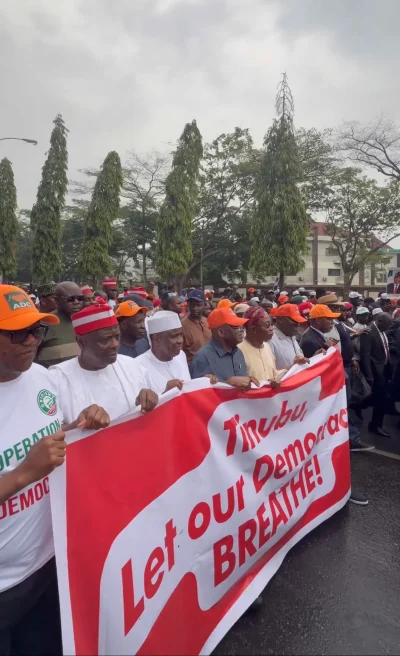
Prominent opposition leaders including Atiku Abubakar, Peter Obi, and Rabiu Kwankwaso have joined a mass protest tagged #OccupyINEC in Abuja.
The demonstration, led by members of the African Democratic Congress (ADC), targeted the Independent National Electoral Commission (INEC) over its recent decisions regarding the party’s internal leadership.
The protest, tagged #OccupyINEC, drew former presidential candidates and prominent politicians, including Rotimi Amaechi, Atiku Abubakar, Peter Obi, Rabiu Kwankwaso, Rauf Aregbesola, Aminu Tambuwal, and Dino Melaye, to Maitama Roundabout. Among others, hundreds of Kwankwasiyya members also participated.
The demonstration saw participants singing Nigeria’s former national anthem, “Arise, O Compatriots!”, despite the fact that it was replaced on May 29, 2024, by President Bola Tinubu with the country’s 1960 independence anthem, “Nigeria, We Hail Thee.”
The ADC further confirmed that the act was done “in an act of defiance.”
Several demonstrators also held placards supporting Senator David Mark, including ones that read, “In David Mark’s NWC we trust.”
Addressing the protest, former presidential candidate Peter Obi spoke on behalf of ADC members and other opposition leaders, urging Nigerians to defend the country’s democracy.
He said on X: “We, members and leaders of the ADC, and other well-meaning Nigerians, lovers of democracy, are saying that our democracy must not be killed.
“We say NO to a one-party system, and for that, today we’re calling out Nigerians who believe in unity, peace, and security of our country to join us as we defend democracy in our land.”
The protest follows INEC’s recent decision to no longer accept correspondence from either faction of the ADC led by Senator David Mark or Nafiu Bala, after a Court of Appeal judgment on the party’s leadership dispute. ADC and other opposition groups described the move as a restriction on party autonomy and an interference with internal party affairs.
National Coordinator of the Obidient Movement, Yunusa Tanko, had earlier told The PUNCH the demonstration aimed to mobilise Nigerians in defence of democracy.
“This commission is now becoming the arbiter, judge, accuser and defender at the same time. Our major issue is the manner in which INEC has been going about creating disaffection in the opposition.
“The people are really angry and plan to show this anger by coming out. So, we’ll expect them to come out en masse for a peaceful rally. Then we’ll just demonstrate and protest,” he said.

The Nigerian Medical Association (NMA), Delta State branch, has officially debunked the cancer claims made by relationship influencer Blessing Okoro, popularly known as Blessing CEO.
In a statement on Tuesday, the association revealed that the document is an altered version of an original medical report belonging to a different patient diagnosed with breast cancer.
The statement, jointly signed by NMA Delta State Chairman, Dr. Israel Adaigho, and Secretary, Dr. Usamah Hannah, was sighted by The Nation on Tuesday.
According to the NMA, the viral report was purportedly issued by Xinus Medical Diagnostics and signed by consultant pathologist Dr. O.A. Odigwe.
However, Dr. Odigwe, who is the proprietor of the diagnostic centre, clarified that his facility never issued any report to Blessing Okoro.
The association explained that Xinus Medical Diagnostics is located in Asaba, Delta State not Enugu State as claimed in the circulating document.
The centre was contacted in May 2025 by a doctor from a private hospital in Asaba to conduct a confirmatory histology test for a patient identified as Mbara Deborah, who had a suspected case of breast cancer.
The test confirmed breast cancer, and the original result was issued to the referring doctor on May 9, 2025.
The NMA stated that the document currently being paraded online by the law firm Allen Juris Law is the original report bearing the name Mbara Deborah.
The version linked to Blessing CEO appears to be a doctored copy of this same report.
The statement read in part: “Our attention has been drawn to an online histology report purportedly issued to one Blessing Okoro, aka Blessing CEO, by Xinus Medical Diagnostics allegedly located in Enugu State. The said histology report was also alleged to have been signed by Dr. O.A. Odigwe, a consultant pathologist.
“The proprietor of Xinus Medical Diagnostics, Dr. O.A. Odigwe, who is also a member of the Nigerian Medical Association, Delta State chapter, has reached us and offered the following clarification: that Xinus Medical Diagnostics is located in Asaba, Delta State and did not at any time issue any report to Blessing Okoro.
“The centre was contacted in May 2025 by a doctor from a private hospital in Asaba to do a confirmatory test on a possible case of breast cancer for a patient, Mbara Deborah. The test was done and the result issued to the referring doctor as a case of breast cancer on May 9, 2025.
“A copy of that result is the one currently being circulated online by the law firm, Allen Juris Law, with the name Mbara Deborah as the patient. That result from the law firm is the original version issued to the patient through her hospital.”
The NMA said the clarification became necessary because of the way the altered report was allegedly being used to solicit public sympathy and financial assistance.
It urged the public to be cautious and warned against actions that could tarnish the integrity of medical professionals.
The association also called on relevant security agencies to take appropriate steps to protect unsuspecting members of the public.
“The integrity of our association and its members is very paramount and should not therefore be taken for granted.
“We call on the authorities responsible for maintaining law and order to do the needful and save unsuspecting members of the public from being unduly taken advantage of,” it added.
Recall that Blessing CEO recently solicited financial help from the public for the treatment of what she claimed was stage four cancer.
Following widespread backlash and allegations that her medical report had been edited, she made a U-turn, stating in an interview: “I don’t have stage 4 cancer. That was a miscommunication.”

Sterling Bank Deepens Commitment to Women Entrepreneurs with OneWoman Financing Dialogue

#OccupyINEC: Nigeria’s Opposition Giants Join Forces In Massive Abuja Rally

Delta NMA Declares Blessing CEO’s Cancer Report Fraudulent

Abuja Court Jails Boko Haram Food Supplier, Hamatu Modu For 40 Years

Just In: Kebbi Assembly Speaker Muhammad Ankwai Passes Away

Gbenga Daniel Slams Successor As ‘Enfant Terrible’ Who Showed Him Hell

Scores Of Terrorists Neutralised As Military Foils Major Borno Offensive

Easter Tragedy: Herdsmen Strike Benue Again, 9 Dead

President Tinubu Authorizes ₦3.3tn For Power Sector Liquidity, Recovery

Tinubu Commiserates With Former INEC Chair Jega Following Death Of Wife
-
 News1 day ago
Delta NMA Declares Blessing CEO’s Cancer Report Fraudulent
-
 News1 day ago
Abuja Court Jails Boko Haram Food Supplier, Hamatu Modu For 40 Years
-
 News1 day ago
Gbenga Daniel Slams Successor As ‘Enfant Terrible’ Who Showed Him Hell
-
 News1 day ago
Just In: Kebbi Assembly Speaker Muhammad Ankwai Passes Away
-
 News3 hours ago
Sterling Bank Deepens Commitment to Women Entrepreneurs with OneWoman Financing Dialogue
-
 News3 hours ago
#OccupyINEC: Nigeria’s Opposition Giants Join Forces In Massive Abuja Rally