News
Hate Speech Bill: You Have No Business In Government If……

Alaafin of Oyo, Oba Lamidi Olayiwola Adeyemi 111, on Thursday took a swipe at members of the National Assembly over the re-introduction of the anti-hate speech bill .
The bill, which seeks to regulate and punish people who make unguarded statements, was recently re-introduced by Senator Aliyu Sabi Abdullahi.
But the monarch, while speaking at a book presentation and platinum recognition as parts of activities marking the 70th anniversary of the Nigerian Tribune titles, insisted that anyone who don’t want to be criticised has no business in government.
He challenged lawyers and other professionals not to allow the bill sail through, saying death penalty should not be the punishment for abuse.
According to him: “If I have not killed anyone; and I give an opinion that is contrary to the government, will it be a sufficient reason for me to be charged for death penalty? Where are the lawyers in Nigeria? Constitutional lawyers in Nigeria, where are they? Can’t they speak up? Chief Olowu, you are here.
“Nobody is speaking up. If you don’t want to be criticised, then you don’t have to be in government. My friend Chief Nnamdi Azikiwe has a peculiar character and I wish he could continue to learn about the Constitutional lesson from Chief Obafemi Awolowo in his reply to Dr. Nnamdi Azikiwe. We have quotation and quotations from this literate man. I have read almost all his books, published.
“They are in my library. I can go on and on citing instances. During the Constitutional conferences that held in the 50s at Lancaster House, three giants from the country postulated different approaches to the Nigerian Independence. Sir Ahmadu Bello said North is for Northerners; East for Easterners and West for the Westerners. Azikiwe said there should be one Constitution, one Country, one destiny.
“Awolowo rose up and said No!. We are not talking about the Constitution that will be suitable for Nigeria. But what is suitable for Nigeria is when you have a multi lingual, multi national and multi religious country with diverse races.
“That before independence the whole school we had on ground were 123 for the whole of the North while the South had 5,000 schools. There is no way that illiterates will continue to govern the literate people. It cannot work and it will not work.
“Awolowo projected what will be the question of North East, North Central. That if you don’t educate the people, the Almajiri will become bandits. Today, in Zamfara and Yobe, the governments are now subjected to banditry. And they are exchanging these bandits, giving them money. How can government give bandits money?
“That is a collapse of governance and government. If you are a student of Constitution, you must believe Awolowo’s views. Well, I am not a politician but I understand politics. I don’t do partisan politics because I want to be progressive.
“In the whole of Nigeria when Awolowo started his free primary education, we felt it would not work. Two to three years after he started it, he appointed Taiwo to head for the review of the proposal and he came out with the position that in the next 30 to 40 years, the Western Region will be 60 years ahead of other areas in education.
“And that demography, if you study people like Professor Akinkugbe, who were their doctors, surgeons, they produced a sector of Obafemi Awolowo University by the Action Group government in 1963-64. If you pass out of primary school , you go to Teacher Training College and if you pass out, you would be given automatic admission to University. That was the reason they established the University of Ife.
“Then we had Agent General United Kingdom catering for the welfare of Western Nigerian students. They go to the school and when they returned, they had jobs already waiting for them. Now our graduates are roaming about the streets.
“There is no index of people who are out of school. Just three days ago, Governor Ganduje said that Kano has the largest number of out of school children. How can we have stability in the country when half of the country are governed by illiterates? When banditry has taken over the governance? Surely there cannot be peace in the country. ”
Afenifere stalwart Pa Ayo Adebanjo expressed dismay with how the Yorubas are being treated in the present administration.
According to him: “Yorubaland is in danger, we have been submerged and our governors cannot face President Buhari to tell him the truth.
“I want to Implore our traditional rulers led by Alaafin of Oyo to be in the forefront of this crusade . Buhari is not governing but to dominate other tribes.
“When the government does not respect the rule of law, there is no governance again. The politicians are not representing us but only projecting themselves”.

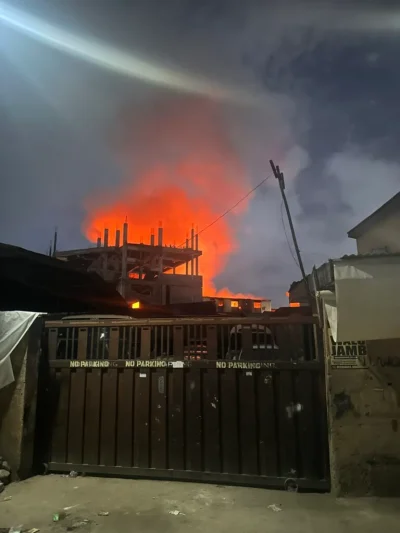
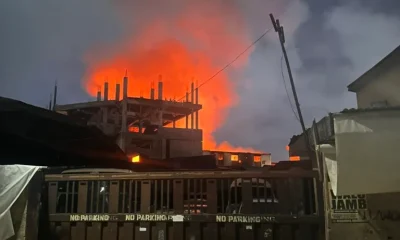
A major fire outbreak occurred at a market in the Yaba area of Lagos State in the early hours of Saturday.
The blaze, which reportedly began between 1:00 AM and 3:00 AM, has destroyed several shops and goods worth millions of naira, leaving numerous traders stranded and counting their losses.
Videos circulating on social media showed thick smoke and flames consuming parts of the market, while traders and residents scrambled to salvage belongings.
An eyewitness, Lugar Feliz, livestreaming on TikTok, noted that firefighters were already at the scene and identified the affected area as the Popo section of Yaba Market. Another user, Olamilekan Iyiola (@Olamilekan0932), described the incident as a “terrible fire outbreak in Yaba right now.”
Some residents expressed frustration over emergency response efforts. Adeoluwa (@Okunlola_Jude) reported that shops behind his property were completely destroyed, with losses estimated in the billions of naira. He added, “Fire service headquarters is just 10 minutes away, yet only one truck was brought to the scene.”
Sullex Print and Branding (@SullexBranding) also highlighted equipment challenges, claiming, “Three fire service trucks responded, but only one had water. The fire is currently at Ajibode Street, Yaba.”
As of Saturday morning, the cause of the fire remained unknown. No official statement has been released by the Lagos State Fire and Rescue Service regarding the extent of damage or potential casualties. Firefighting and containment efforts were ongoing, while residents called for enhanced emergency preparedness to prevent further losses.
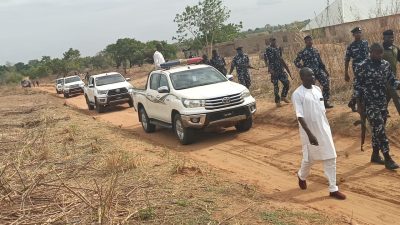
The Nasarawa State Police Command has confirmed that 11 people were killed and over 50 houses were burnt following violent clashes between the Akyawa and Udege Kasa communities in the Nasarawa Local Government Area on Friday.
The two warring communities, Akyawa and Udege Kasa, clashed in the early hours of Friday over some disagreements.
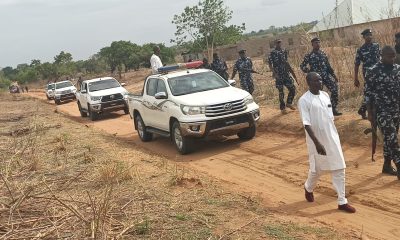
In a statement made available to journalists in Lafia, the Nasarawa State capital, on Saturday, the Police Public Relations Officer of the command, SP Ramhan Nansel, explained that the casualties prompted the Commissioner of Police, Shetima Jauro Mohammed, to visit the communities with a view to restoring normalcy.
According to Nansel, during the CP’s visit to the affected communities of Akyawa and Udege Kasa on April 3, 2026, Mohammed expressed deep sorrow over the tragic incident, which claimed the lives of 11 persons and led to the burning of several houses.
He stated that the CP commiserated with the families of the deceased and the entire community, assuring them of the command’s unwavering commitment to ensuring that justice is served.
The PPRO said, “The incident, which occurred in the early hours of the same day, involved hoodlums suspected to have carried out a reprisal attack over the alleged killing of two of their kinsmen.
“In the course of the attack, 11 persons were killed, while about 50 houses were burnt in Akyawa and two houses in Udege Kasa.
“In response, CP Shetima has ordered an intensive manhunt for all perpetrators of the heinous act, directing tactical teams and investigative units to ensure their prompt identification, arrest, and prosecution.”
Nansel noted that in order to prevent any further breakdown of law and order, the CP had also directed the immediate reinforcement and sustained deployment of police personnel, in synergy with the military and the Nigeria Security and Civil Defence Corps, to provide adequate security and restore lasting peace in the area.
“A stakeholders’ meeting was held during the visit, where the CP urged residents to remain calm, law-abiding, and cooperate with security agencies by providing credible information to support ongoing investigations.
“The Command reassures members of the public that normalcy has been restored to the affected communities, while proactive measures are in place to prevent any recurrence of violence,” the statement added.
Meanwhile, there are rumours that the communities came under violent attacks, as suspected Fulani militias, believed to be bandits, reportedly invaded Akyawa and Udege Kasa late Thursday night.
The latest assault, according to local sources, is believed to be a continuation of an earlier violence in nearby Sabon Gida (Gidan Ada Ogiri), where houses, farm produce and other valuable properties were destroyed.
Residents lamented that barely 48 hours after the attack on Sabon Gida, the fresh assault occurred, heightening fears among residents who say no one can predict which community may be targeted next.
Sources expressed concern that the attackers had been sighted moving around neighbouring communities prior to the incident, yet no decisive preventive measures were taken by security authorities.
“It is becoming unbearable. They abduct at will and now invade our entire communities unchecked. People are living in fear and fleeing their homes for safety,” a resident lamented.
Our correspondent gathered that the affected communities, once known for their mining activities and vibrant local economy, have in recent times been severely impacted by recurring insecurity attributed to suspected bandit groups.
Residents are therefore calling on the Nasarawa State Government to act swiftly to contain the situation and prevent further devastation, especially as farmers have begun planting for the new season amid fears of renewed attacks.
News
Union Bank Looted: How former directors gambled with billions and nearly destroyed a national bank

The former directors and owners of Union Bank did not just fail, they engineered a financial disaster. They manipulated reports, hid massive losses, diverted foreign loans and treated depositors’ money like a private wallet.
Investigators uncovered billions of dollars in misconduct. These directors buried over ₦250 billion in losses, piled a $300 million foreign loan onto the bank without protection and then forced Union Bank to carry the burden. They even used the bank’s own funds to buy its shares, an outrageous betrayal of trust.
It didn’t stop there. Over $100 million was pulled out improperly, leaving the bank exposed and struggling. Loans meant for customers were secretly diverted into shady transactions. False reports were sent to lenders. The system was deliberately deceived.
This was not incompetence. It was exploitation.
By 2025, their actions had created nearly ₦400 billion in losses and over ₦147 billion in unpaid charges. The bank was on the edge.
The Central Bank of Nigeria (CBN) stepped in just in time. Without that intervention, Union Bank could have collapsed, dragging others down with it.
Now, the bank is stabilising. But let’s be clear: this recovery is happening in spite of those former directors, not because of them.
They didn’t build value. They destroyed it.
And Nigerians deserve to never forget who was responsible.

Fire Outbreak Leaves Hundreds Of Traders Stranded At Yaba Market

11 Dead, 50 Homes Razed In Violent Nasarawa Community Clashes

Union Bank Looted: How former directors gambled with billions and nearly destroyed a national bank

Gumi Defends Dialogue As Sole Solution To Nigeria’s Insecurity

Court Clears Senator Ireti Kingibe To Remain Active In ADC

Tinubu: I Was Elected To Establish Peace, Not Comfort Widows, Widowers

COAS Shaibu Hits Jos To Restore Peace, Public Confidence

President Tinubu Appoints New PTDF Executive, Reappoints TCN Head

Simi Welcomes Second Child With Adekunle Gold